Beam Loading Lab
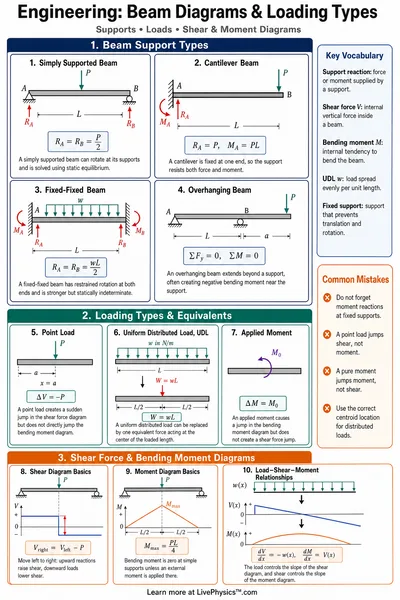
Build a simply-supported beam, place point loads and a distributed load, and watch the shear and bending moment diagrams update in real time. Identify the peak moment and verify the classic formulas PL/4 and wL²/8. NGSS MS-ETS1.
Guided Experiment Center Point Load and PL/4
If you place a single point load P at the exact middle of a simply-supported beam of length L, what do you predict for the support reactions and the maximum bending moment?
Write your hypothesis in the Lab Report panel, then click Next.
Controls
Point loads (set magnitude to 0 to disable)
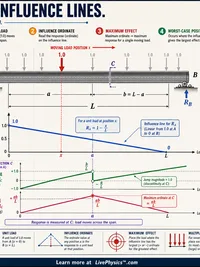
Reactions, Shear, and Moment
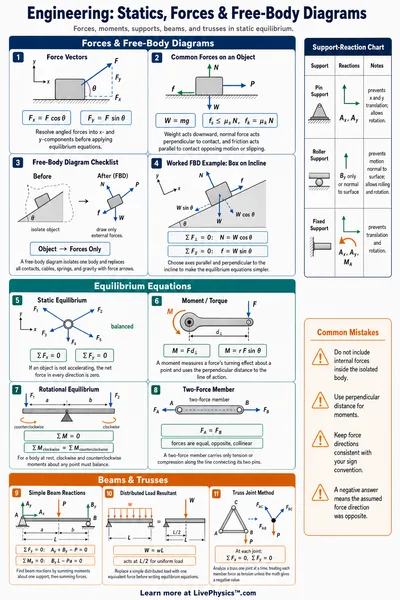
Take moments about the left pin to isolate the right reaction, then use vertical equilibrium for the left reaction.
Data Table
(0 rows)| # | Trial | Span(m) | Total load(kN) | Reaction left(kN) | Reaction right(kN) | Max moment(kN·m) | At x(m) |
|---|
Reference Guide
Support Reactions
A simply-supported beam has a pin on the left and a roller on the right. For vertical loading the pin carries a vertical reaction and the roller carries a vertical reaction, so there are two unknowns.
Sum moments about the pin to isolate the right reaction, then use vertical equilibrium for the left reaction. The solver in this lab follows that exact two-step recipe.
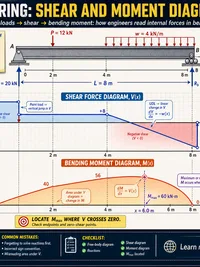
Shear Force Diagram (SFD)
The shear V(x) at a cut is the sum of vertical forces on the left side of the cut, with upward positive.
- Point loads create vertical jumps in V.
- A uniformly distributed load makes V slope linearly with slope minus w.
- V starts at plus R_L at the left support and returns to zero just past the right support.
Positive V is shaded in teal. Negative V is shaded in amber. Where V crosses zero is also where M reaches an extremum.
Bending Moment Diagram (BMD)
The bending moment M(x) is the running integral of V from the left support.
Positive M means the beam sags (concave up) with tension on the bottom fiber. For a simply-supported beam under gravity loads M is positive everywhere in the interior and zero at both supports.
A constant V segment integrates to a linear M ramp. A linear V segment under a UDL integrates to a parabolic M curve.
Textbook Formulas
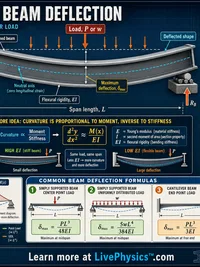
Three closed-form peak moments cover most introductory beam problems.
The lab detects which formula applies for your loading and shows the symbolic equation with values substituted.
Superposition
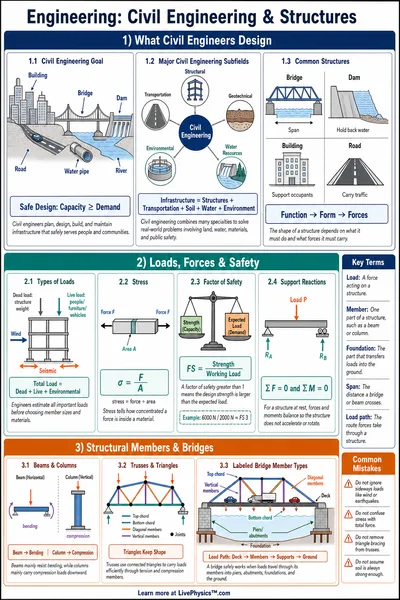
For a linear-elastic beam, the response to a combined load equals the sum of the responses to each individual load. Compute the reactions and moments separately for each load case and add the results.
Engineers use this principle every day. A floor beam under a steel deck must support both the deck weight (a UDL) and any temporary live load (point loads from people and equipment). The total bending stress is the sum of the two component stresses.
NGSS Alignment
This lab supports the middle-school engineering design and physical science standards.
- MS-ETS1-1. Define the criteria and constraints of a design problem with sufficient precision.
- MS-ETS1-2. Evaluate competing design solutions using a systematic process.
- MS-ETS1-3. Analyze data from tests to determine similarities and differences among several design solutions.
- MS-PS2-2. Plan an investigation to provide evidence that the change in motion of an object depends on the sum of the forces.
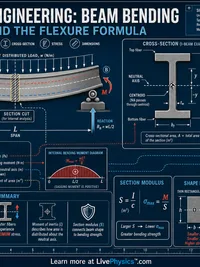
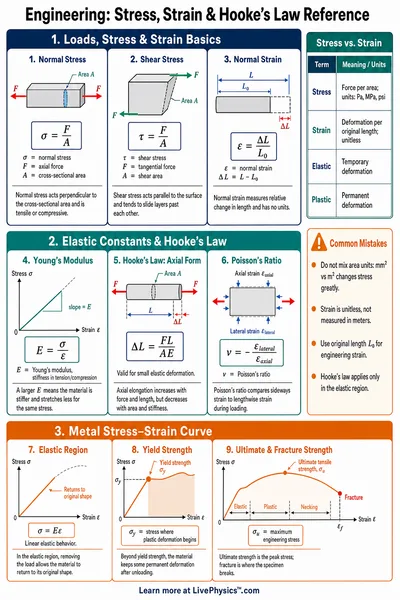
Real-world connection. Civil engineers design floor joists, bridge girders, and crane booms by sizing the section so that the peak moment divided by the section modulus stays below the allowable stress of the material.