Truss Load Lab
Pick a bottom node, set a load, and watch the Pratt truss redistribute the force. Red members are in tension, blue members are in compression, and gray members carry zero force. Method of joints, drawn out one panel at a time. NGSS MS-ETS1, MS-PS2.
Guided Experiment Center Load and Maximum Chord Forces
When a vertical load is applied at the center bottom node of a Pratt truss, which members do you predict will carry the largest forces, and will they be in tension or compression?
Write your hypothesis in the Lab Report panel, then click Next.
Controls
B1 and B5 are the supports. B3 is the center of the span.
Member Forces
The end diagonal angle satisfies tan θ = h / p = 8 / 10, so cos θ ≈ 0.781 and sin θ ≈ 0.625.
Bottom chord
Top chord
Verticals
Diagonals
Data Table
(0 rows)| # | Trial | Load position | Load(kN) | Ry at B1(kN) | Ry at B5(kN) | Max tension(kN) | Max compression(kN) |
|---|
Reference Guide
Method of Joints
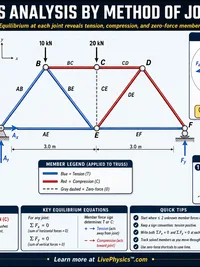
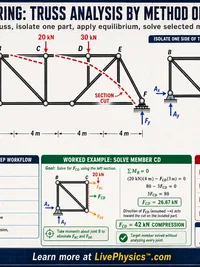
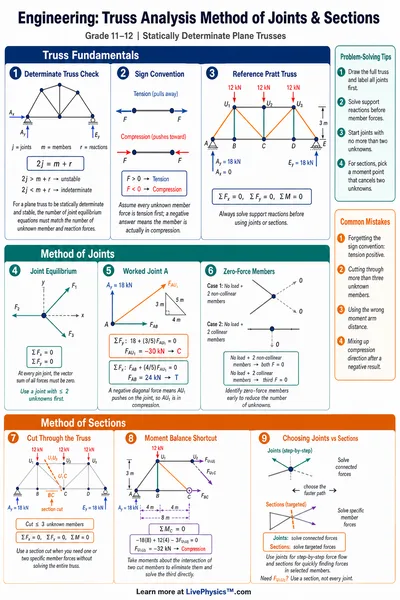
The method of joints isolates each pin and writes two equations of equilibrium for it.
Pick a joint with at most two unknown member forces, solve, then propagate inward. A statically determinate truss has exactly enough equations to find every member force.
For this 4-panel Pratt truss we have 8 joints (16 equations) and 13 members plus 3 support reactions (16 unknowns), so the system has a unique solution.
Tension and Compression
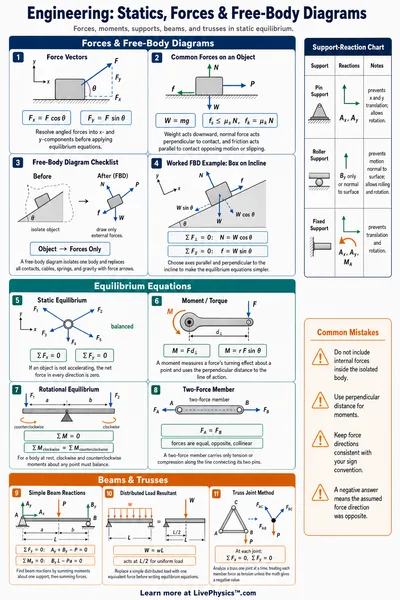
A member in tension is being stretched. A member in compression is being squeezed. The simulator reports a signed axial force.
- Positive force, drawn in red, means tension.
- Negative force, drawn in blue, means compression.
- Force near zero, drawn in gray, is a zero-force member.
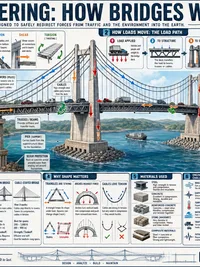
Bridges typically place high-strength steel where the tension is largest and use thicker columns or trusses where the compression is largest, because long slender members fail in buckling under compression long before they yield in tension.
Zero-Force Members
Two short rules identify zero-force members without computing all of them.
- If a joint has exactly two non-collinear members and no external load or support reaction, both members are zero.
- If a joint has three members, two of which are collinear and one is not, and no external load, the non-collinear member is zero.
Zero-force members still serve a purpose. They brace longer members against buckling, keep the truss stable under non-vertical loads, and pick up force when wind or earthquakes shift the load pattern.
Why Triangles
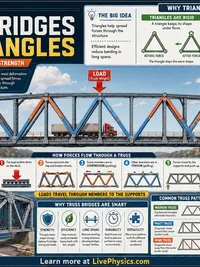
Triangles are the only polygon that cannot change shape without changing the length of a side.
A four-sided panel can collapse into a parallelogram by shear deformation alone. Adding a diagonal across the rectangle splits it into two triangles and locks the shape in place.
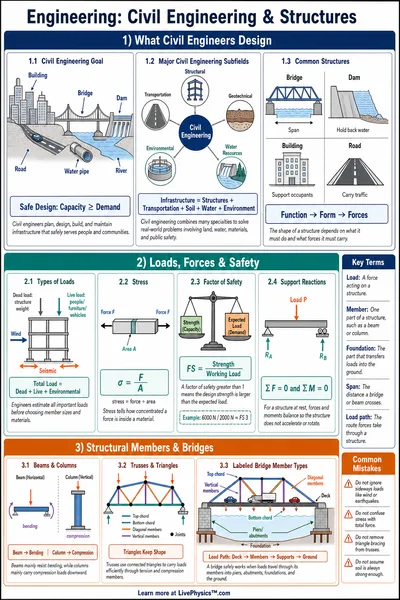
Every panel in this Pratt truss is built from triangles. The diagonals carry the shear that would otherwise rack the rectangular bay sideways. Engineers call this triangulation, and it is the reason every truss bridge you see is a network of triangles.
Pratt Truss in the Real World
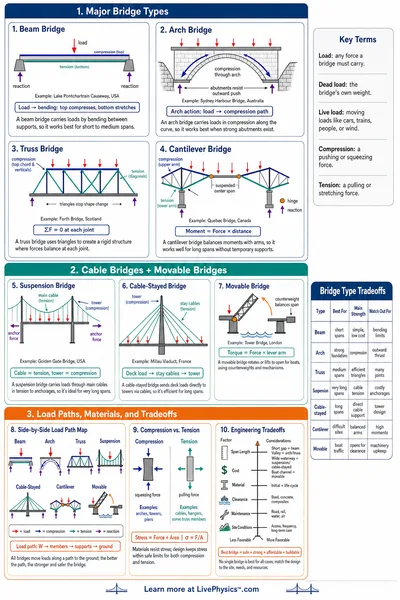
The Pratt truss was patented in 1844 by Caleb and Thomas Pratt. It is one of the most common truss shapes used in steel and timber bridges and roofs.
- Vertical members are short and made stout to resist compression.
- Diagonal members slope toward the centerline so they pick up tension under gravity loads, which lets engineers use thinner steel for them.
- The top chord is in compression and is usually a heavy continuous beam.
- The bottom chord is in tension and is often a continuous tie made of high-strength steel.
The same geometry shows up in railway crossings, roof trusses, lattice booms on cranes, and the trusses inside skyscraper floor plates.
NGSS Alignment
This lab supports the middle-school engineering design and physical science standards.
- MS-ETS1-1. Define the criteria and constraints of a design problem.
- MS-ETS1-3. Analyze data from tests to determine similarities and differences among several design solutions.
- MS-PS2-1. Apply Newton's third law to design a solution that minimizes the force between objects.
- MS-PS2-2. Plan an investigation to provide evidence that the change in motion of an object depends on the sum of forces.
Students collect data across many load positions and magnitudes, then document the patterns in the lab report panel and export a PDF.