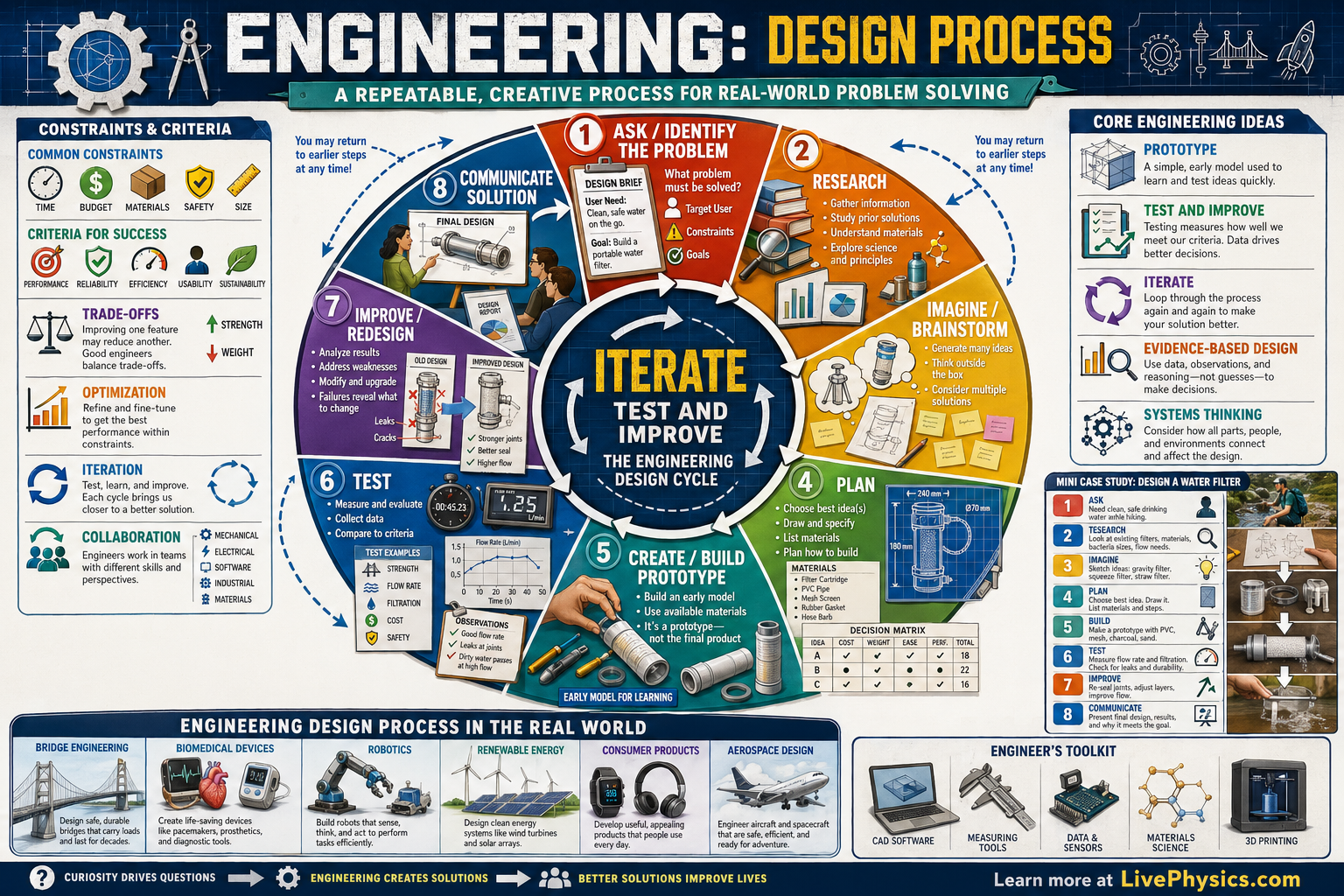
The engineering design process is a structured way to solve real-world problems by creating and improving products, systems, or processes. Engineers use it to move from a need or challenge to a tested solution that meets specific goals. Unlike a one-time plan, the process is iterative, which means teams often repeat steps as they learn more.
This matters because good engineering depends on evidence, trade-offs, and continuous improvement.
A typical design cycle begins by identifying the problem and constraints, then researching, brainstorming, planning, building, testing, and improving. At each stage, engineers collect data and compare results to criteria such as cost, safety, efficiency, and reliability. Feedback from testing often sends the team back to earlier steps, so the process is shown as a loop rather than a straight line.
This cycle helps engineers create solutions that are practical, safe, and effective in the real world.
Understanding Engineering Design Process
A useful design brief turns a vague need into requirements that can be checked. For a bridge model, the brief might state the span it must cross, the load it must hold, the materials allowed, and the maximum budget. It should identify the users and the environment.
A device made for a dry classroom may fail outdoors in rain, dust, heat, or cold. Engineers must notice safety risks early.
They consider what could break, who could be harmed, and how the design can reduce that risk. Clear requirements prevent a team from spending time on an impressive idea that solves the wrong problem.
Research is more than searching for existing answers. It includes learning the science behind the problem and studying the conditions where the solution will operate. A team designing a water bottle holder for a bicycle needs to know about forces from bumps, material strength, vibration, weathering, and the sizes of common bike frames.
Brainstorming works best when ideas are recorded without judging them too quickly. Sketches, labelled diagrams, simple calculations, and models help teams explain their thinking. Several different concepts are valuable because each one may reveal a different strength or weakness.
A prototype is a tool for learning, not necessarily a miniature final product. A cardboard model can check size and shape. A computer model can estimate stress or motion.
A rough working version can show whether moving parts jam or whether a circuit uses too much power. The type of prototype should match the uncertainty being studied.
Building a detailed version too early can waste materials and make people reluctant to change a weak idea. Engineers often test one feature at a time before combining every part into a full system.
Fair testing requires a plan. The team decides what will be measured, which equipment will be used, and how many trials are needed. Only one important variable should change when two designs are compared.
For example, when comparing paper airplane wings, the launch method, paper type, and test location should stay the same while wing shape changes. Repeated trials matter because measurements vary. Results can be recorded in tables or graphs to reveal averages and unusual results.
A test should include realistic conditions, including heavy use or expected mistakes by users. A design that works once is not enough evidence that it is dependable.
Improvement depends on interpreting evidence honestly. A failed test is useful when the team can identify the likely cause. The weakest part may need reinforcement, a material may need replacing, or the original requirement may need clarification.
Every change can create a new trade off. Extra strength may add mass. Lower cost may reduce durability.
Better performance may use more energy. Engineers document choices, test results, and remaining limits so others can review the work.
This communication happens in school design projects, building plans, medical devices, phone apps, transport systems, and renewable energy projects. Learning to explain why a choice was made is as important as making the choice.
Key Facts
- Engineering design is iterative, so testing and redesign can repeat many times before a final solution is chosen.
- A design problem is usually defined by criteria and constraints, where criteria are goals and constraints are limits.
- Efficiency can be expressed as efficiency = useful output / total input.
- A common optimization idea is to maximize performance while minimizing cost, mass, time, or energy use.
- Testing should use measurable data so one design can be compared fairly with another.
- A successful solution must satisfy the problem requirements, not just work once under ideal conditions.
Vocabulary
- Criteria
- Criteria are the standards a design must meet to be considered successful.
- Constraints
- Constraints are the limits on a design, such as cost, size, time, or materials.
- Prototype
- A prototype is an early model built to test how a design works.
- Optimization
- Optimization is the process of improving a design to get the best possible performance under given limits.
- Iteration
- Iteration is the repeated cycle of designing, testing, and improving a solution.
Common Mistakes to Avoid
- Treating the design process as a straight line, because real engineering often requires returning to earlier steps after testing reveals problems.
- Ignoring constraints, because a design that works in theory may still fail if it is too expensive, too large, unsafe, or too slow to build.
- Building before researching, because skipping background information can lead to repeated mistakes and weak design choices.
- Changing multiple variables at once during testing, because then it becomes hard to tell which change actually improved or harmed the design.
Practice Questions
- 1 A team must design a water bottle holder for a bicycle. The holder must cost less than $12, hold a 0.75 kg bottle, and fit in a space 18 cm tall by 9 cm wide. Identify two criteria and two constraints from this problem.
- 2 Prototype A costs 24 and lasts 210 test cycles. Calculate the cost per test cycle for each prototype and decide which is more cost efficient.
- 3 A prototype bridge holds the required load but uses much more material than allowed by the budget. Explain which stage of the engineering design process should come next and why.