Constellations & Seasonal Sky Lab
Discover the constellations hidden in the night sky, learn why different star patterns appear in different seasons, and practice tracing famous constellation shapes. Aligned with NGSS 5-ESS1-2.
Guided ExperimentConstellations and Seasonal Sky Investigation
Why do you think we see different constellations in different seasons? Write your prediction before exploring.
Write your hypothesis in the Lab Report panel, then click Next.
Controls
Explore the night sky, discover which constellations appear each season, and trace star patterns.
Find the Constellations
Click each star cluster to reveal the constellation name, its mythology, and the season it is best seen. Find all 6 to complete this activity.
Data Table
(0 rows)| # | Constellation | Season Visible | Star Pattern | Notes |
|---|
Reference Guide
What Is a Constellation?
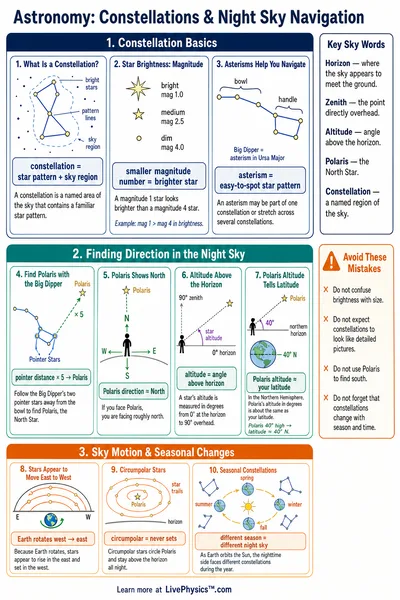
A constellation is a group of stars that forms a recognizable pattern in the night sky. Ancient peoples around the world named these patterns after animals, people, and objects from their stories.
There are 88 official constellations recognized by astronomers today. The stars in a constellation are not actually close to each other in space - they just appear to line up from Earth's point of view.
Why Seasons Change the Sky
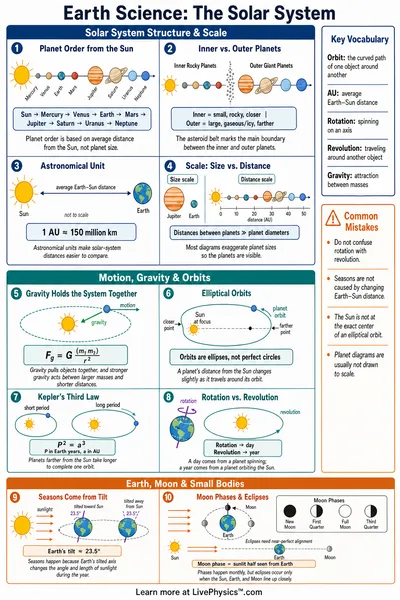
Earth travels around the Sun once each year. Each night, the side of Earth facing away from the Sun looks out at a different region of space.
In winter, Earth's nighttime side faces toward Orion. In summer, Earth has moved to the opposite side of its orbit, and the nighttime side now faces toward Scorpius and Cygnus instead.
- Winter, Orion, Taurus
- Spring, Leo, Virgo
- Summer, Scorpius, Cygnus
- Fall, Cassiopeia, Andromeda
Famous Constellations
Some constellations have been used by people for thousands of years to navigate and mark the seasons.
- Orion - the brightest winter constellation, with a distinctive belt of 3 stars
- Big Dipper - part of Ursa Major, its two outer stars point to the North Star
- Cassiopeia - a W-shape in the northern sky, visible all year from mid-latitudes
- Leo - a spring constellation shaped like a lion, with bright star Regulus
How Astronomers Navigate the Sky
Astronomers divide the sky into regions and use coordinates to locate objects precisely, just like latitude and longitude on Earth.
For beginners, the best way to navigate is to start with a bright, easy-to-find star and "star hop" from one pattern to the next.
- Find the Big Dipper and follow its pointer stars to the North Star (Polaris)
- Orion's belt points toward Sirius, the brightest star in the sky
- Cassiopeia and the Big Dipper are on opposite sides of Polaris