Gravity & Falling Objects Lab
Does a heavier object fall faster? Predict the results, run virtual drop experiments with and without air, and discover what really controls how fast things fall.
Guided ExperimentDoes mass affect how fast objects fall?
Do you think heavier objects fall faster than lighter ones? Write your prediction below.
Write your hypothesis in the Lab Report panel, then click Next.
Controls
Predict which objects fall faster, run drop experiments with and without air resistance, then investigate the forces acting on falling objects.
Which lands first?
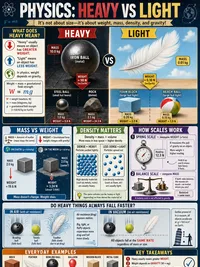
For each pair, predict which object hits the ground first when dropped from the same height. Then reveal the answer!
Data Table
(0 rows)| # | Object | Fall Time with Air (s) | Fall Time in Vacuum (s) | Notes |
|---|
Reference Guide
What Is Gravity?
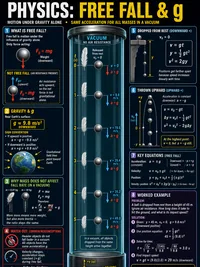
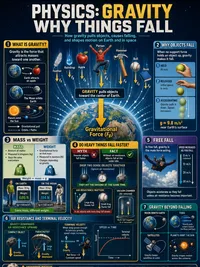
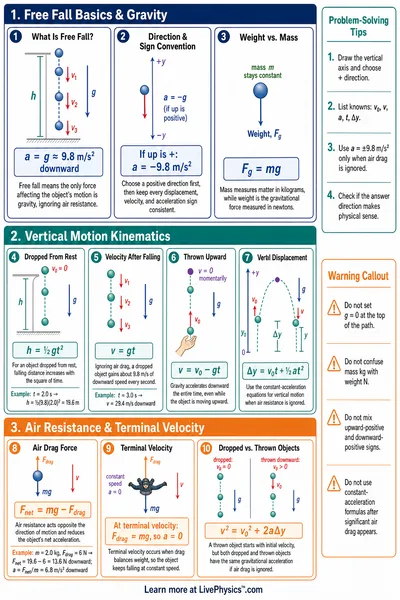
Gravity is a force that pulls objects toward each other. Earth's gravity pulls everything toward the center of the planet at an acceleration of 9.8 m/s squared (written as g = 9.8 m/s²).
Every second an object is in free fall, its speed increases by 9.8 m/s. After 1 second it is moving at 9.8 m/s; after 2 seconds at 19.6 m/s; and so on.
Air Resistance
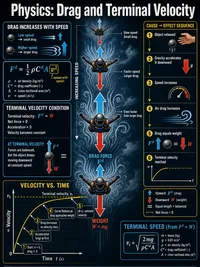
Air resistance (also called drag) is a force that pushes against objects as they move through air. It acts in the opposite direction to motion - upward on a falling object.
The amount of air resistance depends on two things, how fast the object moves and how much surface area faces the airflow. A flat sheet of paper has far more drag than a crumpled ball of the same paper.
- More surface area means more air resistance
- Faster speed means more air resistance
- Streamlined shapes reduce air resistance
Galileo's Experiment
Around 1590, the Italian scientist Galileo Galilei challenged the popular belief that heavier objects fall faster. Legend says he dropped two cannonballs of different masses from the Leaning Tower of Pisa.
Both hit the ground at the same time. This showed that gravity accelerates all objects equally, regardless of mass.
In 1971, astronaut David Scott proved it on the Moon by dropping a hammer and a feather simultaneously - they landed together because there is no air on the Moon.
Terminal Velocity
As a falling object speeds up, air resistance increases. Eventually, the upward air resistance force equals the downward gravity force. When forces are balanced, acceleration stops - the object falls at a constant speed called terminal velocity.
Different objects reach different terminal velocities based on their shape, size, and mass
- Skydiver (spread eagle), about 55 m/s (200 km/h)
- Skydiver (head-down dive), about 90 m/s (320 km/h)
- Feather, less than 1 m/s
- Raindrop, about 9 m/s