Understanding Gravity & Falling Objects for Kids
A falling object is affected by gravity, but its motion can also be affected by the air around it. This activity lets you compare familiar objects and use their different motions to separate those two influences.
In Practice mode, predict the order in which the provided group of three objects will reach the ground. Give a reason based on their shape or how they interact with air, then compare that prediction with the animated fall.
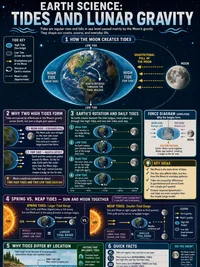
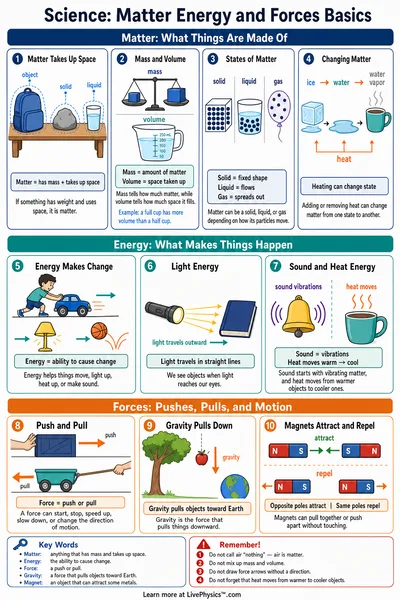
Gravity pulls objects toward Earth. Near the same location on Earth's surface, freely falling objects have approximately the same gravitational acceleration when air resistance can be ignored, even if their masses differ.
A greater mass does experience a greater gravitational force. It also takes proportionally more force to produce the same acceleration, so these effects balance in free fall rather than making heavier objects automatically accelerate faster.
Air resistance acts against motion through the air. During a downward fall, that resistance acts upward, reducing the object's downward acceleration compared with its motion under gravity alone.
Shape changes how strongly air affects an object. A flat sheet of paper presents a broad surface to the air, while the same sheet crumpled into a compact ball usually experiences a different balance between drag and weight.
The paper comparison helps separate shape from mass. Because crumpling does not add material, a difference in falling behavior provides evidence that mass alone cannot explain every result observed in ordinary air.
Parachutes make the role of air especially clear. Compare the small and large parachute choices and describe how the canopy affects the fall, while remembering that a canopy works by interacting with air rather than by removing gravity.
A feather and a compact object provide another useful contrast. Their very different behavior in air should not be taken as evidence that gravity stops acting on the feather or that only heavy objects experience a downward pull.
In a vacuum there is no air to provide drag. Objects released together from the same height with the same initial velocity would fall together under the same gravitational field, including objects that fall quite differently in a classroom.
The animation uses simplified object properties to show these relationships. Treat the displayed races as a conceptual model, rather than precise predictions of drop times for every real feather, coin, ball, or parachute under changing wind conditions.
Finish by explaining on paper how you would revise one prediction using evidence from the activity. Explain separately what gravity does and what air resistance does, then use the paper or parachute comparison to support a claim about how shape can change a fall without changing the existence of gravity.