Understanding Pendulum Lab
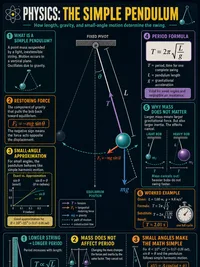
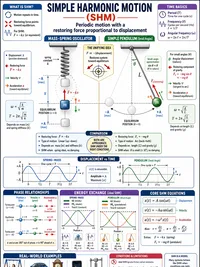
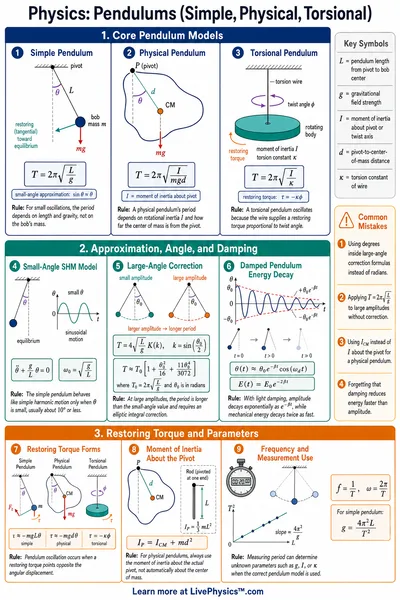
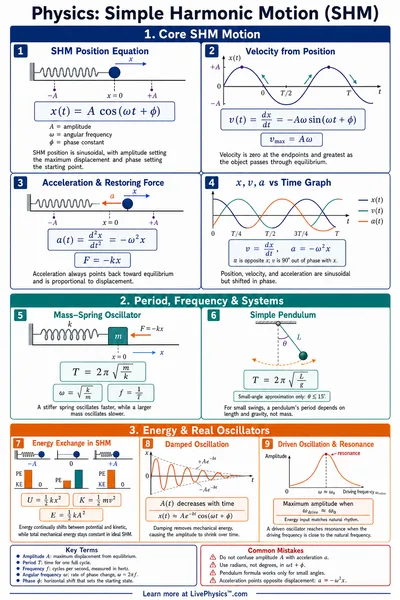
A pendulum moves because gravity pulls the bob back toward its lowest position. The pull along the curved path is called the restoring force. For a small release angle, that force changes almost in proportion to the displacement from the centre.
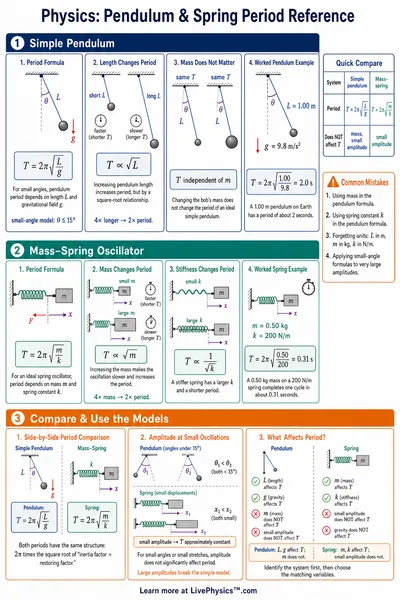
This makes the motion close to simple harmonic motion. The period depends mainly on string length and local gravity. A longer pendulum takes longer because the bob travels through a wider arc and the restoring effect is weaker along that arc.
The ideal relationship says that period squared equals four pi squared times length divided by gravitational acceleration. This is why plotting period squared against length is useful. The points should form a straight trend if the measurements are good and the angle is small.
The slope of that line equals four pi squared divided by gravitational acceleration. Rearranging gives gravitational acceleration as four pi squared divided by the slope. A graph uses all the trials, so it is usually more reliable than calculating gravity from one measurement.
Timing is often the largest source of error in a school pendulum experiment. Starting and stopping a stopwatch for one swing gives a large reaction time error. Time ten or twenty complete swings, then divide the total time by the number of swings.
Begin counting when the bob passes the same central point in the same direction each time. Measure length from the pivot point to the centre of the bob, not to the bottom of the bob. A small length error can noticeably change the result.
The small angle condition matters because the ideal model is an approximation. At larger release angles, the bob spends more time near the ends of its path, where its speed is low. The actual period becomes slightly longer than the small angle prediction.
This effect is not usually obvious at a modest angle, but it grows as the angle increases. Keep the release angle consistent during trials. Comparing results from small and large angles shows where the simple model begins to lose accuracy.
The mass of the bob does not affect the ideal period. A heavy bob feels a larger gravitational force, but it has proportionally more inertia, so the effects cancel. Air resistance and friction at the pivot are different because they remove energy from the motion.
The amplitude then gradually decreases, which is called damping. Light damping has little effect on the period at first, though strong damping can make timing harder. Changing the gravity setting represents different planets, where stronger gravity produces faster swings and weaker gravity produces slower swings.