H-R Diagram & Stellar Classification Lab
Build your own Hertzsprung-Russell diagram by adjusting star temperature, radius, and mass. See how the Stefan-Boltzmann law determines luminosity, classify stars by spectral type (OBAFGKM), and explore the main sequence, giant branch, supergiant region, and white dwarf corner of the diagram.
Guided ExperimentMapping the Main Sequence
How do temperature, luminosity, and mass relate for main-sequence stars? Predict where cool, dim stars and hot, bright stars will appear on the H-R diagram.
Write your hypothesis in the Lab Report panel, then click Next.
Hertzsprung-Russell Diagram
Controls
Star Properties
Data Table
(0 rows)| # | Star Name | Temperature (K) | Radius (R☉) | Luminosity (L☉) | Spectral Class | Region |
|---|
Reference Guide
The H-R Diagram
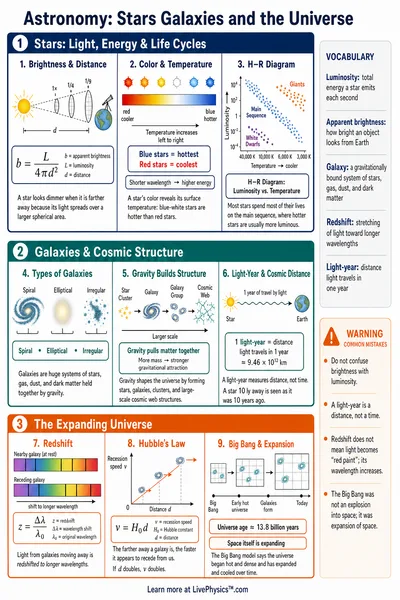
The Hertzsprung-Russell diagram plots stellar luminosity against surface temperature. Hot, bright stars appear in the upper left while cool, dim stars occupy the lower right.
About 90% of all stars fall along the main sequence, a diagonal band where hydrogen fusion powers the star. Stars spend most of their lives here before evolving into giants, supergiants, or white dwarfs.
The diagram is one of the most important tools in astrophysics, revealing how stellar mass governs temperature, luminosity, color, and lifetime.
Spectral Classification
Stars are classified by surface temperature into spectral types O, B, A, F, G, K, M (often remembered as "Oh Be A Fine Girl/Guy, Kiss Me").
- O (>30,000 K) - Blue, very hot, massive, short-lived
- B (10,000-30,000 K) - Blue-white
- A (7,500-10,000 K) - White (e.g. Sirius, Vega)
- F (6,000-7,500 K) - Yellow-white
- G (5,200-6,000 K) - Yellow (e.g. the Sun)
- K (3,700-5,200 K) - Orange
- M (<3,700 K) - Red, coolest, most common
Stefan-Boltzmann Law
A star's luminosity depends on its surface temperature and radius through the Stefan-Boltzmann law.
Here L is luminosity, R is the stellar radius, T is the effective surface temperature, and σ is the Stefan-Boltzmann constant (5.67 × 10⁻⁸ W m⁻² K⁻⁴).
This explains why a cool red giant (large R, moderate T) can outshine a hot main-sequence star, and why a hot white dwarf (tiny R, high T) can be very dim.
Stellar Lifetime
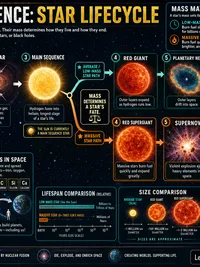
A star's fuel supply (mass) and burn rate (luminosity) determine how long it shines. More massive stars burn through hydrogen far faster than less massive ones.
The Sun will last about 10 billion years. A 10 M☉ star burns out in roughly 30 million years, while a 0.1 M☉ red dwarf can shine for trillions of years, far longer than the current age of the universe.