Sign in to save

Bookmark this page so you can find it later.

Sign in to save

Bookmark this page so you can find it later.

Exoplanet Transit Explorer

Two modes. The Transit Method tab calculates transit depth, orbital period, duration, and impact parameter from star and planet parameters. The Habitable Zone tab shows inner/outer HZ boundaries, equilibrium temperature, and whether a planet falls within the zone. Six presets from Earth-Sun to TRAPPIST-1e.

Mode

Presets

L☉
R☉
R⊕
AU
°
M☉

Transit Diagram

b = 0.11Star (1 R☉)Planet (1 R⊕)Time (phase)Flux1.0

Transit Results

Transit Depth
83.86 ppm
Transit Depth
83.9 ppm
Orbital Period
365.250 days
Impact Parameter
0.1126
Transiting?
Yes
Transit Duration
13.01 hours
R_p from depth
1.000 R⊕
Transit Depth
84 ppm
Orbital Period
365.25 d
Impact Param
0.113
Transiting
Yes

Reference Guide

Transit Method

When a planet passes in front of its host star as seen from Earth, it blocks a tiny fraction of the starlight. The fractional dip in brightness is called the transit depth.

δ=(RpR)2\delta = \left(\frac{R_p}{R_\star}\right)^2

An Earth-sized planet crossing a Sun-like star produces a depth of roughly 84 ppm (0.0084%), while a hot Jupiter can block over 1% of the light. The transit duration depends on the orbital speed, stellar radius, and the planet's impact parameter.

b=acosiRb = \frac{a \cos i}{R_\star}

The impact parameter b describes how far from the stellar center the planet's chord passes. b = 0 is a central transit; b > 1 means no transit.

Kepler's Third Law

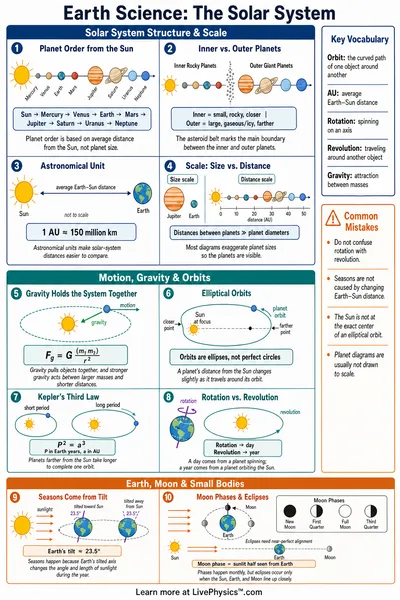
Kepler's third law relates the orbital period to the semi-major axis and the mass of the host star.

P2=a3M(years, AU, M)P^2 = \frac{a^3}{M_\star} \quad (\text{years, AU, } M_\odot)

For the Earth-Sun system with a = 1 AU and M = 1 M☉, P = 1 year (365.25 days). A hot Jupiter at 0.05 AU orbits in just a few days.

Earth365.25 days Hot Jupiter (0.05 AU)~4 days TRAPPIST-1e~6.1 days Kepler-22b~290 days

Habitable Zone

The habitable zone (HZ) is the range of orbital distances where liquid water could exist on a planet's surface. The boundaries depend on the star's luminosity.

dinner=L/1.1,douter=L/0.53d_{\text{inner}} = \sqrt{L_\star / 1.1}, \quad d_{\text{outer}} = \sqrt{L_\star / 0.53}

For the Sun (L = 1 L☉), the HZ spans roughly 0.95 to 1.37 AU. Earth at 1 AU sits comfortably inside. The equilibrium temperature is the blackbody temperature a planet would have without an atmosphere.

Teq=TR2a(1A)1/4T_{eq} = T_\star \sqrt{\frac{R_\star}{2a}}\,(1-A)^{1/4}

A = Bond albedo (fraction of energy reflected). Earth's actual surface temperature (~288 K) exceeds T_eq (~255 K) due to the greenhouse effect.

Notable Exoplanets

Over 5 500 exoplanets have been confirmed as of 2024, most discovered by the transit method (Kepler, TESS) or radial velocity.

TRAPPIST-1 System

Seven Earth-sized planets orbiting an ultra-cool red dwarf 40 light-years away. Three (e, f, g) are in the HZ.

Kepler-22b

Super-Earth (2.4 R⊕) in the HZ of a Sun-like star. Orbital period 290 days.

51 Pegasi b

The first confirmed hot Jupiter (1995). 0.47 Mⱼ, orbits at 0.05 AU with a 4.2-day period.

Proxima Centauri b

Nearest known exoplanet (4.24 ly). Roughly Earth-mass, in the HZ of a red dwarf.

Related Content

Related Tools

Earthquake Magnitude Calculator
Four modes: magnitude scales (Richter Mₗ, moment magnitude M𝑤, energy), energy comparison (each step = 31.6× more energy, logarithmic bar chart), Modified Mercalli Intensity I-XII with descriptions, and Richter magnitude from seismograph amplitude. Presets include Minor M3 through Great M8, 1906 San Francisco M7.9, and 2011 Japan M9.1.
Carbon Footprint Calculator
Estimate annual CO₂ emissions from transportation (car miles, fuel type, flights), home energy (electricity, heating, AC), diet (meat consumption, food waste), and lifestyle (shopping, recycling). Pie chart breakdown, country comparison bar chart, trees-to-offset and equivalent-driving metrics. Five presets: Average American, Eco-Conscious, Heavy Commuter, Frequent Flyer, Work from Home.
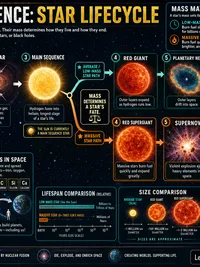
Star Lifecycle Visualizer
Three modes: interactive HR diagram with 23 real stars (click to see properties), stellar evolution pathway from nebula to end state (white dwarf, neutron star, or black hole based on initial mass), and star properties calculator (luminosity L∝M^3.5, radius, lifetime t∝M^-2.5, apparent magnitude). Six presets: Sun, Red Dwarf (0.3 M☉), Sirius A (2 M☉), Blue Giant (20 M☉), Betelgeuse (15 M☉), Supergiant (50 M☉). Includes spectral class colour strip and SVG star visualization.
H-R Diagram Explorer
Three modes: plot a single star on the Hertzsprung-Russell diagram from temperature, radius, and mass (Stefan-Boltzmann luminosity, spectral class O-M, absolute magnitude, HR region); compare multiple stars side by side; and browse the spectral atlas with typical properties for each class. 23 reference stars plotted, 6 presets from Proxima Centauri to Rigel.