Understanding Star Lifecycle Visualizer
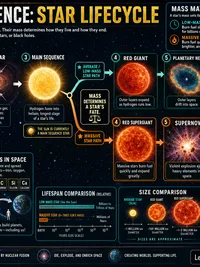
A star begins when gravity pulls cold gas and dust together inside a nebula. As the cloud shrinks, its center becomes denser and hotter, eventually forming a protostar that shines mainly from released gravitational energy.
Fusion starts only when the core reaches an extreme temperature and pressure. Hydrogen nuclei join to make helium, and a tiny amount of mass becomes energy that pushes outward against the inward pull of gravity.
This balance between gravity and outward pressure is why a main sequence star can remain stable for so long. If the core produces too little energy, gravity compresses the star, while extra energy makes the outer layers expand.
Mass is the main factor controlling a star's life because it sets the core pressure. A massive star burns fuel much faster than a small star, even though it begins with far more hydrogen available.
The mass and brightness relationship is especially surprising for students. If mass increases, luminosity rises far more rapidly, so a star with twice the Sun's mass is not merely twice as bright.
A star's lifetime follows the opposite pattern from its brightness. Small red dwarfs use fuel slowly and can last far longer than the current age of the universe, while the largest stars may last only millions of years.
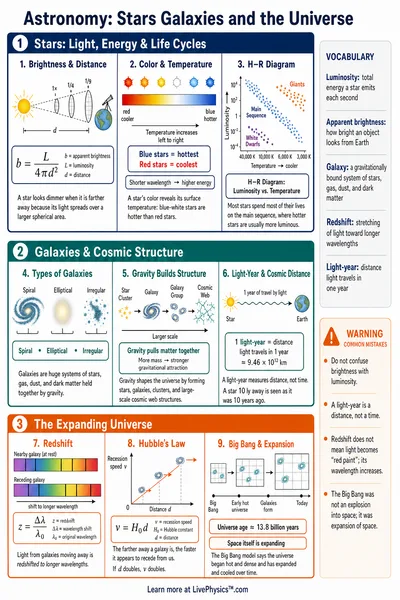
The HR diagram organizes stars by surface temperature and luminosity, not by their distance from Earth. Hot stars appear toward one side, cool stars toward the other, and the main sequence shows where hydrogen fusion is happening steadily.
Star color gives a useful clue about temperature, though it can be misleading in photographs. Blue stars have hotter surfaces than yellow or red stars, and interstellar dust can make distant stars appear redder than they truly are.
When a Sun-like star runs short of hydrogen in its core, the core contracts and heats up. Its outer layers swell into a red giant, even though the surface becomes cooler and redder.
A medium-mass star eventually sheds its outer gas, leaving a hot core called a white dwarf. This remnant no longer makes energy through fusion, but it can remain visible for a very long time as it slowly cools.
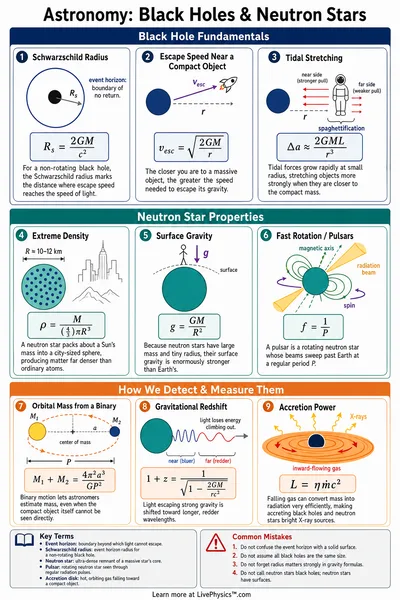
Very massive stars can fuse heavier elements in stages, ending with iron in the core. Iron fusion does not release useful energy, so the core collapses and may trigger a supernova that creates a neutron star or a black hole.
Apparent magnitude describes how bright a star looks from Earth, which depends strongly on distance. Remember that smaller magnitude numbers mean brighter objects, so this scale runs in the opposite direction from what many people first expect.