Sign in to save

Bookmark this page so you can find it later.

Sign in to save

Bookmark this page so you can find it later.

Spectroscopy & Redshift Explorer

Two modes. Emission Spectra displays the visible spectral lines of five elements on an interactive spectrum diagram. Redshift Calculator computes cosmological redshift, recession velocity, and Hubble-law distance from rest and observed wavelengths. Six presets from nearby galaxies to distant quasars.

Mode

Presets

Element

Hydrogen Emission Spectrum

400450500550600650700Wavelength (nm)

Hydrogen (H) Spectral Lines

LineWavelengthColor
410.2 nm
Visible
434.0 nm
Visible
486.1 nm
Visible
656.3 nm
Visible
Element
Hydrogen (H)
Visible Lines
4
Min Wavelength
410.2 nm
Max Wavelength
656.3 nm

Reference Guide

Electromagnetic Spectrum

Light is electromagnetic radiation. The visible portion spans roughly 380 nm (violet) to 750 nm (red). Shorter wavelengths carry more energy per photon according to the Planck-Einstein relation.

E=hν=hcλE = h\nu = \frac{hc}{\lambda}

Where hh is Planck's constant (6.626 × 10⁻³⁴ J·s), ν\nu is frequency, and λ\lambda is wavelength.

Violet380 - 450 nm Blue450 - 490 nm Green490 - 570 nm Yellow570 - 590 nm Orange590 - 620 nm Red620 - 750 nm

Emission & Absorption Lines

When electrons in an atom transition between energy levels, they emit (or absorb) photons at specific wavelengths. These produce bright emission lines or dark absorption lines in a spectrum, acting as a fingerprint for each element.

1λ=RH(1n121n22)\frac{1}{\lambda} = R_H \left(\frac{1}{n_1^2} - \frac{1}{n_2^2}\right)

The Rydberg formula for hydrogen, where RH=1.097×10⁷ m1R_H = 1.097 \times 10^7 \text{ m}^{-1}. The Balmer series (visible) has n1=2n_1 = 2, giving lines at 410.2, 434.0, 486.1, and 656.3 nm.

Doppler Effect & Redshift

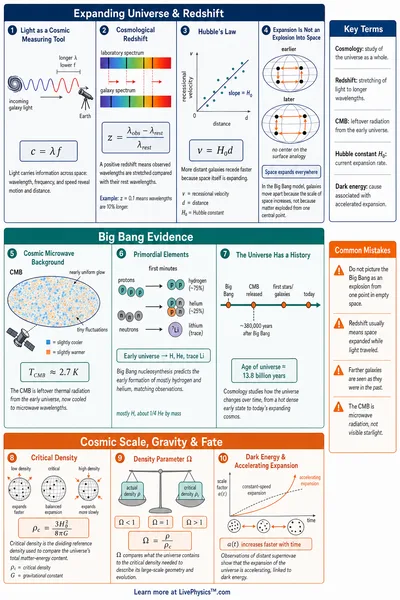
When a light source moves away from the observer, its wavelengths are stretched (redshifted). When it approaches, wavelengths are compressed (blueshifted). The cosmological redshift zz quantifies this shift.

z=λobsλrestλrestz = \frac{\lambda_{\text{obs}} - \lambda_{\text{rest}}}{\lambda_{\text{rest}}}

For recession velocities much less than the speed of light, vzcv \approx zc. At higher redshifts the relativistic Doppler formula is needed. Most distant galaxies and quasars show positive zz, confirming the expansion of the universe.

Hubble's Law & the Expanding Universe

Edwin Hubble discovered that galaxies are receding from us at speeds proportional to their distance. This relationship is the foundation of modern cosmology.

v=H0dv = H_0 \, d

The Hubble constant H067.4 km/s/MpcH_0 \approx 67.4 \text{ km/s/Mpc} (Planck 2018). One megaparsec (Mpc) is about 3.26 million light-years. Combined with redshift measurements, Hubble's law lets us estimate the distance and lookback time to remote objects.
d=vH0=zcH0d = \frac{v}{H_0} = \frac{zc}{H_0}

Related Content

Related Tools

Earthquake Magnitude Calculator
Four modes: magnitude scales (Richter Mₗ, moment magnitude M𝑤, energy), energy comparison (each step = 31.6× more energy, logarithmic bar chart), Modified Mercalli Intensity I-XII with descriptions, and Richter magnitude from seismograph amplitude. Presets include Minor M3 through Great M8, 1906 San Francisco M7.9, and 2011 Japan M9.1.
Carbon Footprint Calculator
Estimate annual CO₂ emissions from transportation (car miles, fuel type, flights), home energy (electricity, heating, AC), diet (meat consumption, food waste), and lifestyle (shopping, recycling). Pie chart breakdown, country comparison bar chart, trees-to-offset and equivalent-driving metrics. Five presets: Average American, Eco-Conscious, Heavy Commuter, Frequent Flyer, Work from Home.
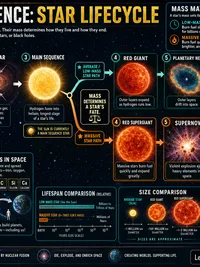
Star Lifecycle Visualizer
Three modes: interactive HR diagram with 23 real stars (click to see properties), stellar evolution pathway from nebula to end state (white dwarf, neutron star, or black hole based on initial mass), and star properties calculator (luminosity L∝M^3.5, radius, lifetime t∝M^-2.5, apparent magnitude). Six presets: Sun, Red Dwarf (0.3 M☉), Sirius A (2 M☉), Blue Giant (20 M☉), Betelgeuse (15 M☉), Supergiant (50 M☉). Includes spectral class colour strip and SVG star visualization.
H-R Diagram Explorer
Three modes: plot a single star on the Hertzsprung-Russell diagram from temperature, radius, and mass (Stefan-Boltzmann luminosity, spectral class O-M, absolute magnitude, HR region); compare multiple stars side by side; and browse the spectral atlas with typical properties for each class. 23 reference stars plotted, 6 presets from Proxima Centauri to Rigel.