Hundreds Chart & Skip Counting Lab
Choose a skip count, watch the pattern light up on the hundreds chart, record what you find, and discover which numbers are multiples of 2, 5, 10, and more.
Guided ExperimentSkip Counting Patterns Investigation
Before you start, predict, when you count by 5, what will the last number in the hundreds chart be? What pattern will the numbers have?
Write your hypothesis in the Lab Report panel, then click Next.
Controls
Choose a skip count and start value, explore the pattern on the hundreds chart, then record what you find.
Counting Controls
First 5 numbers in sequence
2, 4, 6, 8, 10, ...
Last value on chart 100 | Total highlighted 50 | Pattern All even numbers
Hundreds ChartCounting by 2 starting at 0
Highlighted cells show the skip counting pattern. Numbers 1-100.
Data Table
(0 rows)| # | Count By | Start At | First 5 Numbers | Ends At | Pattern Description |
|---|
Reference Guide
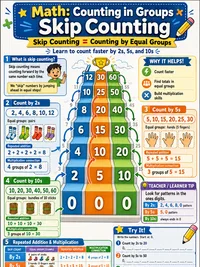
Skip Counting
Skip counting means adding the same number over and over to make a sequence. When you count by 2, you add 2 each time, 2, 4, 6, 8, 10...
- Count by 2. Every other number. These are even numbers.
- Count by 5. Numbers that end in 0 or 5.
- Count by 10. Numbers that end in 0.
- Count by 3. Adds 3 each time. Does not end on 100.
Patterns on the Hundreds Chart
The hundreds chart organizes numbers 1 to 100 in ten rows of ten. Skip counting patterns create visual shapes on the chart.
Counting by 10 highlights only the last column (10, 20, 30...). Counting by 2 highlights every other cell in every row. Counting by 5 highlights every fifth cell, making two columns.
Even and Odd Numbers
Even numbers can be split into two equal groups with nothing left over. They are exactly divisible by 2: 2, 4, 6, 8, 10...
Odd numbers always have one left over when split into two groups. They are not divisible by 2: 1, 3, 5, 7, 9...
- Even numbers always end in 0, 2, 4, 6, or 8.
- Odd numbers always end in 1, 3, 5, 7, or 9.
- Counting by 2 from 0 gives only even numbers.
- Counting by 2 from 1 gives only odd numbers.
Multiples
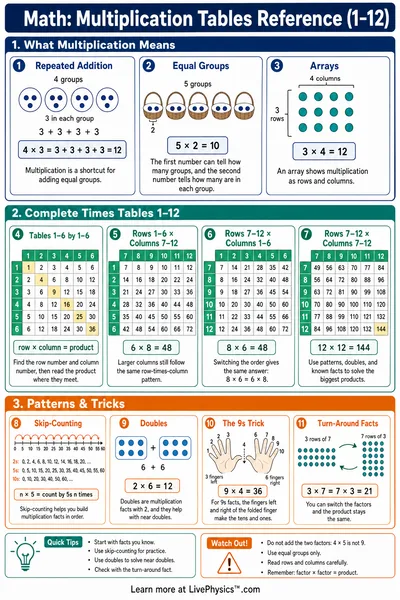
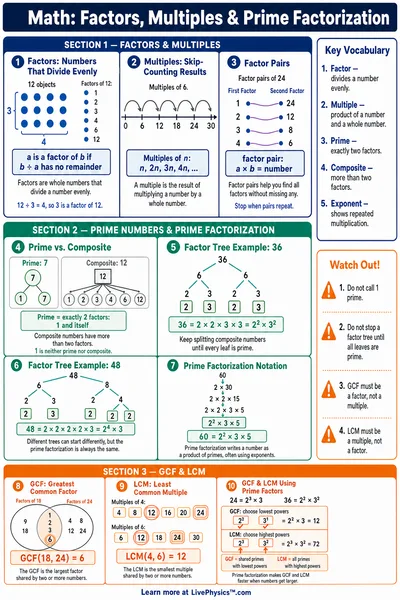
A multiple of a number is what you get when you multiply that number by a whole number. The multiples of 3 are 3, 6, 9, 12, 15... and so on.
Skip counting by 3 gives you the multiples of 3. Every highlighted cell on the hundreds chart is a multiple of your chosen skip count.
- Multiples of 2 and 10. 10, 20, 30, 40, 50, 60, 70, 80, 90, 100.
- Multiples of 2 and 5. 10, 20, 30, 40, 50, 60, 70, 80, 90, 100.
- Only some numbers divide 100 evenly (1, 2, 4, 5, 10, 20, 25, 50, 100).