Understanding Photosynthesis Bubble Lab
A bubble count is useful, but it is not a perfect measure of oxygen production. Bubble size can change, so ten large bubbles may contain more oxygen than ten small ones. Some oxygen dissolves in the water instead of escaping as bubbles.
For more careful results, students can collect the gas in a measuring tube or use a sensor that records oxygen concentration. Repeating each setting several times gives an average and makes random differences less important.
Light provides energy for the reactions inside chloroplasts. When a lamp is moved farther away, the light spreads over a larger area, so less reaches the pondweed. This is why the change is often large at short distances.
Heat from a nearby lamp can warm the water at the same time. A fair test needs the temperature kept steady, or a cool LED lamp, because otherwise two variables are changing together.
Temperature affects enzymes, which are proteins that control chemical reactions in plant cells. As water warms, particles move faster and enzyme reactions usually speed up until an effective temperature is reached. Above that range, enzyme shape can be damaged, causing the rate to fall.
Pondweed is living tissue, so its best temperature depends on the species. A result from a school lab may not match the conditions of plants growing in a cold stream or a tropical pond.
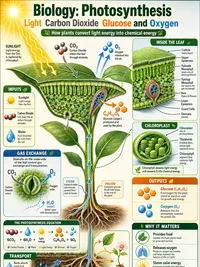
Carbon dioxide must enter the leaf before it can be used to build sugars. In water, it moves slowly and its amount may be low, especially if algae or other plants are present. Sodium hydrogencarbonate is often added in practical work because it supplies dissolved carbon dioxide.
At high enough levels, adding more carbon dioxide stops increasing the rate. Another factor has become limiting, such as light intensity, temperature, or the capacity of the chloroplast enzymes.
The idea of a limiting factor explains the shape of many results. If light is scarce, increasing carbon dioxide has little effect because there is not enough energy to process it. If carbon dioxide is scarce, brighter light eventually gives little improvement because the raw material runs short.
Graphs often rise at first and then level off. The flat section does not mean photosynthesis has stopped. It means one condition is preventing a further increase.
A reliable investigation changes one factor and controls the rest. Use equal lengths of the same type of pondweed, the same volume of water, and the same time for every count.
Cut the stem underwater before starting, since trapped air or a blocked cut surface can affect bubble release. Allow a short settling period after each change, because the plant needs time to respond.
Students meet these ideas outside the laboratory in gardening, farming, and climate science. Greenhouses use light, warmth, and carbon dioxide carefully because plants only grow faster when the limiting condition is improved.
Lakes can lose oxygen when water becomes too warm or when plant growth changes. Understanding the measurements matters because bubble counts show a visible clue, not the whole story of the plant's chemistry.