Pushes & Motion Lab
Discover how pushes and pulls change the way objects move. Pick an object, choose your force, and find out what happens when you apply it in different directions and strengths.
Guided ExperimentPushes and Pulls Investigation
Before you start, predict whether a heavy object or a light object needs a stronger push to move. Write your prediction.
Write your hypothesis in the Lab Report panel, then click Next.
Controls
Choose an Object
Force Type
Force Strength
Direction
Reference Guide
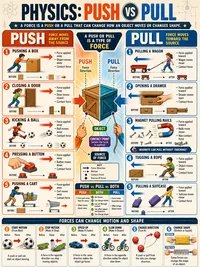
Pushes and Pulls
A push is a force that moves an object away from you. A pull is a force that brings an object toward you.
- Both pushes and pulls can make objects start moving.
- Both can also stop a moving object or change its direction.
- Pushes and pulls are all around us every day.
Force and Motion
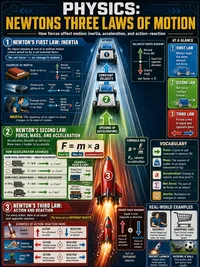
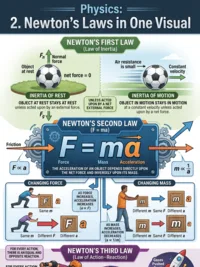
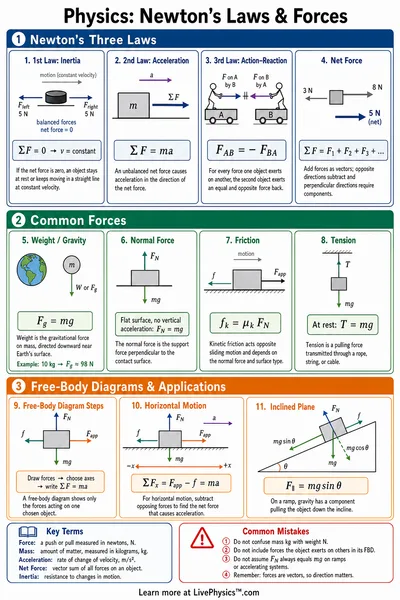
When you apply a force to an object, its motion changes. No force means no change in motion.
- A force can make a still object start moving.
- A force can make a moving object stop.
- A force can make an object speed up, slow down, or change direction.
Strength of Force
A stronger force causes a bigger change in motion than a weaker force.
- A light tap moves an object a little.
- A strong shove moves an object a lot.
- Heavier objects need more force to move the same distance as lighter ones.
Direction of Force
Objects move in the same direction as the force applied to them.
- Push left and the object moves left.
- Pull up and the object moves up.
- Changing direction changes where the object goes, not how far.