Senses, Brain & Response Lab
Click each sense card to discover what it detects, then sequence a full stimulus-to-response pathway, and finally measure your own reaction time in real time.
Guided Experiment Senses, Brain and Response Investigation
How do your senses, brain, and body work together to respond to the world? Pick one sense and predict what happens from stimulus to response.
Write your hypothesis in the Lab Report panel, then click Next.
Controls
Explore each tab to learn how your senses and brain work together to respond to the world.
Click each sense card to learn what that sense detects and how your body responds.
Data Table
(0 rows)| # | Scenario / Sense | Sense Organ | Brain Action | Body Response | Reaction Time (ms) | Notes |
|---|
Reference Guide
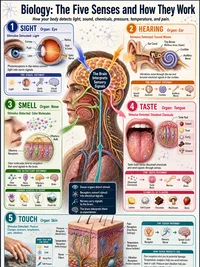
The Five Senses
Your body has five main sense receptors that detect information from the world around you.
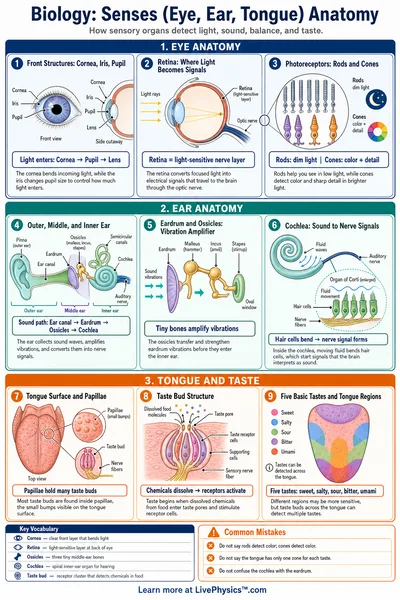
- Sight (Eyes) - detect light and color
- Hearing (Ears) - detect sound waves
- Smell (Nose) - detect chemicals in the air
- Taste (Tongue) - detect chemicals in food
- Touch (Skin) - detect pressure, heat, and pain
How the Brain Processes Information
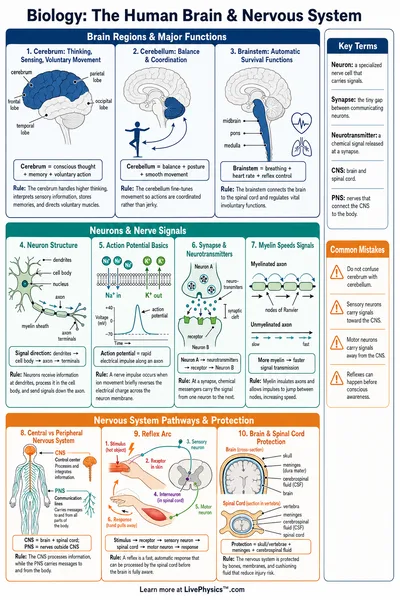
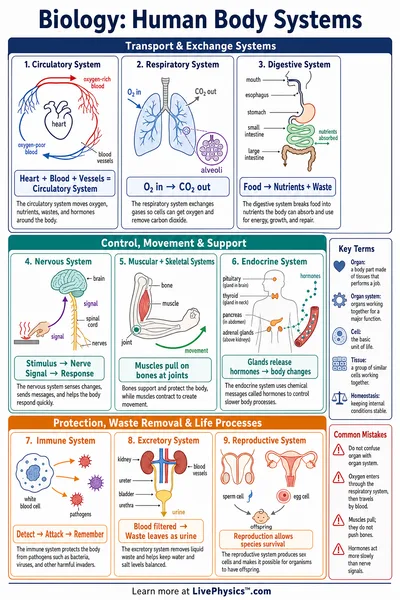
The brain is the control center of your body. When a sense receptor detects a stimulus, it sends an electrical signal through nerves to the brain.
The brain interprets the signal, decides what it means, and sends instructions back through nerves to muscles and organs to produce a response.
Stimulus and Response
Every response follows the same three-step pathway
- Stimulus - something in the environment changes
- Sense organ detects it - sends signal to brain
- Response - brain tells the body what to do
Example, You see a ball flying toward you (stimulus) - your eyes detect it (sense organ) - your hands reach up to catch it (response).
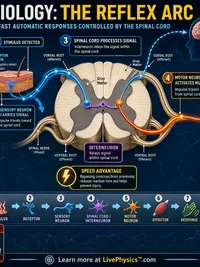
Reflex vs Learned Response
Some responses are reflexes - automatic and very fast. Your spinal cord can send a reflex response before the signal even fully reaches your brain.
Other responses are learned - your brain has to think about what to do based on past experience. Learned responses take a little longer.
- Reflex jerking hand from hot surface
- Learned solving a math problem, stopping at a sign