Understanding Plant Structure and Function Explorer
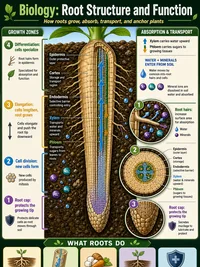
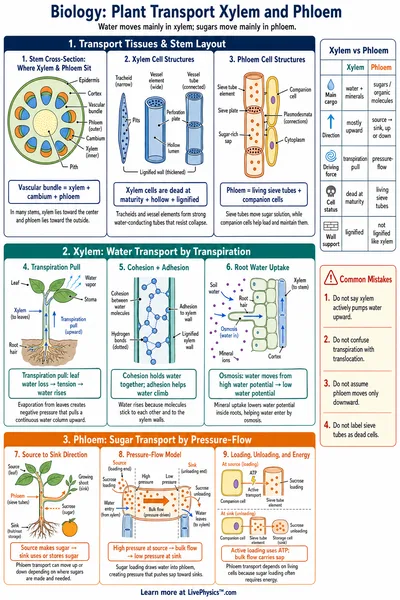
Plants solve a transport problem that animals solve with hearts. A tall tree must move water from soil to leaves many metres above ground without a pump. Water enters root hairs by osmosis, moving from wetter soil into root cells.
Mineral ions are taken in through membrane proteins, often using energy from the plant. These ions help the plant build proteins, chlorophyll, and new tissues.
Root systems spread widely because water is not evenly available. Fine roots give a large surface area, while older woody roots anchor the plant and store food.
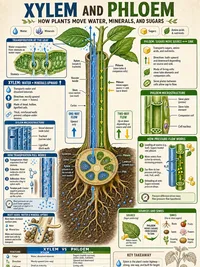
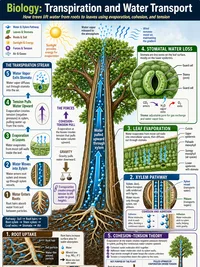
The upward flow in xylem depends mainly on evaporation from leaves. When water evaporates through tiny leaf pores called stomata, it pulls on the continuous column of water below it. Water molecules stick to each other, so the pull can travel down through the stem to the roots.
This process is called transpiration. It works best when the air is dry and leaves have enough water, but it creates a risk. On hot, dry days, a plant may close its stomata to reduce water loss, though this also limits the carbon dioxide needed for photosynthesis.
Phloem moves dissolved sugars from places that make or release sugar to places that need it. A mature leaf is often a source because it produces sugar, while roots, growing shoots, fruits, and seeds can be sinks. This direction can change during the year.
In spring, stored sugar in roots may travel upward to support new leaves before those leaves can make much food. Phloem transport requires living cells and energy to load sugar into the tubes. Water then enters by osmosis and creates pressure that pushes the sugary sap along.
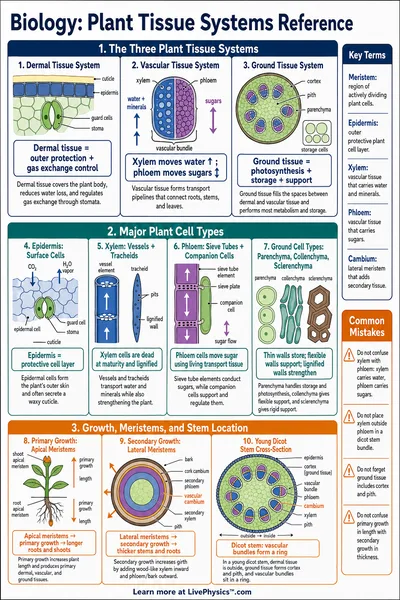
Plant organs are built from specialised cells, and their arrangement explains what each organ can do. Leaves contain packed photosynthetic cells near the light, air spaces for gas movement, veins for transport, and a waxy outer layer that slows evaporation. Stems place strong supporting tissues around transport tissues, helping them resist bending in wind.
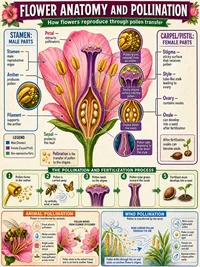
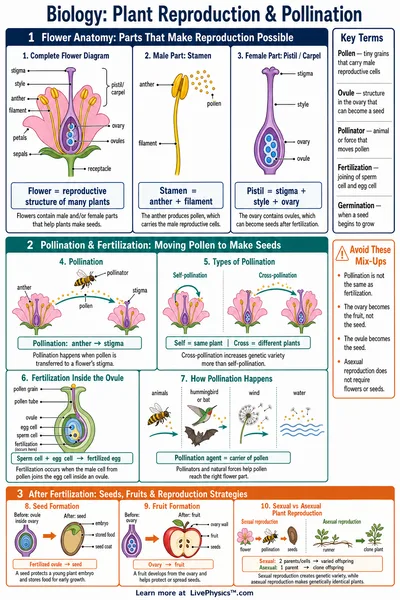
Flowers use colour, scent, nectar, shape, and timing to move pollen between plants. Fruits protect seeds and often encourage animals, wind, or water to carry them away. When studying a cross-section, notice where the transport tissues sit, how their pattern differs in roots and stems, and how structure matches the job of each part.