Senses, Brain & Response Explorer
Your body collects information every second. Explore how your five senses send signals to your brain, how your brain decides what to do, and how some animals can sense things humans cannot.
Senses, Brain & Response Explorer
Pick a situation and follow the signal from your sense organ all the way to your response.
Pick a situation to explore
⚾Stimulus
→
👁Sense Organ
→
⚡Nerve Signal
→
🧠Brain
→
🙌Response
⚾
Step 1: Stimulus
A stimulus happens: "You see a ball flying toward you". Something in the environment changes and your body needs to notice it.
Senses Reference
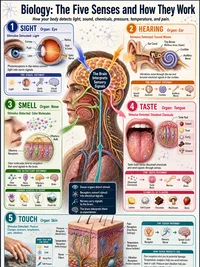
The Five Senses
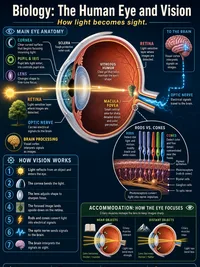
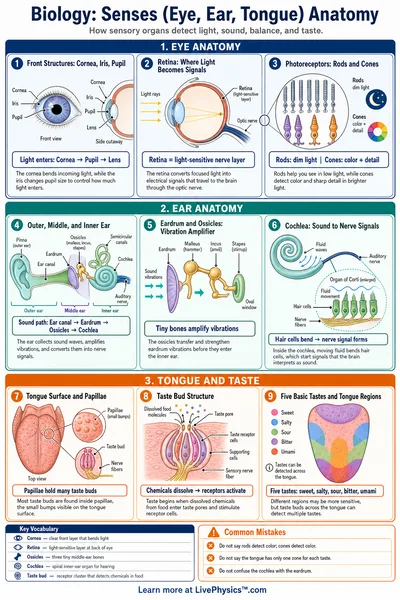
- Sight eyes detect light and color
- Hearing ears detect sound waves
- Smell nose detects airborne chemicals
- Taste tongue detects dissolved chemicals
- Touch skin detects pressure, heat, and pain
Stimulus to Response
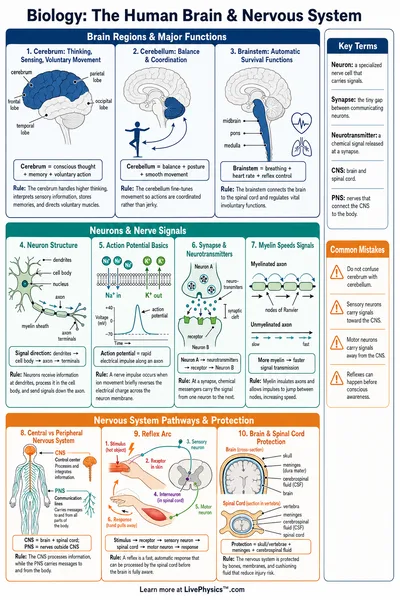
Every response follows the same basic path
- A stimulus occurs (sound, sight, touch)
- A sense organ detects it
- A nerve signal travels to the brain
- The brain processes the information
- The body makes a response
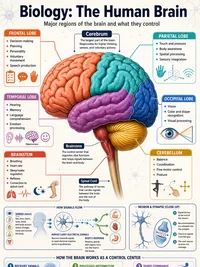
Nerves and the Brain
- Optic nerve carries signals from eyes to visual cortex
- Auditory nerve carries signals from ears to auditory cortex
- Olfactory nerve carries smell signals to olfactory bulb
- Gustatory nerve carries taste signals to taste cortex
- Sensory nerves carry touch signals to somatosensory cortex
Animal Super-Senses
- Dogs smell 100,000x better than humans
- Eagles vision 4-8x sharper, see ultraviolet light
- Bats echolocation maps objects in total darkness
- Sharks detect electric fields from other animals
- Mantis shrimp 16 color receptors vs human's 3
Related Content
Related Tools
Genetics & Punnett Square Calculator
Generate Punnett squares for monohybrid, dihybrid, incomplete dominance, and sex-linked crosses. Color-coded SVG grid with genotype and phenotype ratios and step-by-step analysis.
Pedigree Chart & Inheritance Pattern Analyzer
Read a pedigree chart and work out which inheritance patterns fit, with autosomal and X-linked and Y-linked rules applied and each pattern marked consistent or ruled out.
Population Growth Simulator
Simulate exponential, logistic, and Lotka-Volterra predator-prey population models. Interactive JSXGraph plots with carrying capacity, inflection points, phase portraits, and ecological presets.
DNA/RNA Codon Translator
Transcribe DNA to mRNA and translate codons into amino acid chains. Beautiful sequence diagram with color-coded nucleotides, codon brackets, amino acid pills, full 64-codon table, and reverse translation.
Related Labs
Senses, Brain & Response Lab
Explore the five senses, trace stimulus-to-response pathways through the brain, and measure your own reaction time. NGSS 4-LS1-2. Grades 3–5.
Nervous System Signal Speed Lab
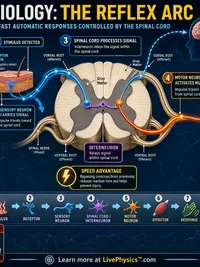
Trigger an action potential and watch an animated signal propagate along a nerve to the brain. Myelination slider controls conduction velocity (0.5 to 120 m/s). Compare voluntary pathway vs reflex arc. Displays velocity, reaction time, refractory period, and max firing rate. Data table tracks fiber type vs response time.
Plant & Animal Structures Lab
Explore plant and animal structures, match each structure to its function, and solve habitat design challenges. NGSS 4-LS1-1. Grades 3–5.