3D Nets & Shape Folding Lab
Unfold six 3D shapes, study their nets, and discover Euler's formula, V - E + F = 2.
Guided Experiment3D Nets & Shape Folding Lab
Before exploring, predict, do you think all 3D shapes follow the same rule connecting their faces, edges, and vertices? Write your prediction.
Write your hypothesis in the Lab Report panel, then click Next.
Shape 1 of 6: Cube
Net Diagram
Face Shapes
6 squares
Net Description
A cross of 6 equal squares: 4 in a column, 1 attached to each side of the 2nd square from the top.
Controls
Data Table
(0 rows)| # | Shape | Faces (F) | Edges (E) | Vertices (V) | V - E + F | Face Shapes |
|---|
Reference Guide
What Is a Net?
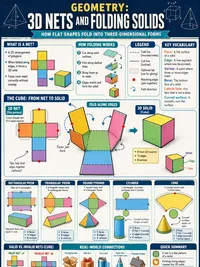
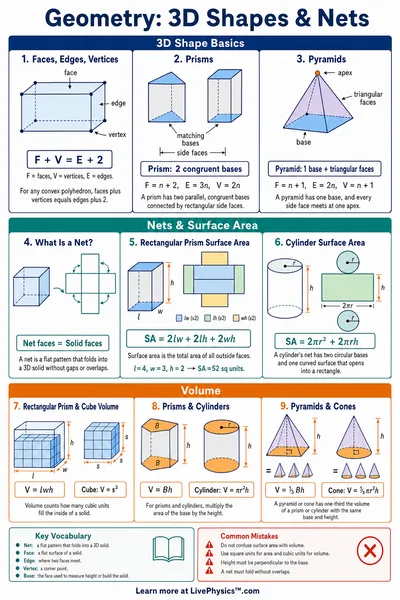
A net is a flat 2D pattern that folds into a 3D shape. Every face of the 3D shape appears exactly once in its net.
For example, the net of a cube is a cross of 6 equal squares. When you fold them along each edge, the squares form the 6 faces of the cube.
Not every shape has a unique net. A cube has 11 different valid nets that all fold into the same shape.
Euler's Formula
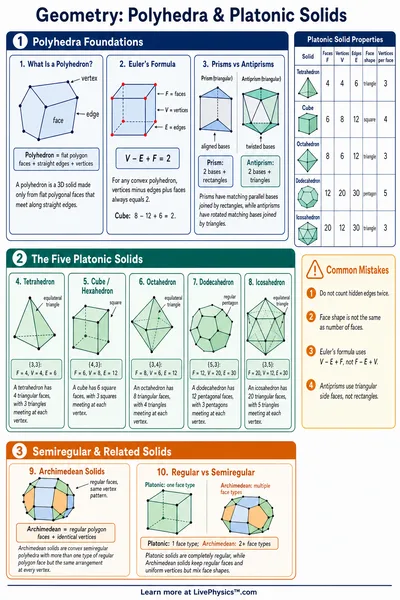
For any polyhedron V - E + F = 2. Vertices minus Edges plus Faces always equals 2.
First proved by Leonhard Euler in 1758.
Knowing any two values lets you find the third. If a shape has 8 vertices and 12 edges, it must have 6 faces, 8 - 12 + F = 2, so F = 6.
The formula only works for polyhedra (shapes with flat, polygonal faces). Curved surfaces break the rule.
Polyhedra in This Lab
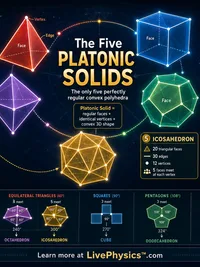
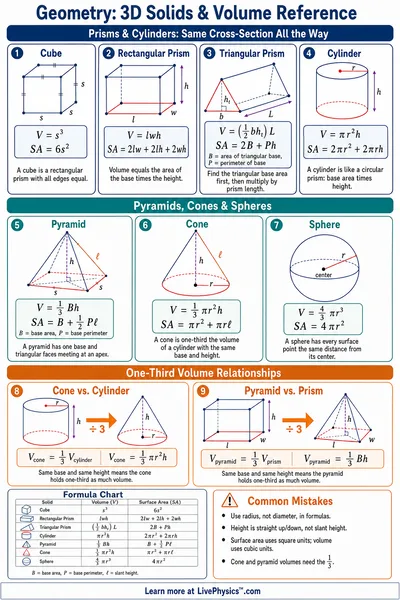
Cube 6 square faces, all equal. F=6, E=12, V=8.
Rectangular Prism 6 rectangular faces. F=6, E=12, V=8.
Triangular Prism 5 faces, 2 triangles and 3 rectangles. F=5, E=9, V=6.
Square Pyramid 5 faces, 1 square base and 4 triangles. F=5, E=8, V=5.
Cone Treated as 2 surfaces (base circle and sector). V=1, E=1, F=2, and V-E+F=2.
Analysis Questions
What value does V - E + F equal for all the true polyhedra in this lab?
Why does the cylinder not follow Euler's formula for polyhedra?
The cube and rectangular prism have the same F, E, and V. Why are they still different shapes?
A shape has 8 vertices and 12 edges. Using Euler's formula, how many faces must it have?