Budget Planner for Students
Enter your monthly income from allowance or a part-time job, then slide the category bars to divide it across savings, food, entertainment, and more. The sliders always keep your total at 100%, and a live pie chart shows where your money goes each month.
💰Monthly Income
📊Allocate Your Budget
100% ✓🥧Budget Breakdown
📋Monthly Amounts
| Category | % | $/month |
|---|---|---|
🏦 Savings | 20% | $40.00 |
🍕 Food & Snacks | 20% | $40.00 |
🎮 Entertainment | 20% | $40.00 |
👕 Clothing | 15% | $30.00 |
📚 School & Learning | 15% | $30.00 |
✨ Other / Flexible | 10% | $20.00 |
| Total | 100% | $200.00 |
🎯Savings Projections
At $40.00/month in savings, here is what you could reach
Financial Literacy Guide
Why Budget?
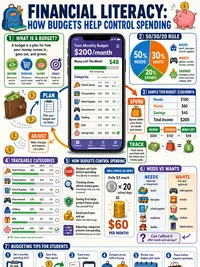
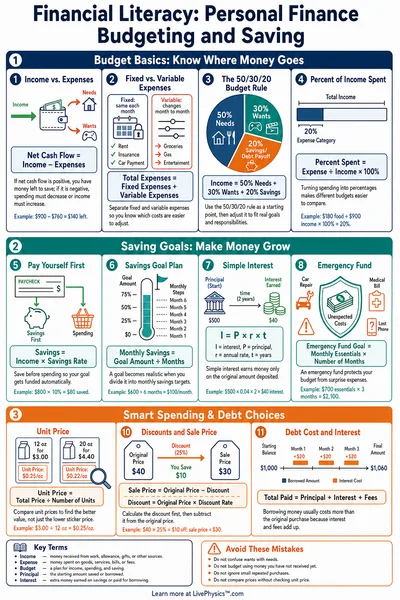
A budget is a plan that tells your money where to go instead of wondering where it went. Even a small income of $20 a month is worth planning because small habits build big financial skills.
Three core reasons to budget
- Reach goals faster by setting money aside on purpose
- Avoid running out of money before the end of the month
- Make spending decisions that match your values
A budget does not mean you cannot spend on fun. It means you decide how much fun costs before you spend, so you stay in control.
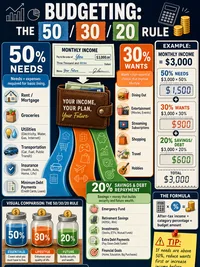
The 50/30/20 Guideline
One popular budgeting rule splits income into three buckets. It works as a starting point for adults and students alike.
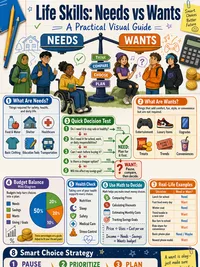
50% Needs
Essential costs you must cover, food, school supplies, transportation.
30% Wants
Enjoyable but optional, games, movies, clothing beyond basics.
20% Savings
Money set aside for future goals, emergencies, and opportunities.
Savings Goals
Savings goals fall into three time horizons. Having goals in each makes budgeting feel purposeful rather than restrictive.
Short-term (under 3 months)
- A new book, game, or accessory
- A trip to the movies or a concert with friends
Medium-term (3-12 months)
- A laptop, camera, or instrument
- A course, camp, or workshop fee
Long-term (1+ years)
- A car or first month of rent
- College textbooks and supplies