Understanding Set Theory Visualizer
A set is a collection in which membership is what matters. Repeating an item does not create a new member, so the list red, red, blue represents the same set as red, blue. Order does not matter either.
This differs from a shopping list or a sequence, where position and repeats can carry information. Students often make mistakes by treating sets like ordinary lists.
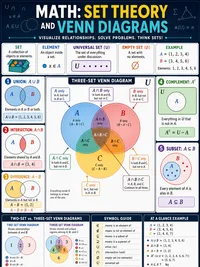
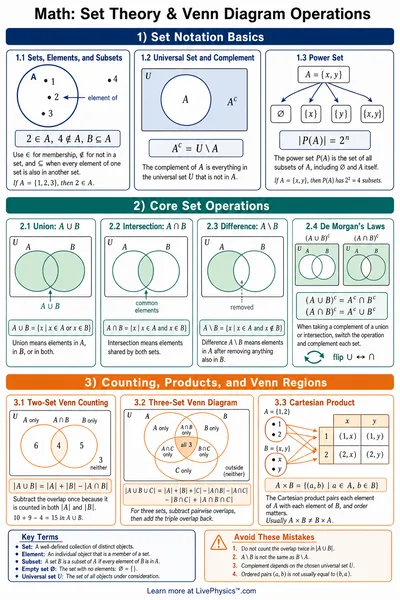
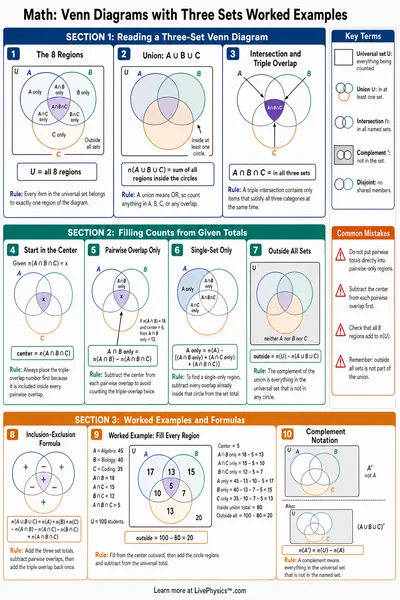
Before using complements or some differences, define the universal set. It contains every item currently allowed in the discussion. If the universe is all students in a class, the complement of the football set means students in that class who are not in football.
It does not mean every person outside the class. Changing the universe can change a complement, even when the original set stays exactly the same.
The separate regions in a three-set diagram help track precise membership. An item in the middle belongs to all three sets, while an item in the overlap of the first two but outside the third belongs to exactly those two.
Pay close attention to words such as at least one, exactly one, and none. They describe different regions and lead to different answers in survey problems, club memberships, and probability questions.
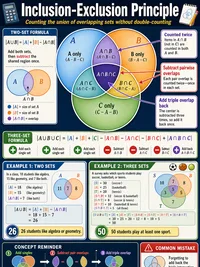
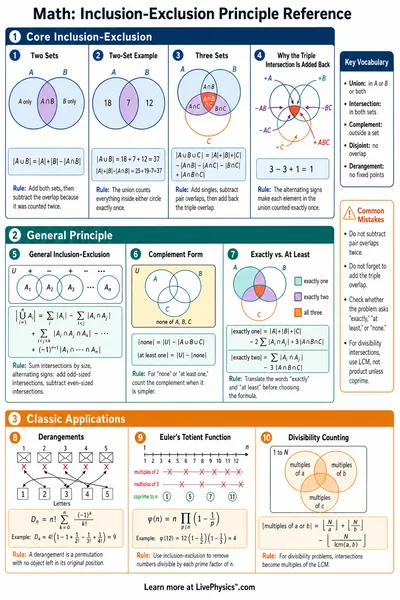
Counting gives set ideas a practical purpose. When two groups overlap, adding their sizes counts shared members twice. The inclusion-exclusion principle fixes this by subtracting the size of the overlap once.
With three groups, the shared center needs special care because it has been added too many times and then removed too many times. This method is useful when a school records students taking subjects, playing sports, or using several transport methods.
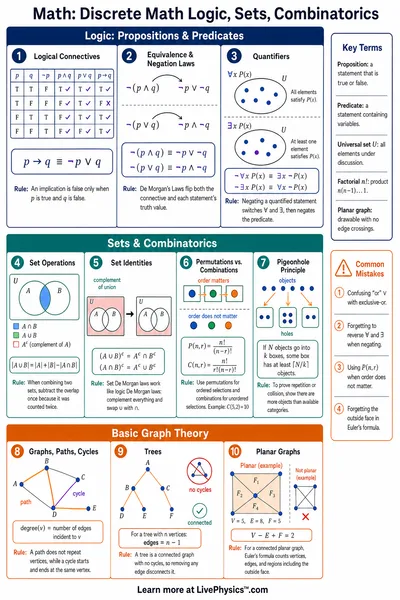
De Morgan's laws describe how a complement changes a combined condition. The complement of being in either group is being in neither group. The complement of being in both groups is missing at least one group.
These statements are helpful for checking work because the shaded regions must match. They also connect to computer searches, where a filter that excludes two conditions can be rewritten in a clearer form.
A power set is the set of every possible subset, including the empty set and the full original set. For a set with three members, there are eight subsets.
Each extra member doubles the number of subsets, which explains why the total grows quickly. This idea appears when counting possible choices, testing combinations, and studying binary decisions.
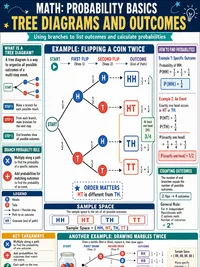
A Cartesian product makes ordered pairs from two sets. Unlike an ordinary set operation, order matters here because first coordinate, second coordinate is different from second coordinate, first coordinate when the values differ.
If one set has three members and another has four, their product has twelve pairs. Coordinate grids, tables of possible meals, and input-output relations all use this structure.
Good set work starts by writing each element clearly and deciding what counts as the same item. Names with different spelling, capital letters, or extra spaces may look different to a computer even if they mean the same person.
Check whether every listed element belongs to the chosen universe. Then read the operation in words before trusting a shaded picture or a final count.