Practice interpreting reaction mechanisms, identifying intermediates and catalysts, and explaining how activation energy affects reaction rates.
Read each problem carefully. Show your work in the space provided and explain your reasoning when asked.
Connecting reaction pathways, rate-determining steps, and energy changes
Chemistry - Grade 9-12
- 1
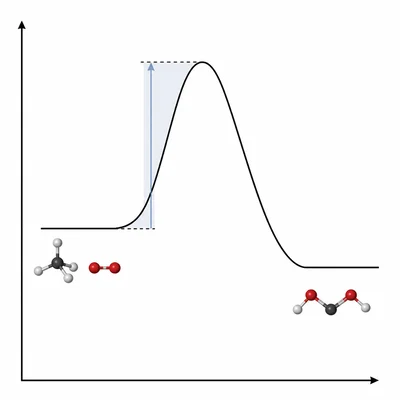
In your own words, explain what activation energy is and why it matters in a chemical reaction.
- 2
A reaction has the following mechanism: Step 1: A + B -> C, Step 2: C + D -> E. Write the overall reaction and identify any intermediate.
- 3
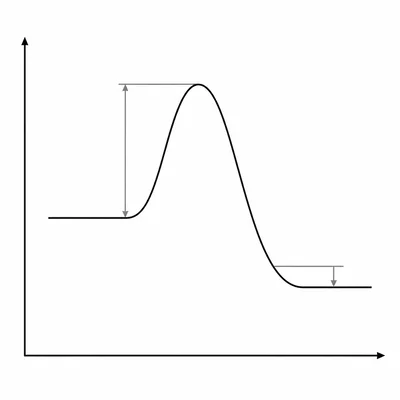
A potential energy diagram shows reactants at 40 kJ, a peak at 110 kJ, and products at 25 kJ. What is the activation energy for the forward reaction, and is the reaction exothermic or endothermic?
- 4
For the mechanism Step 1: NO2 + NO2 -> NO3 + NO, slow, Step 2: NO3 + CO -> NO2 + CO2, fast, write the overall reaction.
- 5
Using the same mechanism, Step 1: NO2 + NO2 -> NO3 + NO, slow, Step 2: NO3 + CO -> NO2 + CO2, fast, what rate law is predicted by the slow elementary step?
- 6
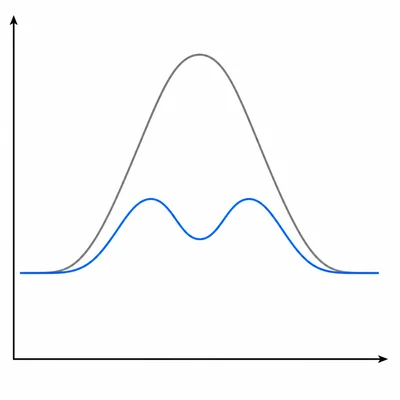
A catalyst is added to a reaction mixture. Explain how the catalyst changes the reaction mechanism and activation energy.
- 7
In a reaction mechanism, how can you tell the difference between a catalyst and an intermediate?
- 8
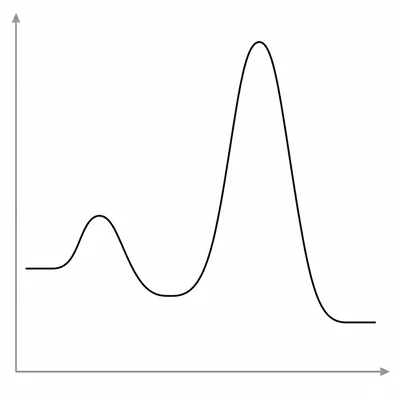
A reaction has two steps. Step 1 has an activation energy of 35 kJ and Step 2 has an activation energy of 80 kJ. Which step is most likely the rate-determining step? Explain.
- 9
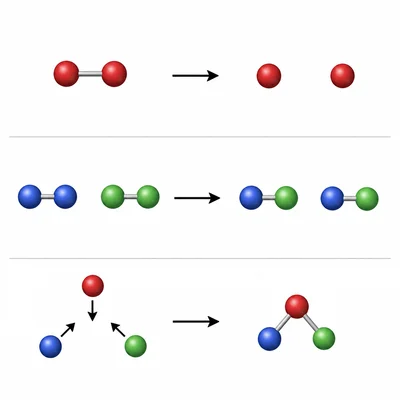
Classify each elementary step by molecularity: Step 1: A -> products, Step 2: A + B -> products, Step 3: 2A + B -> products.
- 10
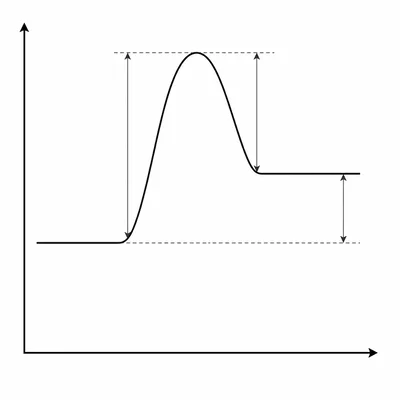
A reaction has reactants at 60 kJ, products at 100 kJ, and a transition state at 150 kJ. Calculate the forward activation energy, reverse activation energy, and enthalpy change.
- 11
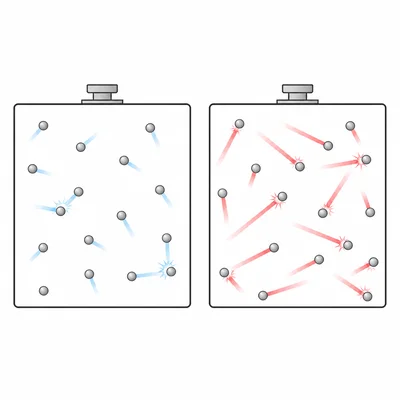
Explain why increasing temperature usually increases the rate of a chemical reaction.
- 12
For the elementary reaction H2 + I2 -> 2HI, write the rate law for this single-step process.
- 13
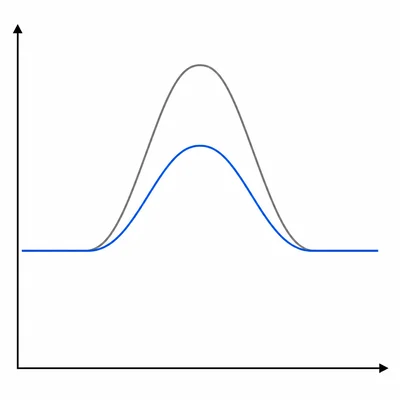
A student says, "A catalyst increases the amount of product formed at equilibrium because it lowers activation energy." Explain what is correct and what is incorrect in this statement.
- 14
Consider the mechanism Step 1: X + Y -> Z, fast, Step 2: Z + Y -> W, slow. Why might the experimentally measured rate law not be simply rate = k[Z][Y]?
- 15
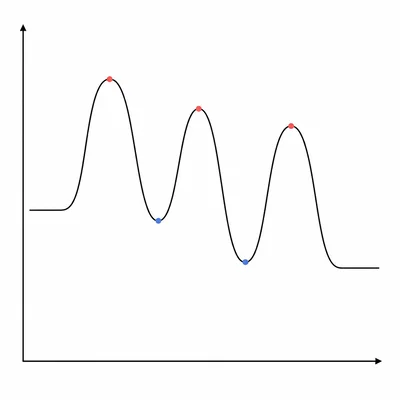
A reaction coordinate diagram has three peaks and two valleys between the reactants and products. What do the peaks and valleys represent in a multi-step mechanism?