Understanding Periodic Table Explorer
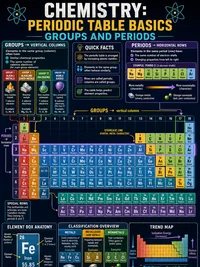
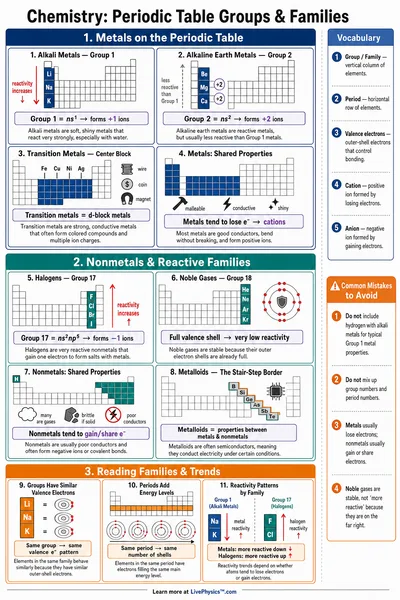
The table is arranged so that position gives useful clues about chemical behavior. Elements in one vertical group tend to have the same number of outer electrons. Those electrons take part in most bonds.
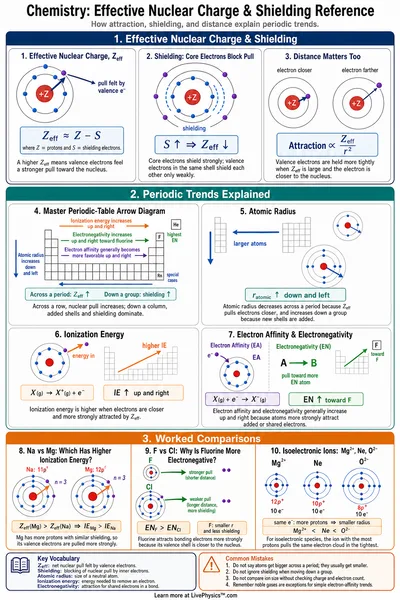
This is why lithium, sodium, and potassium react in related ways, while chlorine, bromine, and iodine often form salts with metals. Across a row, each step adds a proton and an electron to the same main energy level.
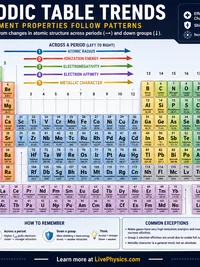
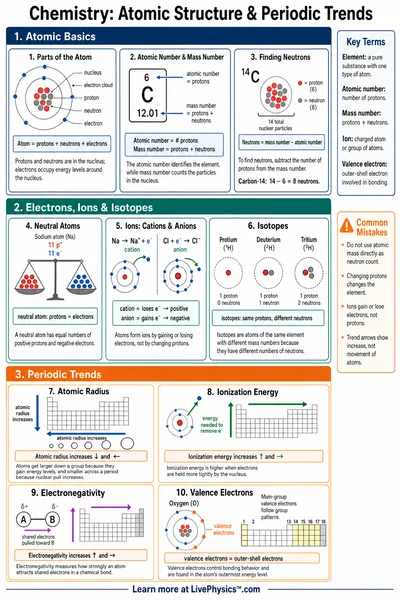
The growing nuclear pull changes how tightly atoms hold electrons. As a result, properties shift from strongly metallic toward nonmetallic.
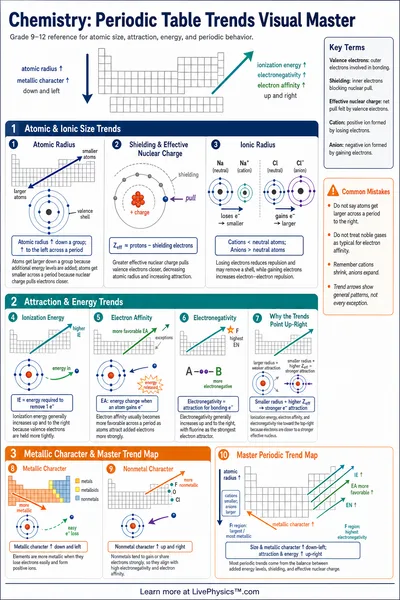
Atomic size is not measured by looking at a sharp edge, because an atom has a fuzzy electron cloud. Scientists use agreed measurements, such as the distance between nuclei in bonded atoms, to compare radii. Atoms generally become smaller from left to right because additional protons pull the cloud inward.
They become larger down a group because a new electron shell is added. This helps explain why potassium loses an electron more easily than lithium.
It also helps explain why fluorine attracts shared electrons strongly in many compounds. These patterns affect melting points and the energy released during reactions.
Electron arrangements explain the shape of the table more deeply. Electrons fill energy regions in an order set by energy, not simply by distance from the nucleus. The wide middle section contains transition metals, where electrons enter a particular inner region.
These elements can form ions with different charges, which gives compounds such as iron oxides and copper salts varied formulas and colors. The bottom two rows are placed separately to keep the table compact.
Their electrons fill another inner region, creating many elements with closely related properties. This is one reason their chemistry can be difficult to predict using a simple charge rule.
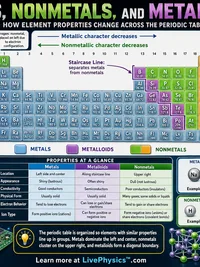
Metals on the left commonly lose outer electrons, producing positive ions. Nonmetals near the right often gain or share electrons, producing ionic or covalent substances. Magnesium and oxygen form a stable compound because electron transfer gives both atoms more stable outer arrangements.
Silicon sits near the boundary between metals and nonmetals. Its limited conductivity makes it useful in electronic devices, where its behavior can be adjusted by adding tiny amounts of other elements.
A table shows tendencies, not fixed rules that work in every situation. Temperature and pressure can change a substance from solid to liquid or gas, so phase labels refer to stated conditions. Some values are missing or estimated for short lived synthetic elements because only tiny amounts have been made.
Comparing two elements is most useful when you choose one property and connect it to atomic structure. Notice whether a number describes a neutral atom, an ion, or a particular isotope. That habit prevents common mistakes in class problems, laboratory work, and reading safety information about materials.