Practice key investing concepts, including risk, return, diversification, asset allocation, compound growth, and the tradeoffs investors consider when building a portfolio.
Read each problem carefully. Show calculations when needed and explain your reasoning in complete sentences.
Understanding how investment choices balance potential growth and uncertainty
Financial Literacy - Grade 9-12
- 1
Define risk and return in the context of investing. Then explain how they are usually related.
- 2
Maya invests $1,000 in a stock fund. After one year, the fund is worth $1,080. What is her rate of return for the year?
- 3
A savings account pays a 2% annual return, while a stock fund has an expected annual return of 8%. Explain why the stock fund might not always be the better choice.
- 4

Look at the investment options below: Option A has a possible return range of 1% to 3%, Option B has a possible return range of -10% to 15%, and Option C has a possible return range of -30% to 40%. Rank the options from lowest risk to highest risk and explain your choice.
- 5
Explain diversification in your own words. Include why owning only one company's stock can be risky.
- 6
Jordan owns stock in 20 different technology companies but no other industries. Is Jordan fully diversified? Explain.
- 7
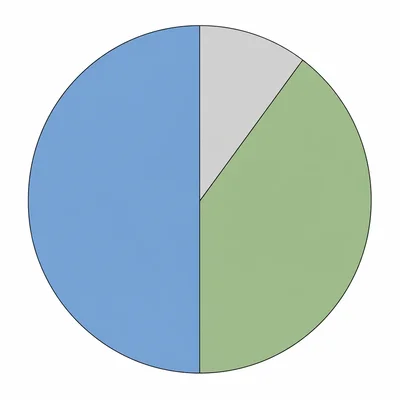
A portfolio contains 50% stocks, 40% bonds, and 10% cash. If the total portfolio is worth $12,000, how many dollars are invested in each asset type?
- 8
An investment grows from $2,500 to $3,000 over two years. What is the total dollar gain and total percentage return over the two years?
- 9

Two investors each have $5,000. Investor A puts all $5,000 into one restaurant company. Investor B puts $1,000 each into five companies in different industries. Which investor is more diversified, and why?
- 10
A bond fund is expected to have lower risk and lower return than a stock fund. Describe one reason a person might still choose the bond fund.
- 11

The chart shows three portfolios. Portfolio X is 90% stocks and 10% bonds. Portfolio Y is 60% stocks and 40% bonds. Portfolio Z is 30% stocks and 70% bonds. Which portfolio is likely the most aggressive, and which is likely the most conservative? Explain.
- 12
Explain how time horizon can affect investment choices. Compare a person saving for retirement in 40 years with a person saving for a car next year.
- 13

An index fund owns shares of hundreds of companies. Explain how this can help reduce company-specific risk.
- 14
The table shows annual returns for two investments over three years. Investment A: 6%, 6%, 6%. Investment B: 20%, -10%, 8%. Which investment had more predictable returns? Explain.
- 15
Lena says, 'Diversification guarantees that I will not lose money.' Explain why this statement is incorrect.