Practice advanced acid-base concepts, including Ka, Kb, pH calculations, buffer systems, titration curves, hydrolysis, and Brønsted-Lowry and Lewis acid-base theory.
Read each problem carefully. Show your setup, calculations, and reasoning in the space provided. Use appropriate significant figures and include units when needed.
Equilibrium, pH, buffers, titrations, and acid-base theories
Chemistry - Grade advanced
- 1
A 0.0250 M solution of hydrofluoric acid, HF, has Ka = 6.8 x 10^-4. Calculate the pH of the solution using an equilibrium expression.
- 2
A weak base B has Kb = 1.6 x 10^-5. What is the pH of a 0.100 M solution of B?
- 3
Calculate the pH of a buffer made by mixing 0.200 mol of acetic acid, HC2H3O2, and 0.300 mol of sodium acetate, NaC2H3O2, in enough water to make 1.00 L of solution. The Ka of acetic acid is 1.8 x 10^-5.
- 4
A buffer contains 0.250 M NH3 and 0.150 M NH4Cl. The Kb of NH3 is 1.8 x 10^-5. Calculate the pH of the buffer.
- 5
A 25.00 mL sample of 0.1000 M HCl is titrated with 0.1000 M NaOH. Calculate the pH after 10.00 mL of NaOH has been added.
- 6
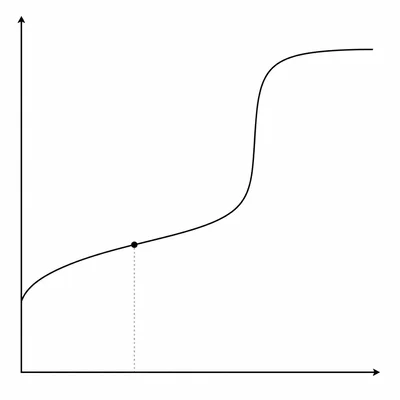
A 25.00 mL sample of 0.1000 M acetic acid, Ka = 1.8 x 10^-5, is titrated with 0.1000 M NaOH. Calculate the pH at the half-equivalence point.
- 7
A 40.00 mL sample of 0.200 M HNO3 is mixed with 60.00 mL of 0.150 M KOH. Determine whether the final solution is acidic, basic, or neutral, and calculate the final pH.
- 8
Rank the following 0.10 M acid solutions from lowest pH to highest pH: HCl, HF, CH3COOH, and HCN. Use these Ka values: HF = 6.8 x 10^-4, CH3COOH = 1.8 x 10^-5, HCN = 6.2 x 10^-10.
- 9
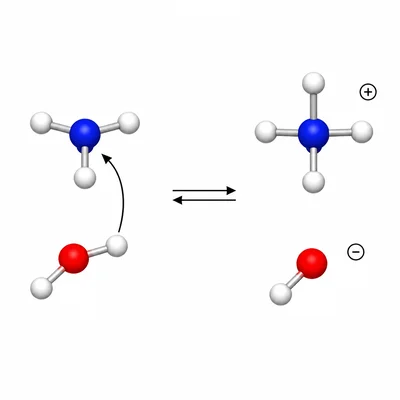
Identify the acid, base, conjugate acid, and conjugate base in this reaction: NH3(aq) + H2O(l) ⇌ NH4+(aq) + OH-(aq).
- 10
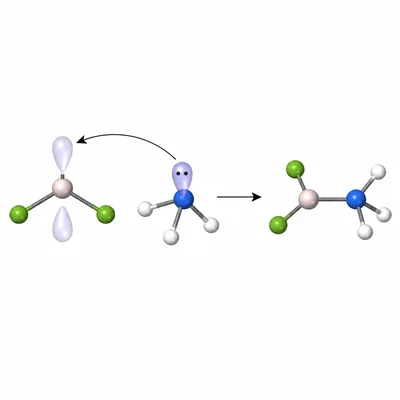
In the reaction BF3 + NH3 → F3B-NH3, identify the Lewis acid and the Lewis base. Explain your choice.
- 11
A salt solution contains 0.100 M NaF. The Ka of HF is 6.8 x 10^-4. Calculate the pH of the solution, assuming ideal behavior.
- 12
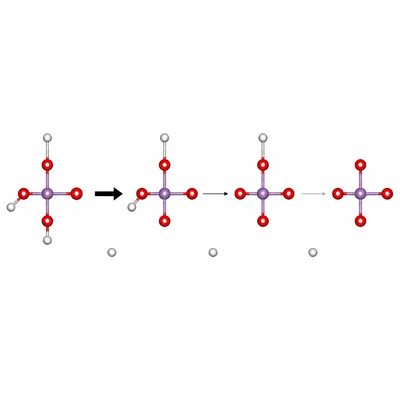
Phosphoric acid, H3PO4, is triprotic with Ka1 = 7.1 x 10^-3, Ka2 = 6.3 x 10^-8, and Ka3 = 4.2 x 10^-13. Explain why the first dissociation dominates the pH of a typical H3PO4 solution.
- 13
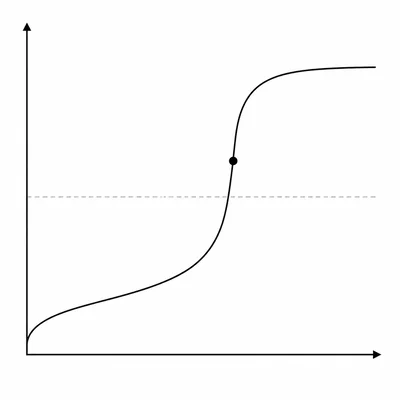
A titration curve begins at pH 2.9, has a buffer region, reaches equivalence at pH 8.7, and levels off above pH 12. Identify the most likely type of titration and justify your answer.
- 14
A solution has [H+] = 3.2 x 10^-9 M at 25°C. Calculate [OH-], pH, and pOH.
- 15
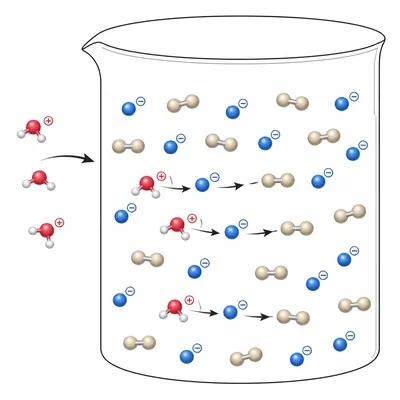
A student adds a small amount of strong acid to a buffer containing HA and A-. Explain, using Le Châtelier's principle, how the buffer resists a large change in pH.