Practice evaluating, transforming, solving, and modeling exponential and logarithmic functions.
Read each problem carefully. Show your work in the space provided. Use exact values when possible and round approximations to three decimal places unless told otherwise.
Solving, graphing, and modeling with exponentials and logarithms
Math - Grade 9-12
- 1
Evaluate f(x) = 3(2)^x for x = -2, x = 0, and x = 3.
- 2
Rewrite each equation in the other form: log_5(125) = 3 and 10^-2 = 0.01.
- 3
Solve for x: 2^(x + 1) = 16.
- 4
Solve for t: 7e^(0.4t) = 35.
- 5
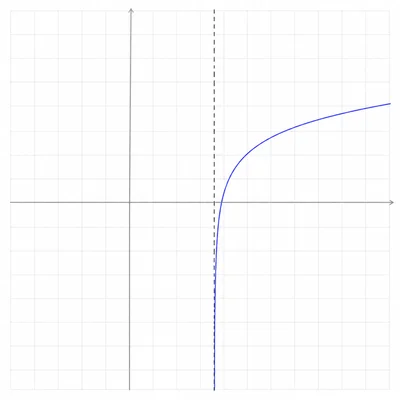
For the function y = log_2(x - 3) + 1, identify the domain, range, vertical asymptote, and the transformation from y = log_2(x).
- 6
Expand the expression using logarithm properties: ln(5x^3/sqrt(y)), where x and y are positive.
- 7
Condense the expression into a single logarithm: 2log(x) - (1/3)log(y) + log(4), where x and y are positive.
- 8
Solve for x and check for extraneous solutions: log_3(x - 2) + log_3(x + 2) = 2.
- 9
Find the inverse of f(x) = 4e^(x - 1) - 6.
- 10
An exponential function has the form y = ab^x and passes through the points (0, 5) and (3, 40). Find the values of a and b.
- 11
A savings account starts with $1,200 and earns 4.5% annual interest compounded monthly. Write a model for the balance after t years, then find the balance after 6 years.
- 12
A radioactive substance has a half-life of 9 days. If the initial amount is 80 grams, write a model for the amount A after t days and find the amount after 27 days.
- 13
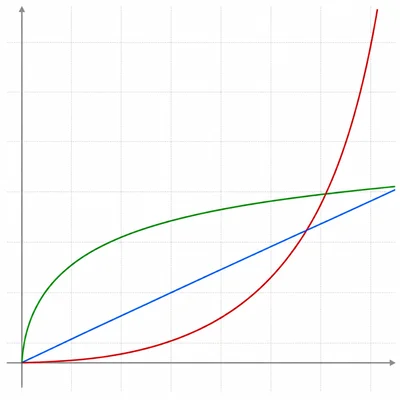
Order the functions ln(x), x, and 2^x from slowest growth to fastest growth as x becomes very large. Explain your reasoning.
- 14
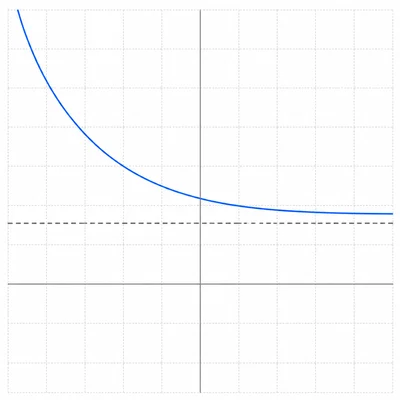
For the function y = 2^(-x) + 1, describe whether it represents growth or decay, find the horizontal asymptote, and state the y-intercept.
- 15
Solve for x: 10^(2x - 1) = 7. Give an exact answer and a decimal approximation.