Practice using simple interest and compound interest to solve real-world money problems.
Read each problem carefully. Show your work in the space provided. Round money answers to the nearest cent when needed.
Calculating interest, balances, rates, and time
Math - Grade 6-8
- 1
Lena deposits $200 in an account that earns 5% simple interest each year. How much interest will she earn after 3 years?
- 2
A savings account has a principal of $450 and earns 4% simple interest for 2 years. What is the total balance at the end of 2 years?
- 3
Marcus earned $36 in simple interest on a principal of $300 after 3 years. What was the annual interest rate?
- 4
A loan of $600 earns $72 in simple interest at an annual rate of 6%. How many years did it take to earn that interest?
- 5

In an interest problem, what does the principal represent?
- 6
A $1,000 investment earns 5% interest compounded annually for 2 years. What is the final balance?
- 7
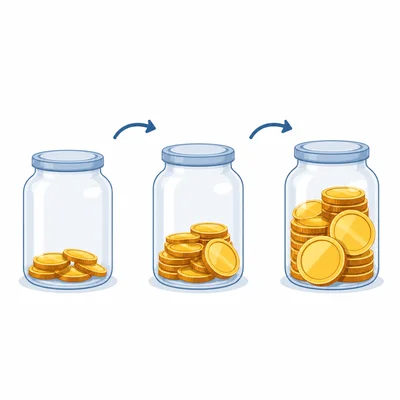
An account starts with $800 and earns 10% interest compounded annually. Find the balance after year 1, year 2, and year 3.
- 8
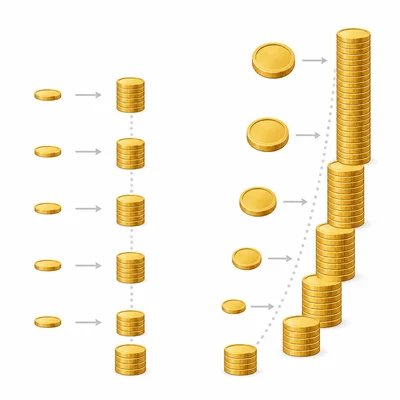
Compare $500 invested at 8% simple interest for 3 years with $500 invested at 8% interest compounded annually for 3 years. Which has the larger balance, and by how much?
- 9
A bank compounds $300 annually at a rate of 3% for 4 years. What is the final balance rounded to the nearest cent?
- 10
Nia can invest $1,200 for 2 years. Option A earns 6% simple interest. Option B earns 5.5% interest compounded annually. Which option gives her more money after 2 years?
- 11
A credit union gives a simple interest loan of $900 at an annual rate of 7% for 1.5 years. How much interest will be paid?
- 12
An account earned $40 in simple interest at a rate of 5% per year for 2 years. What was the original principal?
- 13
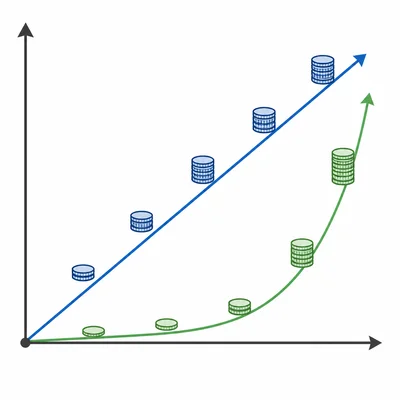
Which type of interest usually grows faster over a long time, simple interest or compound interest? Explain why.
- 14
Jay calculates the balance for $700 at 4% interest compounded annually for 3 years as 700 x (1 + 4)^3. What mistake did Jay make, and what expression should he use instead?
- 15

An account starts with $1,000 and earns 6% interest compounded annually. Find the balances for years 0, 1, 2, and 3. Then explain whether the yearly increase stays the same or changes.