Understanding Percent Calculator & Visualizer
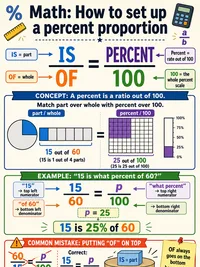
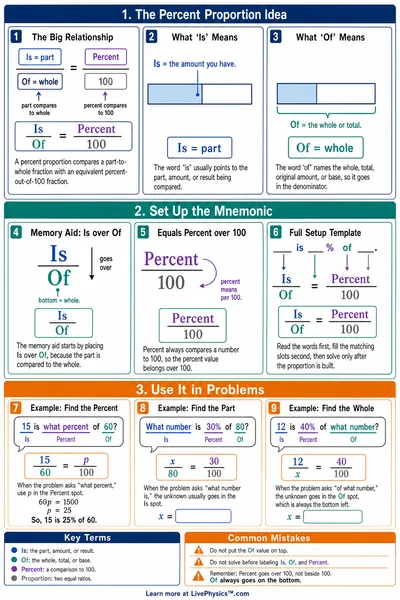
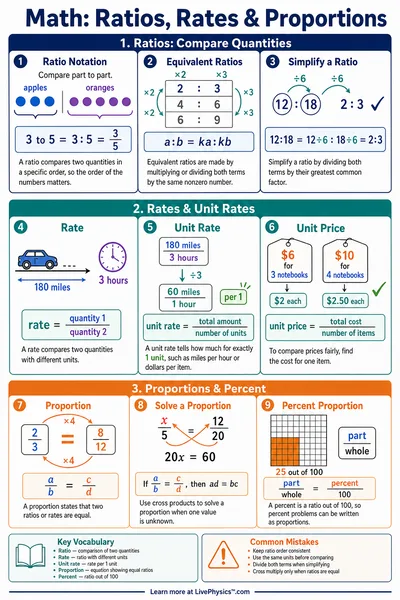
A percent is a comparison to a fixed reference amount of one hundred. The same percent can describe very different actual amounts because the whole may be different. Thirty percent of a small class is not the same number of students as thirty percent of a large class.
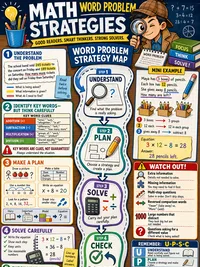
Before calculating, identify the whole that the percent is based on. Words such as of, total, original, and full price often point to that whole.
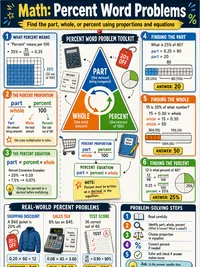
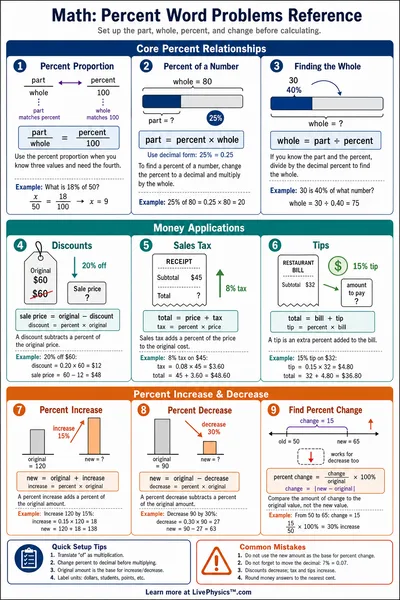
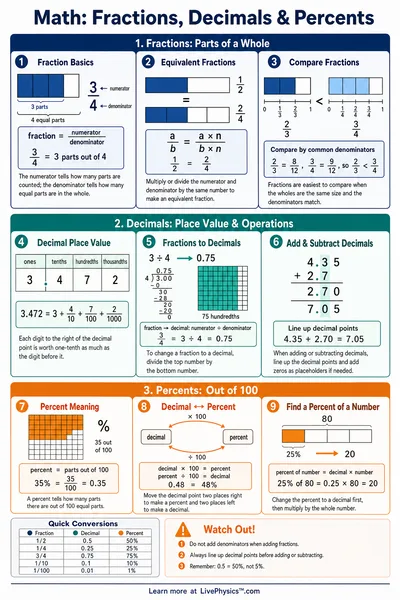
Finding a part usually means taking a fraction of a whole. Twenty five percent means twenty five hundredths, which is the same as one quarter. A useful method is to divide the whole by one hundred, then multiply by the number of percent units.
For example, twenty five percent of eighty is twenty groups of one percent, or one quarter of eighty. Bar models help because they show that equal percent sections must represent equal-sized pieces of the whole.
Inverse problems need a different kind of thinking. If eighteen is thirty percent of a quantity, eighteen is only a known piece, not the whole answer. Since thirty percent is thirty hundredths, divide eighteen by thirty hundredths to find the whole of sixty.
When the percent is unknown, compare the part with the whole first, then convert that comparison into an amount out of one hundred. Keep units clear, since a number of books, dollars, or students is different from a percent rate.
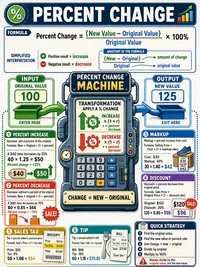
Percent change always uses the starting value as its reference. A rise from forty to fifty is an increase of ten units, but it is a twenty five percent increase because ten is one quarter of forty. Subtracting two percentages gives a change in percentage points, which is not always a percent change.
For example, a test score moving from seventy percent to eighty percent rises by ten percentage points, while its percent increase is based on the original seventy percent. Percent change cannot be found normally when the starting value is zero because there is no starting amount to use as the reference.
Percent ideas appear in sale prices, tax, tips, sports statistics, grades, interest, and survey results. A discount followed by a tax does not usually return an item to its original price because each calculation uses a different base amount.
Two successive ten percent increases are not the same as one twenty percent increase, since the second increase is taken from a larger value. Check whether a problem asks for an exact value or a sensible estimate, and round only near the end so early rounding does not change the result.