Loan Payment Explorer
Enter a loan amount, interest rate, and term to see your monthly payment, total interest paid, and a full amortization schedule. Compare scenarios to understand how the APR affects the true cost of borrowing.
Loan scenarios
Loan Term
Mode
Payment Summary
Payment Breakdown
Principal
$15,000.00 (86.2%)
Total Interest
$2,399.40 (13.8%)
Total paid
$17,399.40
APR Comparison
How the interest rate affects your payments
Amortization Schedule
| Month | Payment | Principal | Interest | Balance |
|---|---|---|---|---|
| 1 | $289.99 | $214.99 | $75.00 | $14,785.01 |
| 2 | $289.99 | $216.06 | $73.93 | $14,568.95 |
| 3 | $289.99 | $217.15 | $72.84 | $14,351.80 |
| 4 | $289.99 | $218.23 | $71.76 | $14,133.57 |
| 5 | $289.99 | $219.32 | $70.67 | $13,914.25 |
| 6 | $289.99 | $220.42 | $69.57 | $13,693.83 |
| ... 51 more payments ... | ||||
| 58 | $289.99 | $285.68 | $4.31 | $575.84 |
| 59 | $289.99 | $287.11 | $2.88 | $288.73 |
| 60 | $290.17 | $288.73 | $1.44 | $0.00 |
60 total payments shown
Reference Guide
How Loans Work
A loan is an agreement where a lender provides money now and the borrower repays it over time with interest. Each monthly payment covers two parts, a portion that reduces the principal balance and a portion that pays the interest charge for that month.
In the early months, most of each payment goes toward interest because the outstanding balance is large. As the balance falls, the interest charge per payment shrinks and a growing share goes to principal. This is called an amortizing loan.
- Principal, the original amount borrowed
- Interest, the cost charged for borrowing
- Term, the total number of payment periods
Understanding APR
APR stands for Annual Percentage Rate. It is the yearly cost of borrowing expressed as a percentage. A higher APR means more interest is charged each month and the total cost of the loan rises significantly over a long term.
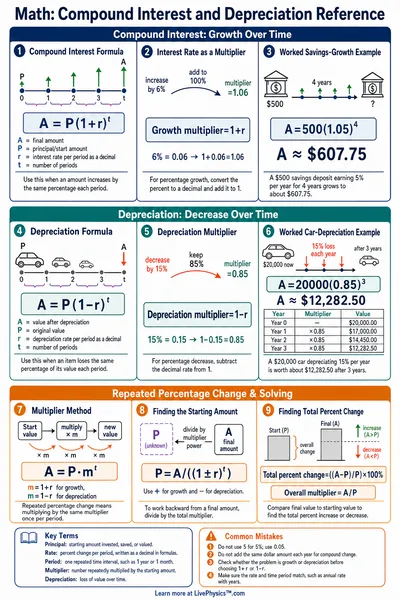
To convert APR to a monthly rate, divide by 12. For example, 6% APR becomes 0.5% per month (0.005 as a decimal). This monthly rate is applied to the remaining balance to calculate each month's interest charge.
- 6% APR monthly rate = 6 / 12 = 0.5%
- Even small APR differences matter over long terms
- Shopping for a lower rate can save thousands
Principal vs Interest
Total interest paid is the difference between the total amount repaid and the original loan balance. For a 30-year mortgage at 7%, you may pay nearly as much in interest as the original loan amount.
Paying extra toward principal each month reduces the outstanding balance faster, which shrinks future interest charges. Even small extra payments compound into significant savings over the life of a long-term loan.
- Total paid = monthly payment times number of months
- Total interest = total paid minus original principal
- Interest ratio = total interest divided by principal
The Payment Formula
Monthly payment M is calculated from three inputs, the principal P, monthly interest rate r (APR divided by 12 as a decimal), and number of payments n.
The numerator grows with the rate and compounding, while the denominator scales with the number of payments. When APR is zero, the formula simplifies to M = P / n (equal principal payments, no interest).
- P = loan amount in dollars
- r = APR / 12 (e.g. 0.06 / 12 = 0.005)
- n = years x 12 payments per year