Practice advanced concepts in heat and thermodynamics, including calorimetry, ideal gases, work, heat engines, entropy, and thermodynamic cycles.
Read each problem carefully. Show your equations, substitutions, units, and reasoning in the space provided. Use consistent sign conventions for heat, work, and internal energy.
Energy transfer, thermal processes, and the laws of thermodynamics
Physics - Grade advanced
- 1
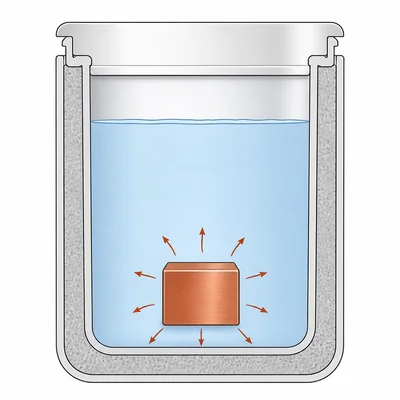
A 0.250 kg block of copper at 95.0°C is placed into 0.400 kg of water at 22.0°C in an insulated container. The specific heat of copper is 385 J/kg·°C and the specific heat of water is 4186 J/kg·°C. Assume no heat is lost to the container. Find the final equilibrium temperature.
- 2
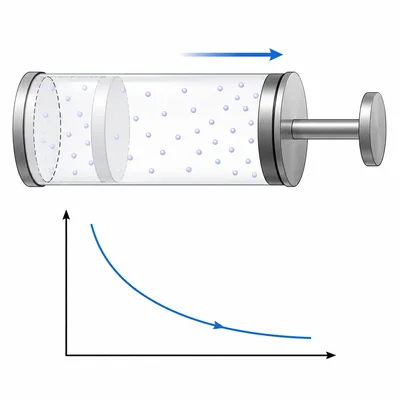
An ideal monatomic gas expands isothermally at 300 K from 2.00 L to 8.00 L. The gas contains 0.500 mol. Calculate the work done by the gas.
- 3
A gas undergoes a process in which 750 J of heat is added to the gas and 420 J of work is done by the gas. Using the convention ΔU = Q - W, find the change in internal energy.
- 4
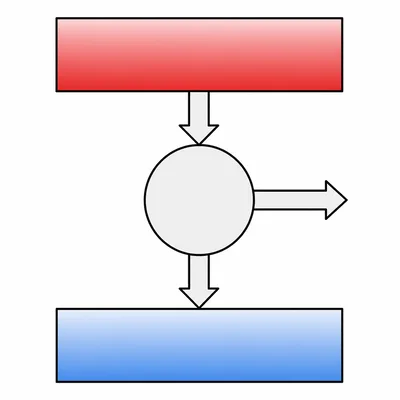
A heat engine absorbs 2400 J of heat from a hot reservoir and rejects 1500 J of heat to a cold reservoir during each cycle. Find the work output and the thermal efficiency.
- 5
A Carnot engine operates between a hot reservoir at 600 K and a cold reservoir at 300 K. What is its maximum possible efficiency?
- 6
A 2.00 mol sample of an ideal monatomic gas is heated at constant volume from 250 K to 400 K. Calculate the heat added. Use Cv = (3/2)R.
- 7
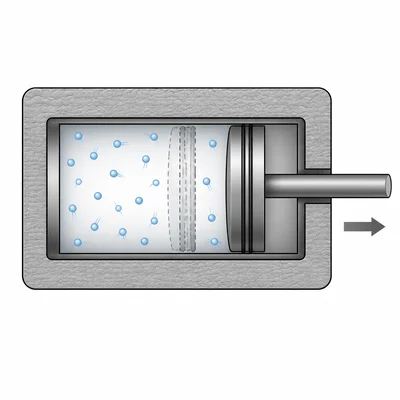
A 1.50 mol sample of ideal diatomic gas expands adiabatically from 1.00 L to 3.00 L. Its initial temperature is 500 K. Use γ = 1.40. Find the final temperature.
- 8
A 0.600 kg sample of ice at 0°C is completely melted into water at 0°C. The latent heat of fusion of water is 3.34 × 10^5 J/kg. How much heat is required?
- 9
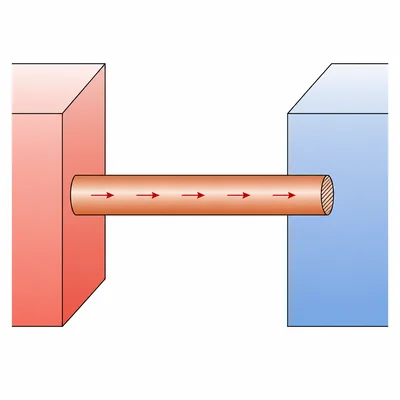
A copper rod of length 0.750 m and cross-sectional area 1.20 × 10^-4 m^2 connects two thermal reservoirs at 100°C and 20°C. The thermal conductivity of copper is 400 W/m·K. Find the steady-state rate of heat conduction through the rod.
- 10
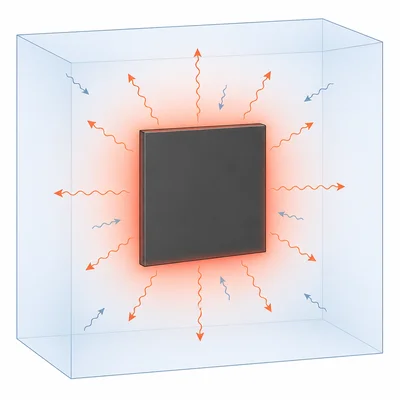
A blackbody radiator has a surface area of 0.0500 m^2 and temperature 800 K. Its surroundings are at 300 K. Use σ = 5.67 × 10^-8 W/m^2·K^4 and emissivity e = 1.00. Calculate the net radiated power.
- 11
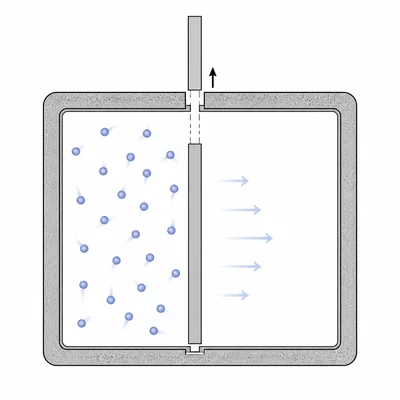
One mole of an ideal gas expands freely into a vacuum from volume V to volume 4V in an insulated container. For an ideal gas, determine Q, W, ΔU, and ΔS.
- 12
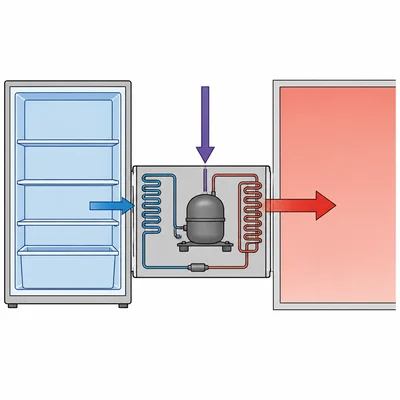
A refrigerator removes 450 J of heat from its cold interior while 150 J of work is done on it during one cycle. Find the heat rejected to the room and the coefficient of performance.
- 13
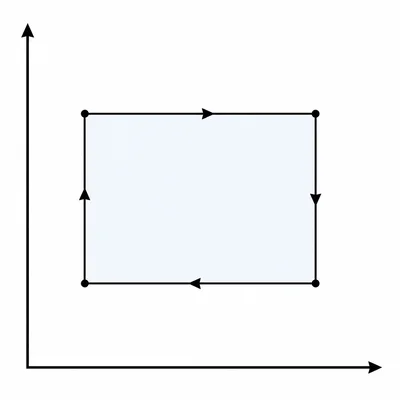
An ideal gas follows a rectangular cycle on a P-V diagram with corners at (V, P), (3V, P), (3V, 2P), and (V, 2P), traversed clockwise. Find the net work done by the gas in one cycle in terms of P and V.
- 14
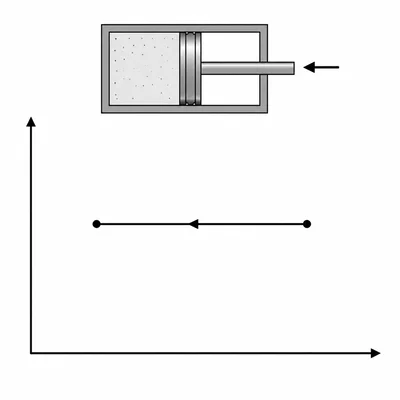
A 3.00 mol sample of ideal gas is compressed isobarically at 2.50 × 10^5 Pa from 0.0400 m^3 to 0.0150 m^3. Find the work done by the gas and state whether energy is transferred into or out of the gas by work.
- 15
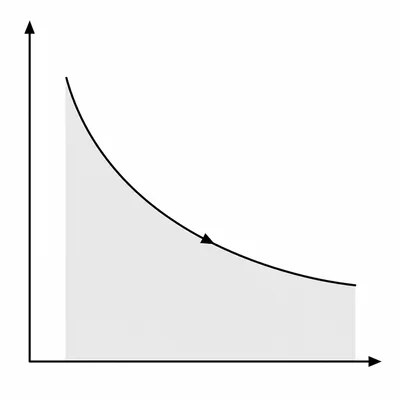
A 1.00 mol sample of an ideal gas is taken reversibly and isothermally at 350 K from volume V to volume 2V. Find the entropy change of the gas.