Practice AP Macroeconomics concepts related to fiscal policy, government spending, tax changes, multipliers, deficits, debt, and the AD-AS model.
Read each problem carefully. Show calculations when needed and explain your reasoning using correct macroeconomic terms.
Analyzing taxes, spending, deficits, and aggregate demand
Social Studies - Grade 9-12
- 1
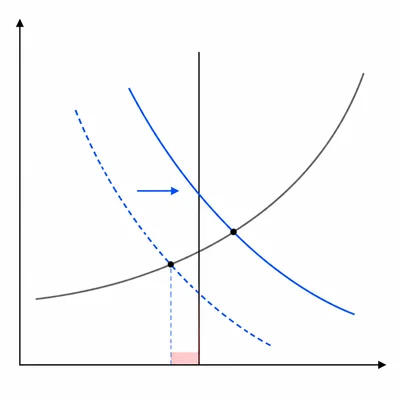
An economy is in a recessionary gap. Identify one discretionary fiscal policy action the government could take to increase real GDP, and explain how it affects aggregate demand.
- 2
The marginal propensity to consume is 0.8. Calculate the government spending multiplier.
- 3
The marginal propensity to consume is 0.75. The government increases spending by $40 billion. Calculate the maximum change in aggregate demand.
- 4
The marginal propensity to consume is 0.6. Calculate the tax multiplier and explain why it has a negative sign.
- 5
An economy has a recessionary gap of $200 billion and an MPC of 0.75. Calculate the increase in government spending needed to close the gap.
- 6
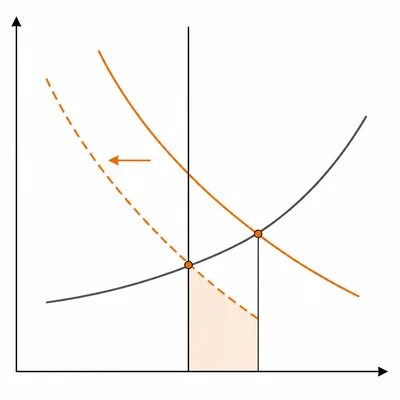
An economy has an inflationary gap. Explain how a decrease in government spending can help reduce inflationary pressure in the AD-AS model.
- 7
Suppose the government cuts taxes by $100 billion and the MPC is 0.8. Calculate the maximum change in aggregate demand.
- 8
Explain the difference between discretionary fiscal policy and automatic stabilizers. Give one example of each.
- 9
A government collects $3.8 trillion in tax revenue and spends $4.4 trillion in one year. Identify whether it has a budget deficit or surplus and calculate the amount.
- 10
Use the budget table to calculate the government's budget balance: tax revenue is $5.0 trillion, transfer payments are $1.5 trillion, government purchases are $3.0 trillion, and interest payments are $0.7 trillion.
- 11
Explain how persistent budget deficits can affect the national debt.
- 12
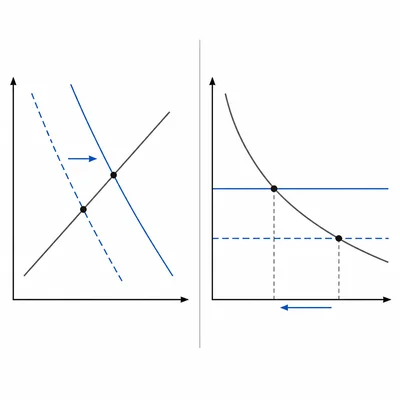
Describe the crowding-out effect that can result from expansionary fiscal policy financed by borrowing.
- 13
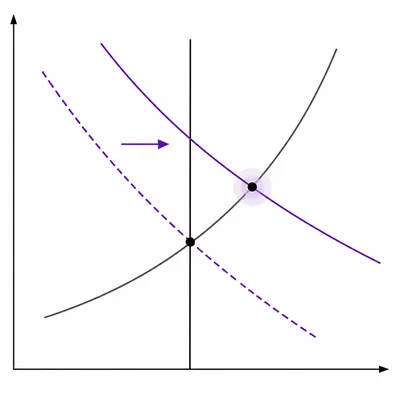
A country is at full employment. The government increases spending without changing taxes. In the short run, predict the effect on real GDP, unemployment, and the price level.
- 14
Explain why a balanced budget increase in government spending and taxes can still increase aggregate demand.
- 15
A recession begins quickly, but Congress takes several months to approve a spending bill. Identify the type of fiscal policy lag shown and explain why it matters.