Economic Systems Lab
Explore the four major economic systems - Traditional, Command, Market, and Mixed. Compare who controls resources, how prices are set, and use the Design Your Economy tool to see how policy choices shape economic outcomes.
Explore Economic Systems
Click a card to expand detailsYour Analysis Notes
After exploring each system, write your own notes about what makes it unique or where it works best.
Side-by-Side Comparison
Private individuals and businesses own resources and capital. Consumer choices and market competition guide what gets produced.
The central government owns most means of production and directs what is produced, how much, and at what price.
Prices emerge from voluntary exchange between buyers and sellers. Supply and demand signals guide producers to allocate resources efficiently.
Government planners set prices administratively to achieve policy goals such as keeping essentials affordable or redirecting resources to strategic industries.
- Efficient resource allocation through price signals
- Strong incentives for innovation and productivity
- Wide variety of goods and services
- Individual economic freedom and choice
- Can mobilize resources rapidly for national goals
- Reduces extreme income inequality
- Eliminates unemployment through job guarantees
- Coordinates large-scale projects efficiently
- Can produce large income inequality
- Market failures (monopolies, externalities, public goods)
- No guarantee of basic needs for all citizens
- Boom-bust economic cycles
- Inefficient allocation due to lack of price signals
- Suppresses individual choice and entrepreneurship
- Prone to shortages and surpluses
- Corruption and bureaucratic waste
- Hong Kong (pre-2020)
- Singapore
- United States (closest large economy)
- New Zealand
- Soviet Union (1922-1991)
- North Korea
- Cuba
- Maoist China (1949-1976)
Design Your Economy
Move the sliders to set your economic policy choices. The lab will classify your economy and explain why.
Low government ownership (30%), minimal price controls (20%), and open trade (65%) describe a market economy. Private enterprise and voluntary exchange drive most decisions.
Controls
Explore all four systems, then record your observations in the data table and lab report below.
Data Table
(0 rows)| # | Economic System | Who Controls Resources | Price Mechanism | Main Advantage | Main Disadvantage | Real Country Example |
|---|
Reference Guide
The Four Economic Systems
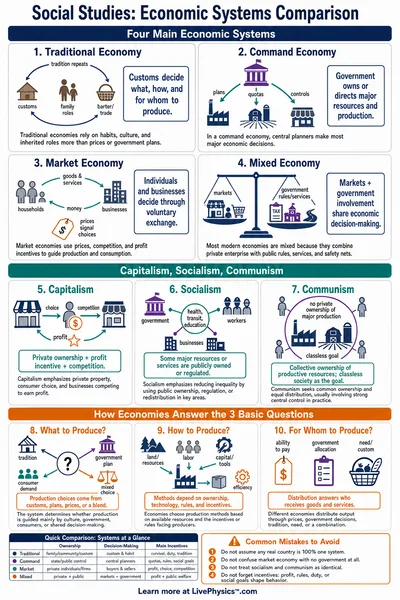
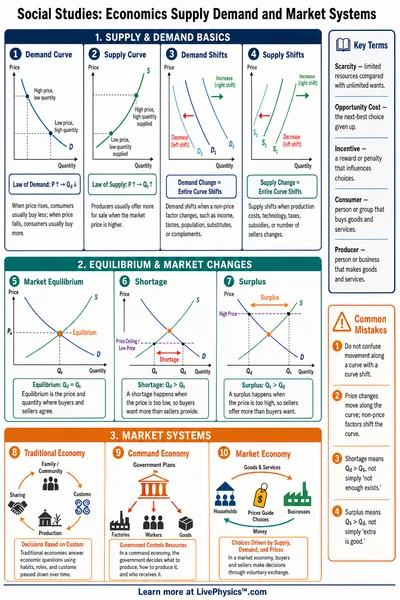
Every society must answer three fundamental economic questions, what to produce, how to produce it, and for whom. The answer to these questions defines an economic system.
- Traditional customs and heritage decide - common in isolated or indigenous communities.
- Command central government decides - seen in socialist and communist states.
- Market supply, demand, and private enterprise decide - found in capitalist economies.
- Mixed both government and markets share decision-making - most modern democracies.
No real-world economy is purely one type. Every country blends elements of multiple systems, differing mainly in the degree of government involvement.
Market Economies
In a market economy, prices emerge from voluntary exchange between buyers and sellers. The price mechanism serves three key functions
- Signaling rising prices signal producers to make more of a good.
- Incentive profits reward producers who satisfy consumer needs efficiently.
- Rationing prices allocate scarce goods to those willing to pay for them.
Adam Smith's concept of the "invisible hand" describes how individual self-interest, guided by competitive markets, produces outcomes that benefit society as a whole - without central coordination.
Market economies excel at innovation and consumer choice but can produce inequality and may fail to provide public goods like national defense or clean air.
Command Economies
Command economies rely on central planning to coordinate production and distribution. Government ministries set production targets, allocate inputs, and fix prices for goods and services.
The core challenge is the "knowledge problem," identified by economist Friedrich Hayek. No central planner can gather and process the vast amount of dispersed, local information that markets aggregate automatically through prices.
- Chronic shortages when prices are set below market clearing levels, demand exceeds supply.
- Surpluses planners often overproduce goods that consumers do not want.
- Low incentive without profit motive, workers and firms have little reason to innovate.
The Soviet Union's command economy did achieve rapid industrialization in the 1930s-1950s, but ultimately collapsed under inefficiency by 1991.
Mixed Economies in Practice
Most countries today operate as mixed economies, combining private enterprise with government regulation and social programs. Key policy levers include
- Taxation and spending redistributes income and funds public goods.
- Regulation corrects market failures such as monopolies and externalities.
- Monetary policy central banks manage money supply and interest rates.
- Safety nets unemployment insurance, healthcare, and pensions provide security.
Scandinavian countries like Sweden and Denmark combine highly free markets with extensive welfare states and high tax rates. The United States leans more market-oriented but still maintains substantial regulation and public programs.
The debate over the right balance between market freedom and government intervention is one of the central questions in modern economics and political science.