Branches of Government Explorer
Explore the three branches of the US federal government. Learn what each branch does, how checks and balances prevent abuses of power, and trace the path from an idea to a signed law.
Branches of Government Explorer
US Federal Government - Civics
Legislative
Legislative Branch
Also known as Congress
Key Powers
- Make federal laws
- Declare war on foreign nations
- Approve treaties with other countries
- Control the federal budget (power of the purse)
- Impeach (charge) federal officials including the President
- Override a presidential veto with 2/3 majority vote
- Confirm presidential appointments (Senate)
- Ratify treaties (Senate, 2/3 vote)
Key Roles
- 1Speaker of the House - leads the House of Representatives
- 2Senate Majority Leader - leads the Senate majority party
- 3Committee Chairs - oversee specific policy areas
- 4Congressional members - represent states and districts
Branch fact
The number of House representatives per state is based on population. California has the most (52) while 7 states have just 1 representative.
Reference Guide
The Three Branches
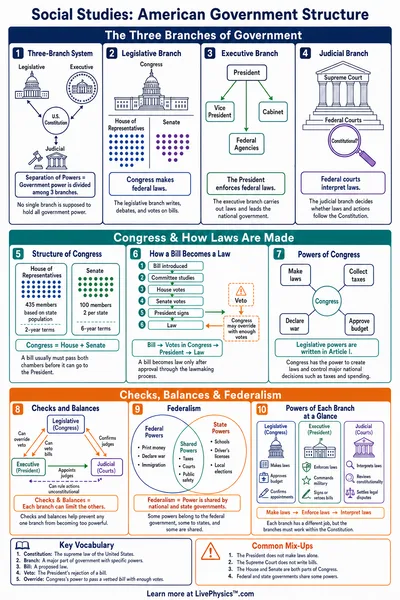
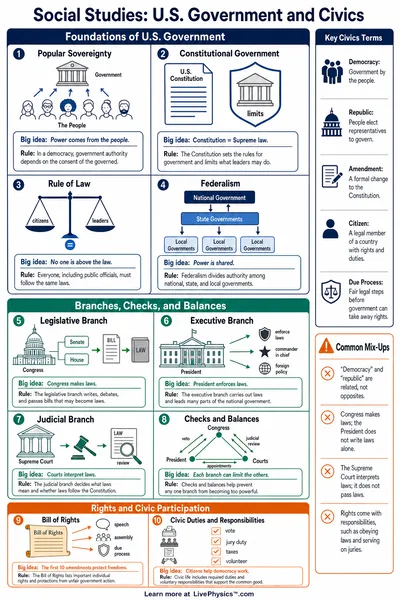
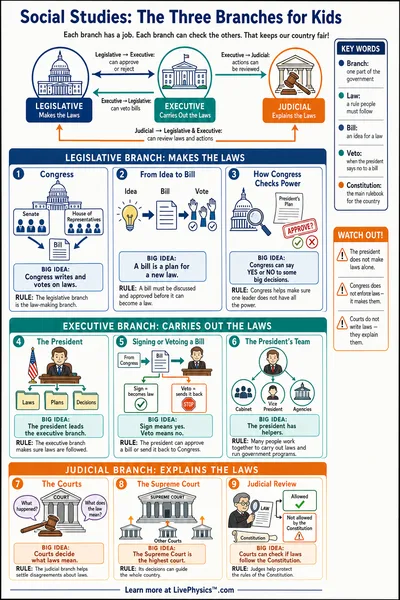
The United States Constitution divides the federal government into three separate branches. This separation prevents any single person or group from holding all power at once.
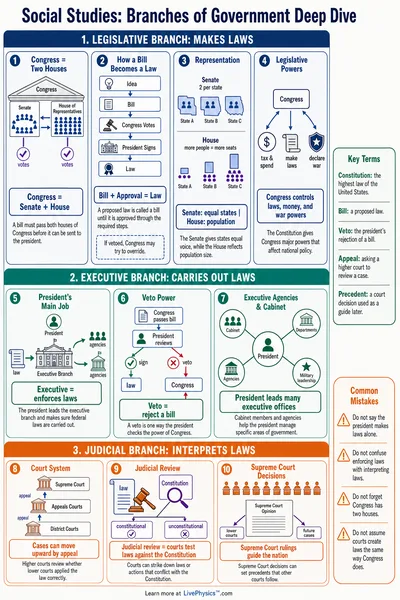
Legislative Branch (Congress) creates federal laws, controls spending, and can declare war. It is made up of the Senate (100 senators, 2 per state) and the House of Representatives (435 members based on state population).
Executive Branch enforces and carries out laws. The President serves a 4-year term and can serve a maximum of two terms. The Cabinet of 15 department secretaries assists the President.
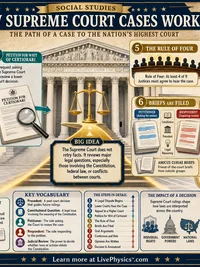
Judicial Branch interprets the meaning of laws and the Constitution. The Supreme Court has 9 justices who serve lifetime appointments and have final say on constitutional questions.
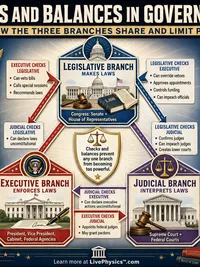
Checks and Balances
Checks and balances is a system where each branch has specific powers to limit and oversee the other two. The Founders designed this to prevent tyranny and protect citizens' rights.
Congress checks the President by overriding vetoes (2/3 majority), controlling the budget, confirming appointments, and having the power to impeach and remove the President from office.
The President checks Congress by vetoing legislation and calling special sessions. The President checks the courts by appointing federal judges and issuing pardons.
Courts check both branches by declaring laws or executive actions unconstitutional through the power of judicial review, first established in Marbury v. Madison (1803).
How a Bill Becomes a Law
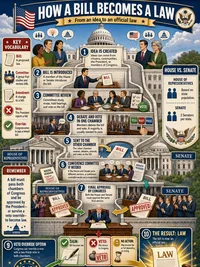
The process of creating a law is long and deliberate. A bill must survive multiple steps before it can be signed into law. Most bills never complete the journey.
A bill starts when a member of Congress introduces it. It then goes to a committee where it is studied, debated, and possibly revised. If the committee approves it, the full chamber votes. It then repeats this process in the other chamber.
If both chambers pass different versions, a conference committee creates a compromise version. The final version goes to the President, who can sign it into law or veto it. Congress can override a veto with a 2/3 majority in both chambers.
Of roughly 10,000 bills introduced each Congress, only 3-5% become law.
The Constitution
The US Constitution is the supreme law of the land, ratified in 1788. It establishes the three branches and defines the limits of their power. No law or executive action can contradict the Constitution.
Article I creates Congress and grants it legislative powers. Article II creates the executive branch. Article III creates the federal courts. Article VI establishes the Constitution as the supreme law.
The Constitution has been amended 27 times. The first 10 amendments, known as the Bill of Rights, were ratified in 1791 and protect individual freedoms such as free speech, religion, and fair trial rights.
Amendments require approval by 2/3 of both chambers of Congress and ratification by 3/4 of states, making the Constitution deliberately difficult to change.