Supply and Demand Visualizer
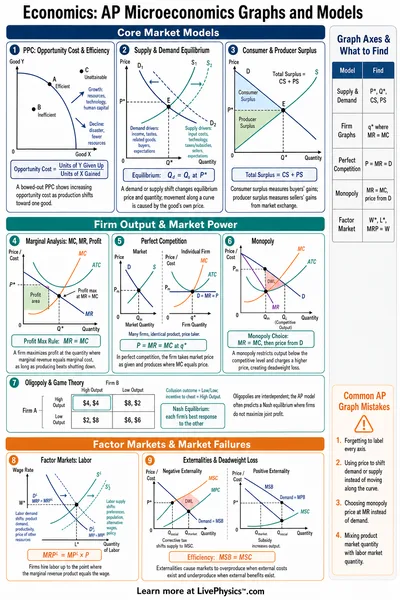
Adjust supply and demand curves to see how price and quantity change at market equilibrium. Add price floors and ceilings to explore government price controls and their effects.
Market Equilibrium , Widget
Equilibrium Price
$15.00
Equilibrium Quantity
10.00
Equations
Supply, P = 5.0 + 1.0 Q
Demand, P = 25.0 - 1.0 Q
Equilibrium, P* = 15.00, Q* = 10.00
Scenario Presets
Supply Curve (S)
P = 5.0 + 1.0 × Q
Demand Curve (D)
P = 25.0 - 1.0 × Q
Government Price Controls
Show Areas
Reference Guide
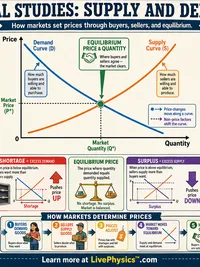
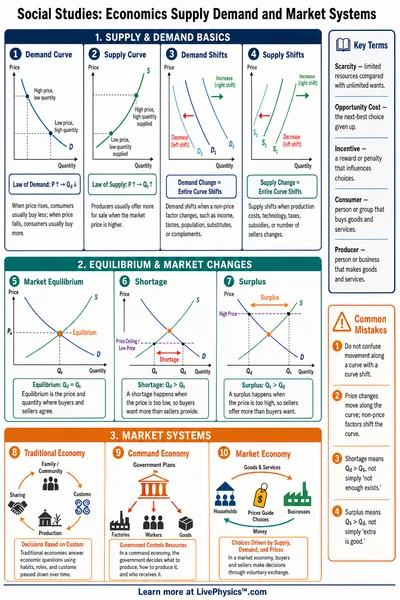
The Law of Supply
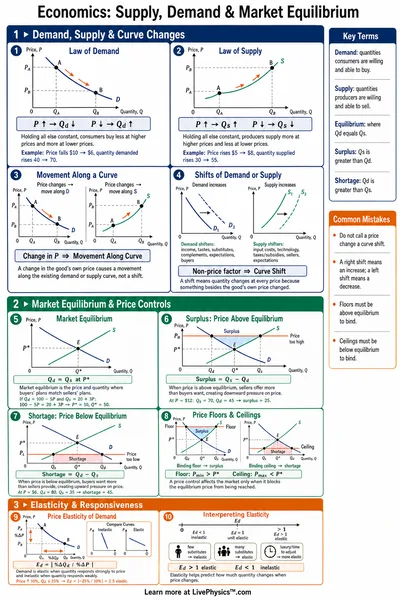
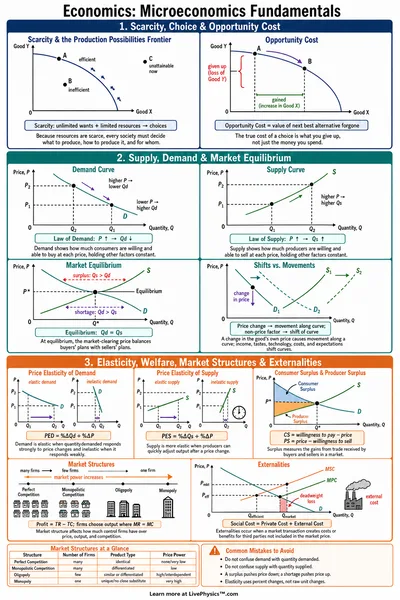
The law of supply states that, all else equal, as the price of a good rises, producers are willing to supply more of it. Higher prices make production more profitable, drawing in more sellers and encouraging existing ones to expand output.
On the graph, the supply curve slopes upward from left to right. A steeper slope means supply is less responsive to price changes (inelastic supply), while a flatter slope indicates more responsiveness (elastic supply).
The Law of Demand
The law of demand states that, all else equal, as the price of a good rises, consumers demand less of it. Higher prices make a good relatively more expensive compared to alternatives, so buyers purchase fewer units.
On the graph, the demand curve slopes downward. The demand intercept represents the maximum price any consumer is willing to pay. A steeper slope means demand is inelastic; a flatter slope means it is elastic.
Market Equilibrium
Market equilibrium is the price and quantity at which the quantity supplied equals the quantity demanded. At this point there is no tendency for prices to change, as the market "clears" with no surplus or shortage.
Mathematically, equilibrium is where the two curves intersect. If supply is P = a + bQ and demand is P = c - dQ, then
- Q* = (c - a) / (b + d)
- P* = (a x d + c x b) / (b + d)
Price Floors and Ceilings
A price floor is a government-imposed minimum price, such as a minimum wage. When a floor is set above equilibrium, it is binding and creates a surplus because quantity supplied exceeds quantity demanded at that price.
A price ceiling is a government-imposed maximum price, such as rent control. When a ceiling is set below equilibrium, it is binding and creates a shortage because quantity demanded exceeds quantity supplied at that price. Non-binding controls (floors below equilibrium or ceilings above it) have no effect.