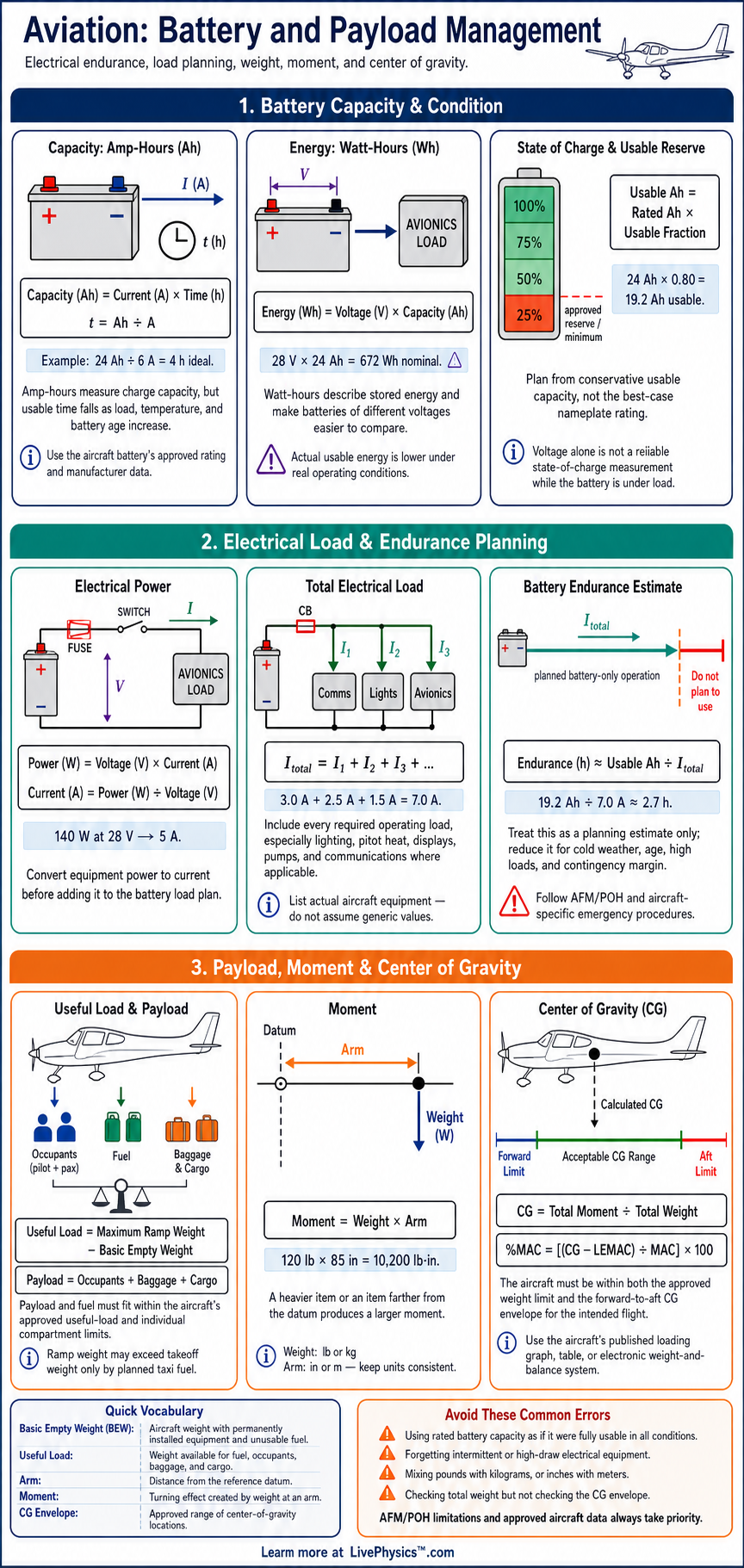
Battery and payload management helps pilots and operators keep an aircraft within safe operating limits. It applies to electric aircraft, drones, and any aircraft carrying equipment, cargo, or sensors. This cheat sheet helps students connect battery performance, aircraft mass, payload limits, and balance decisions.
Accurate planning improves safety, endurance, and flight performance.
Battery planning begins with voltage, current, capacity, energy, and power. Payload planning uses mass limits, useful load, and center of gravity limits. Every item added to an aircraft changes its total mass and may change its balance.
Students should calculate values carefully and leave a realistic safety reserve before flight.
Key Facts
- Battery energy in watt hours equals voltage in volts times capacity in ampere hours.
- Electrical power in watts equals voltage in volts times current in amperes.
- Estimated endurance in hours equals usable battery energy in watt hours divided by average power in watts.
- Usable battery energy equals rated battery energy times the planned usable fraction.
- Useful load equals maximum takeoff mass minus empty mass.
- Payload mass equals loaded mass minus the aircraft empty mass and required operating equipment mass.
- Moment equals mass times arm, where arm is the distance from the chosen reference point.
- Center of gravity position equals total moment divided by total mass and must remain within approved limits.
Vocabulary
- Capacity
- Capacity is the amount of electric charge a battery can supply, usually measured in ampere hours.
- Watt hour
- A watt hour is a unit of stored electrical energy equal to one watt of power used for one hour.
- Endurance
- Endurance is the maximum time an aircraft can remain airborne under stated conditions.
- Payload
- Payload is the cargo, equipment, sensors, or other carried items that support a mission.
- Useful load
- Useful load is the mass available for people, fuel or batteries, payload, and other variable items.
- Center of gravity
- The center of gravity is the point where an aircraft's total mass is considered to act.
Common Mistakes to Avoid
- Using the full rated battery capacity is unsafe because a battery reserve is needed for landing, unexpected wind, and battery protection.
- Calculating endurance from maximum power is inaccurate because aircraft power changes between takeoff, climb, cruise, hover, and descent.
- Adding a payload without checking maximum takeoff mass is wrong because the aircraft may exceed its structural or performance limits.
- Checking total mass but ignoring center of gravity is dangerous because a correctly loaded aircraft can still be out of balance.
- Moving a battery or camera without recalculating moments is unreliable because even a small position change can move the center of gravity outside its limits.
Practice Questions
- 1 A battery has a nominal voltage of 14.8 volts and a capacity of 6 ampere hours. Calculate its rated energy in watt hours.
- 2 An aircraft has a 444 watt hour battery and uses an average of 370 watts in flight. If only 80 percent of the battery energy is planned for use, calculate the estimated endurance in minutes.
- 3 An aircraft has a maximum takeoff mass of 12 kilograms and an empty mass of 7.4 kilograms. It carries a 1.1 kilogram battery and a 2.3 kilogram camera payload. Determine whether the loaded aircraft is within its maximum takeoff mass.
- 4 Explain why moving a battery farther forward can affect flight safety even when the total aircraft mass does not change.
Understanding Battery and Payload Management
A battery stores electrical energy, but its label does not guarantee that all listed energy is available in flight. Capacity is commonly given in ampere hours, while energy is more useful for endurance planning. Energy in watt hours equals voltage times capacity in ampere hours.
A battery rated at 22.2 volts and 5 ampere hours stores about 111 watt hours. Operators should use the nominal voltage for basic planning unless a manufacturer provides a more accurate usable energy value. Battery voltage falls under load, and cold conditions can reduce available capacity.
Power describes how quickly the aircraft uses energy. Power in watts equals voltage times current in amperes. Endurance in hours equals usable battery energy in watt hours divided by average power in watts.
Average power is important because takeoff, climb, hovering, and strong winds usually need more power than level cruise. A sensible plan uses a battery reserve rather than assuming the battery can be fully discharged. For example, planning to use only 80 percent of a battery's rated energy protects the battery and provides time for a safe landing.
Payload includes every item carried beyond the basic aircraft configuration. Cameras, cargo, sensors, release mechanisms, and extra batteries all count as payload. The loaded mass must remain at or below the maximum takeoff mass.
Useful load equals maximum takeoff mass minus empty mass. A heavier aircraft needs more lift, which commonly requires more power. This can shorten endurance, increase takeoff distance, reduce climb performance, and make handling less responsive.
Payload limits are therefore not only structural limits. They also affect the aircraft's practical flight performance.
Balance matters as much as total mass. Each item creates a moment around a chosen reference point. Moment equals mass times arm, where arm is the distance from the reference point.
The center of gravity position equals total moment divided by total mass. The final center of gravity must stay within the approved forward and aft limits. A forward center of gravity can make the aircraft harder to pitch up and may increase stall speed.
An aft center of gravity can reduce stability and make recovery from a stall more difficult. Students should record each item, its mass, and its location before calculating totals.
Good battery and payload management is a repeatable preflight process. Inspect batteries for damage, swelling, heat, loose connectors, and correct charge level. Confirm that the aircraft mass, center of gravity, and expected power use meet the flight plan.
Consider wind, temperature, route length, alternate landing areas, and the power required for the mission equipment. Recheck calculations after changing a camera, cargo item, or battery position. Small changes can create a large effect when the aircraft is close to its mass, balance, or endurance limit.