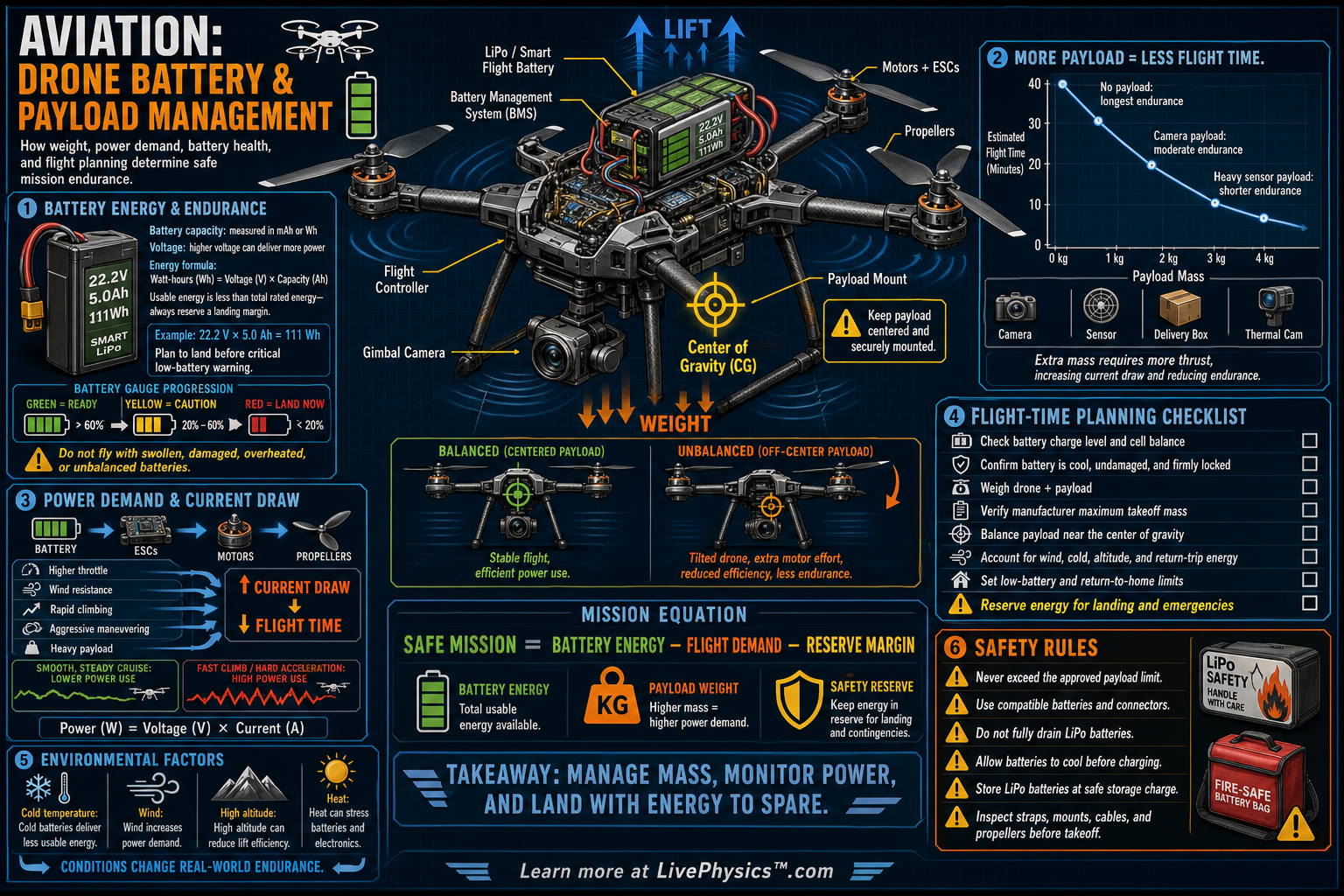
A drone can only fly safely when its battery, motors, and payload are managed as one system. The battery supplies limited electrical energy, while a camera, sensor, or package adds mass that the motors must lift. Poor planning can shorten flight time, reduce stability, and leave too little reserve for landing.
For pilots, knowing these limits prevents damaged equipment and unsafe flights.
Payload placement matters as much as payload mass. A load mounted near the drone's center of gravity keeps each motor working more evenly and helps the flight controller hold a steady attitude. Batteries must be secured, monitored, and protected from excessive discharge.
These ideas appear in aerial photography, surveying, delivery tests, emergency response, and engineering design.
Understanding Aviation, Drone Battery and Payload Management
A multicopter stays airborne by producing upward thrust with its propellers. Each motor draws electrical power from the battery, and the flight controller constantly changes motor speeds to control roll, pitch, yaw, and altitude. Hover occurs when total upward thrust matches the drone's weight.
Adding a payload raises that weight, so the motors must spin faster to hover. Faster motors draw more current, which drains the battery sooner and creates more heat in the motors and electronic speed controllers.
Battery capacity is commonly measured in milliamp hours. This value describes how much electric charge a battery can deliver under stated conditions. A larger capacity can extend flight time, though it usually adds mass.
Battery voltage affects motor speed and available power. Lithium polymer packs contain cells connected in series, so a higher cell count gives a higher voltage.
The battery discharge rating indicates the maximum current the pack can safely provide. A pack with too low a discharge rating can overheat, swell, or suffer a large voltage drop when the drone accelerates.
Payload management begins with a mass budget. The pilot or engineer lists the drone frame, battery, camera, gimbal, sensors, mounting hardware, and any carried item. The total must remain below the manufacturer flight weight limit.
That limit is not a target for routine flights. A drone needs thrust reserve to climb, resist wind, brake, and return safely.
Payloads should sit close to the center of gravity. A forward or side offset forces the flight controller to compensate continuously, increasing power use and making handling less predictable.
Flight time estimates need a safety margin. Wind, cold weather, rapid climbing, and aggressive turns raise current draw beyond a calm hover estimate. Cold batteries have greater internal resistance and may show a sudden voltage drop under load.
Pilots should inspect battery condition before flight, confirm that the pack is fully locked in place, and set a conservative low battery warning. They should land with enough energy for an unexpected delay rather than trying to use every remaining percent. Battery logs can reveal declining capacity or repeated overheating over many flights.
Students can model these tradeoffs with simple measurements. Measure the mass of each component and compare several payload choices. Record hover current using flight telemetry, then calculate an approximate flight duration from usable battery capacity divided by average current.
Treat the result as an estimate, not a guarantee. Focus on the connection between mass, thrust, current, voltage, temperature, and center of gravity. Good drone operation comes from planning the entire energy and load system before takeoff.
Key Facts
- Hover occurs when total thrust equals the total weight of the drone.
- Weight = mass × gravitational acceleration.
- Electrical power = voltage × current.
- Estimated flight time = usable battery capacity ÷ average current draw.
- A heavier payload increases the thrust required for hover and usually increases current draw.
- Keep the payload center of mass close to the drone center of gravity to reduce control effort.
Vocabulary
- Payload
- A payload is equipment or cargo carried by a drone, such as a camera, sensor, or package.
- Center of gravity
- The center of gravity is the balance point where the total weight of an object effectively acts.
- Thrust
- Thrust is the upward force produced by drone propellers that lifts the aircraft.
- Battery capacity
- Battery capacity is the amount of electric charge a battery can store and deliver, often measured in milliamp hours.
- Discharge rating
- A discharge rating states how much current a battery can safely deliver without excessive heating or damage.
Common Mistakes to Avoid
- Flying until the battery is nearly empty is unsafe because wind, detours, or a missed landing approach can require extra energy. Land with a planned reserve rather than trusting the final battery percentage.
- Choosing a battery only by its capacity ignores battery mass and discharge rating. A larger pack may increase flight time, but it can reduce performance if its added weight is too great.
- Mounting a camera or sensor far from the center of gravity creates an unbalanced drone. Move the payload closer to the center and check balance before flight.
- Using a damaged, swollen, or unusually hot battery risks power loss and fire. Remove the pack from service and inspect it according to the manufacturer guidance.
Practice Questions
- 1 A drone has a usable battery capacity of 4,000 mAh and draws an average current of 8 A in hover. Calculate its estimated hover time in minutes.
- 2 A drone weighs 1.8 kg without payload and can produce a maximum total thrust of 3.0 kg equivalent. Determine the greatest payload mass that reaches this thrust limit, then explain why a pilot should choose a smaller payload.
- 3 Explain why a camera mounted far in front of a drone can reduce flight time and make the drone harder to control.