Tower Stability Lab
Stack blocks of different widths, observe how the center of mass shifts, and find the tipping point. Add an earthquake force to test how horizontal loads challenge even a well-balanced structure.
Guided Experiment Stability Investigation
If you shift the upper blocks further from center, at what point do you predict the tower will tip?
Write your hypothesis in the Lab Report panel, then click Next.
Tower View
Stability
Tower is balanced. Center of mass is within the base footprint.
Controls
Earthquake Simulator
Applies horizontal force. Click Run to oscillate sinusoidally.
Data Table
(0 rows)| # | Trial | Block Count | Tower Height(units) | Base Width(units) | CoM Offset(units) | Earthquake Force | Result |
|---|
Reference Guide
Center of Mass
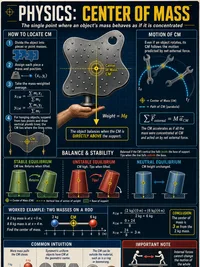
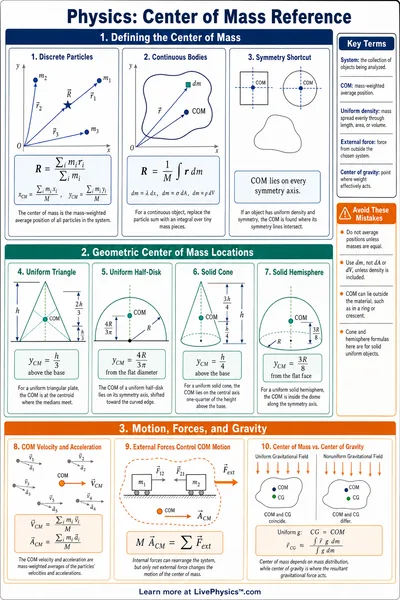
The center of mass (CoM) is the average position of all mass in the tower, weighted by how much mass is at each location.
Each block has mass proportional to its width (uniform density, equal height). A wider block near the edge pulls the CoM further from center.
Stability Condition
A tower is stable as long as the center of mass lies directly above the base footprint. It tips when the CoM moves past the base edge.
The stability margin shows how close the CoM is to the edge as a percentage. 100% is perfectly centered; 0% means the tower is at the tipping point.
Earthquake Engineering
Earthquakes apply horizontal forces to structures. In this lab, the earthquake adds an effective displacement to the CoM proportional to the force and tower height.
Taller towers amplify the earthquake effect. Real engineers use wide bases, base isolators, and mass dampers to counteract this.
Real-World Applications
The same physics governs skyscrapers, bridges, and cranes. Engineers keep the CoM low and centered to maximize stability.
- Wide bases resist overturning moments
- Counterweights shift the CoM back toward center
- Base isolation decouples a building from ground motion
- Tuned mass dampers absorb oscillation energy