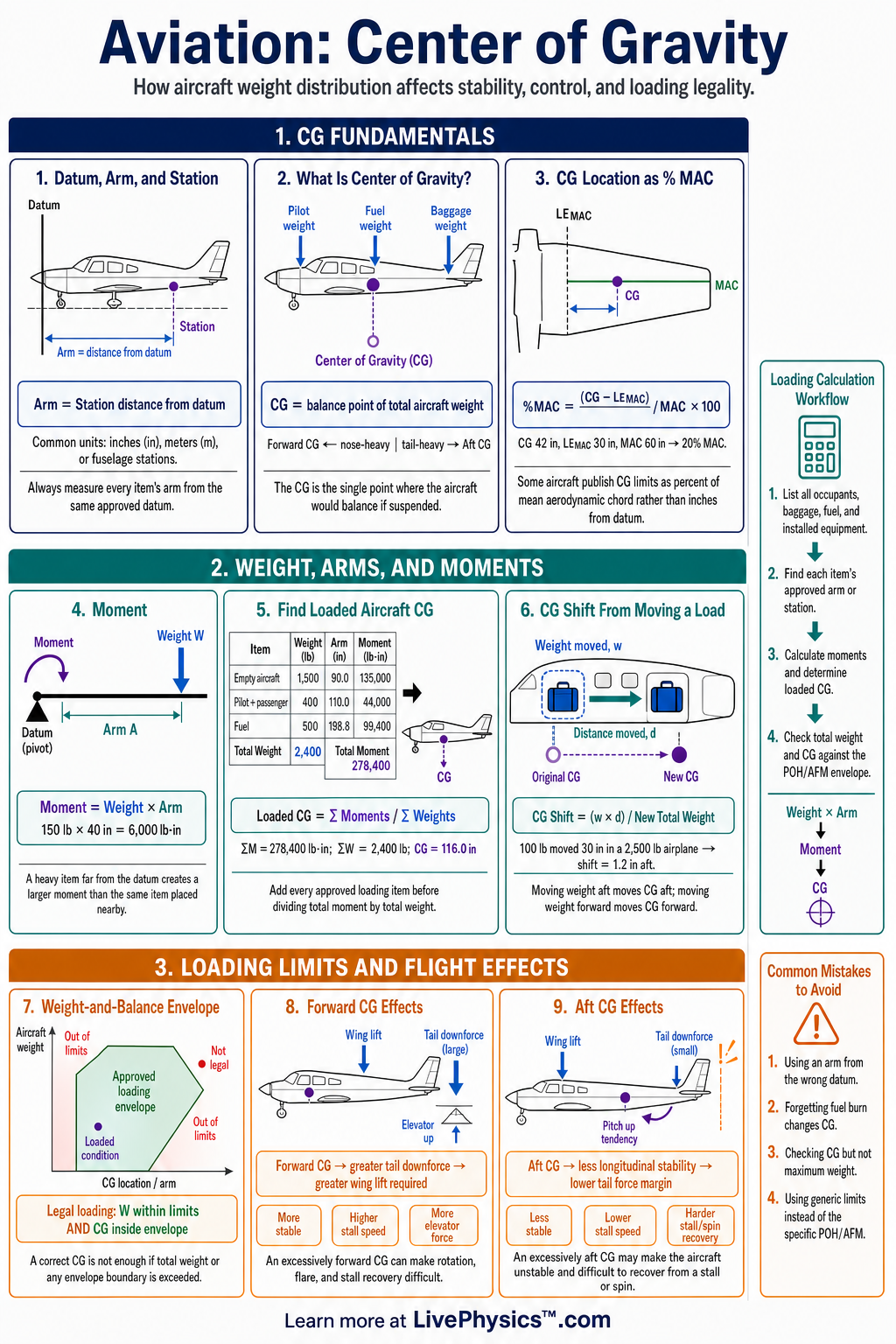
Aviation center of gravity, or CG, is the balance point where an aircraft’s total weight is considered to act. Pilots must calculate it before flight because loading people, baggage, fuel, and cargo changes aircraft balance. A CG outside the approved range can make the aircraft difficult or unsafe to control.
This cheat sheet organizes the essential terms, formulas, limits, and flight effects used in weight and balance work.
Every item in an aircraft has a weight and an arm, which is its distance from a chosen reference point called the datum. Multiplying weight by arm gives a moment. Adding all weights and all moments allows the loaded CG to be found by dividing total moment by total weight.
The final result must be within the aircraft’s approved CG envelope and must not exceed any weight limit.
Key Facts
- An aircraft center of gravity is found using CG equals total moment divided by total weight.
- Moment equals weight times arm.
- The arm is the distance from the datum to the location of an item.
- Total weight equals the sum of the empty weight, occupants, fuel, baggage, cargo, and installed equipment.
- A loaded aircraft must remain below its maximum allowable weight and within its approved CG envelope.
- Moving a weight aft increases its aft moment and usually moves the CG aft.
- A forward CG usually increases stability but can reduce elevator authority during rotation and landing flare.
- An aft CG reduces longitudinal stability and can make stall and spin recovery more difficult.
Vocabulary
- Center of gravity
- The point at which an aircraft’s entire weight is considered to act.
- Datum
- A manufacturer-selected reference plane from which arms are measured.
- Arm
- The horizontal distance from the datum to an item’s location in the aircraft.
- Moment
- The turning effect of a weight, calculated by multiplying the weight by its arm.
- CG envelope
- The approved chart or set of limits showing allowable CG positions at specified aircraft weights.
- Useful load
- The weight available for fuel, occupants, baggage, cargo, and other loadable items after empty weight.
Common Mistakes to Avoid
- Using the wrong arm for a seat or baggage station produces an incorrect moment and can place the calculated CG in the wrong location.
- Adding moments that are listed in thousands as if they were full moments gives a result that is off by a factor of one thousand.
- Checking only total weight is wrong because an aircraft can be under its maximum weight but still outside its approved CG limits.
- Forgetting to account for fuel burn is unsafe because the CG may move outside limits before the aircraft reaches its destination.
- Using data from a different aircraft is incorrect because empty weight, equipment, arms, and CG limits can vary between aircraft of the same model.
Practice Questions
- 1 A 170 pound passenger sits at an arm of 85 inches. Calculate the passenger’s moment.
- 2 An aircraft has a total weight of 2,400 pounds and a total moment of 216,000 pound-inches. Calculate the loaded CG arm.
- 3 An aircraft weighs 2,100 pounds with a moment of 176,400 pound-inches. A 60 pound bag is loaded at an arm of 150 inches. Calculate the new total weight, total moment, and CG arm.
- 4 Explain why an aft CG can be more hazardous than a forward CG during a stall or spin recovery.
Understanding Center of Gravity
The datum is a fixed reference plane selected by the aircraft manufacturer. It may be located at the propeller, ahead of the nose, or at another convenient position. Each station in the loading schedule has an arm measured from this datum.
Arms behind the datum are commonly positive, while arms ahead of it may be negative. Students should always follow the sign convention printed in the specific aircraft records.
A moment describes the turning effect produced by a weight at a distance from the datum. Moment equals weight times arm. A heavy item far from the datum creates a larger moment than the same item close to it.
This is why a small bag in an aft baggage area can significantly shift CG. Weight and balance tables may list moments directly or list moments divided by one thousand. The table heading must be checked before adding values.
To calculate loaded CG, list every loaded item. Include empty aircraft weight, usable fuel, occupants, baggage, cargo, and installed equipment. Find the moment for each item, then add the weights and moments separately.
CG equals total moment divided by total weight. Compare both the total weight and CG location with the approved limits for the planned flight condition. Many aircraft have different limits at different weights, so a single forward or aft number is not always enough.
Fuel burn can move the CG during flight. The direction depends on where the fuel tanks sit relative to the aircraft CG. A pilot must consider takeoff, landing, and sometimes zero fuel conditions.
Loading also affects performance. A forward CG generally increases longitudinal stability but requires more tail downforce and may raise stall speed. An aft CG can reduce stability and make pitch changes stronger, especially during stalls, spins, and recovery.
Weight and balance work appears in flight training, dispatch, cargo operations, and aircraft maintenance. It is also used when equipment is added or removed from an aircraft. The most important study habits are careful unit checking, accurate arithmetic, and use of the correct aircraft-specific handbook.
Never rely on a generic example when preparing an actual flight. The approved pilot operating handbook, weight and balance report, and loading graph are the controlling sources.