Balanced Forces Lab
Drop up to four forces on an object at any angle, change the mass, and see whether the forces balance to zero or push the object into acceleration. A high school take on Newton's First Law with full vector decomposition.
Guided Experiment When Is an Object in Equilibrium?
What conditions on the forces acting on an object must be satisfied for the object to remain at rest or move at constant velocity (Newton's First Law)?
Write your hypothesis in the Lab Report panel, then click Next.
Force Diagram
Forces balance, net F ≈ 0 (Newton's First Law, equilibrium)
Net Force Analysis
Data Table
(0 rows)| # | Trial | Forces | Mass(kg) | Net Fx(N) | Net Fy(N) | Net F(N) | Net θ(°) | a(m/s²) | Equilibrium? |
|---|
Reference Guide
Newton's First Law
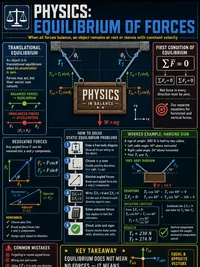
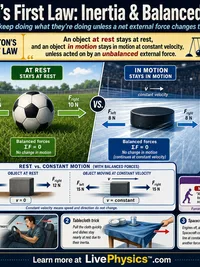
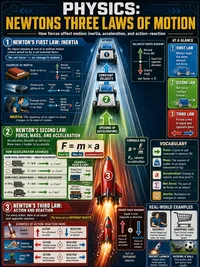
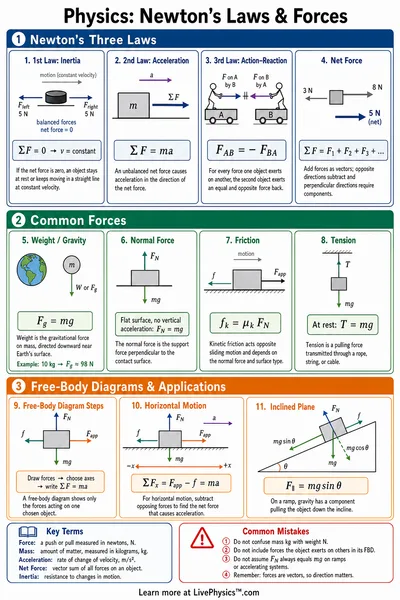
Newton's First Law says an object at rest stays at rest and an object in motion stays in motion at constant velocity unless an unbalanced force acts on it. The condition is that the vector sum of all forces is zero.
In two dimensions, equilibrium requires both the x and y components of the total force to be zero. If either component is non-zero, the object accelerates in that direction.
Force Components
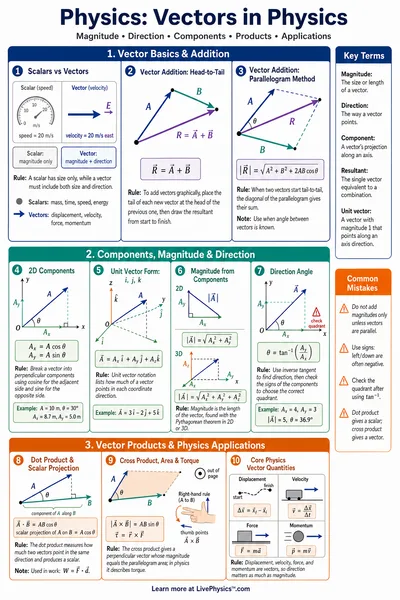
Any force at angle θ can be broken into a horizontal component F cos θ and a vertical component F sin θ. The net x and y components are found by summing each force's components.
The total net force is the vector sum of those component sums, and its magnitude follows the Pythagorean theorem.
Inertia and Mass
Inertia is an object's resistance to changes in motion. Mass is the quantitative measure of inertia. A more massive object requires a larger net force to produce the same acceleration.
Mass does not change whether an object is in equilibrium. If the forces balance, any mass stays at rest. If the forces are unbalanced, mass only changes the acceleration.
Solving Equilibrium Problems
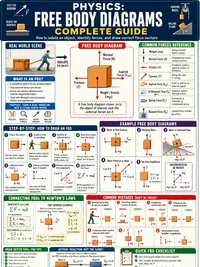
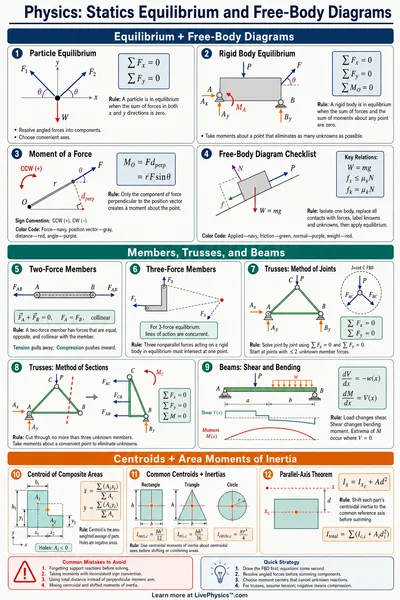
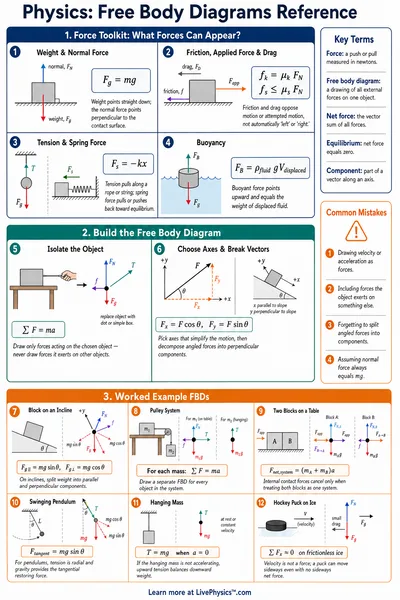
The standard workflow is to draw a free body diagram, choose x and y axes, decompose each force into components, sum the components, and set both sums to zero for equilibrium.
This lab automates the algebra so you can build intuition for which arrangements of forces produce equilibrium and which produce specific accelerations.