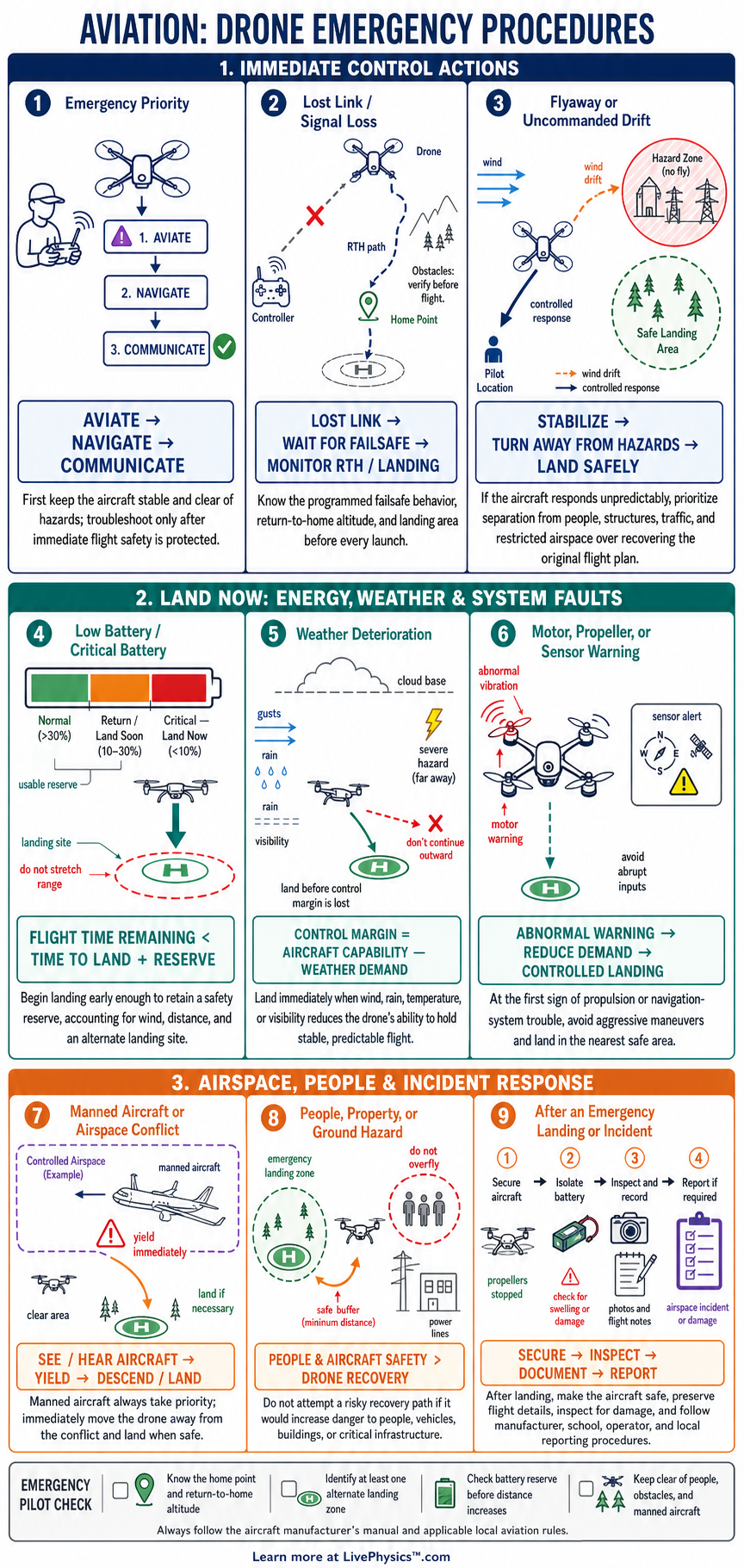
Drone emergencies require fast decisions that protect people, property, and other airspace users. This cheat sheet gives pilots a clear order of actions for common failures, including low battery, lost signal, flyaways, weather changes, and crashes. It helps students move from panic to a controlled response.
It also reinforces the need to follow local aviation rules and the aircraft manufacturer’s procedures.
The central safety priority is to prevent injury and avoid creating a greater hazard. Pilots should maintain visual observation when possible, use the emergency procedure built into the drone, and choose a safe landing area. Return to home settings, battery limits, and lost-link behavior must be checked before every flight.
After an incident, the pilot should secure the aircraft, record key details, and report the event when required.
Key Facts
- The emergency priority order is protect people, avoid other aircraft and hazards, then protect the drone.
- Return to home altitude should be set above known obstacles on the planned route while remaining within applicable flight limits.
- When a low battery warning occurs, end the mission and land as soon as practical in a safe area.
- When a critical battery warning occurs, land immediately in the nearest safe clear location.
- Lost-link behavior can be hover, land, or return to home, so the selected failsafe action must be checked before takeoff.
- Usable flight time decreases when wind is strong, temperature is low, payload is heavy, or the battery is old.
- After a crash, keep clear of damaged lithium batteries and do not fly the aircraft again until it is inspected.
- An incident record should include the time, location, weather, battery status, warnings, aircraft settings, and observed damage.
Vocabulary
- Return to home
- An automated function that directs a drone to return to its recorded home point or begin a programmed landing action.
- Failsafe
- A preselected automatic action that a drone performs when it loses a signal or detects a serious problem.
- Lost link
- A condition in which the controller and drone can no longer communicate reliably.
- Flyaway
- An event in which a drone moves unexpectedly or cannot be controlled as intended by the pilot.
- Home point
- The recorded location that a drone uses as its destination during a return to home procedure.
- Critical battery
- A battery state in which remaining power is too low for normal flight and immediate landing is needed.
Common Mistakes to Avoid
- Flying toward the launch point after a critical battery warning is wrong because the drone may run out of power before reaching it. Land in the nearest safe clear area instead.
- Setting return to home altitude below trees, wires, or buildings is wrong because the automated route can cause a collision. Check obstacle heights before each flight.
- Assuming every lost-link event will return the drone home is wrong because some drones are set to hover or land. Verify the failsafe setting before takeoff.
- Chasing a flyaway into a road or restricted area is wrong because it creates a second emergency for the pilot. Maintain personal safety and alert others when needed.
- Restarting a drone immediately after a crash is wrong because hidden damage or a damaged battery can cause another failure or fire. Inspect and document the aircraft first.
Practice Questions
- 1 A drone has a return to home altitude of 45 meters, but a nearby building is 52 meters high. What should the pilot change before takeoff?
- 2 A drone normally flies for 24 minutes, but cold weather reduces usable flight time by 25 percent. How many minutes of usable flight time should the pilot plan for?
- 3 During flight, a critical battery warning appears while the drone is 300 meters from its launch point and a clear field is 40 meters away. What action should the pilot take?
- 4 A drone loses controller signal and begins returning toward a home point that was recorded incorrectly near a busy road. Explain the pilot's main safety priorities if control is regained.
Understanding Drone Emergency Procedures
An emergency response begins before takeoff. A pilot should set a suitable return to home altitude, confirm the home point, inspect the propellers, and make sure the controller and aircraft batteries are charged. The return altitude must clear nearby trees, buildings, wires, and terrain.
It must also remain suitable for local airspace limits. A well planned preflight check prevents many emergencies from becoming serious events.
When a warning appears, the pilot should first identify the hazard and avoid abrupt control inputs. For a low battery warning, the safest action is usually to stop the planned mission and land as soon as practical. A critical battery warning needs immediate landing in the nearest safe clear area.
Continuing toward a distant launch point can cause the drone to descend before it arrives. Wind, cold temperatures, payload weight, and battery age can all reduce the usable flight time.
Lost-link events happen when the controller cannot communicate with the drone. The pilot should stay calm, keep watching the aircraft if it remains visible, and allow the programmed failsafe action to operate. Depending on its settings, the drone may hover, land, or return to home.
The pilot must not assume return to home is safe if the route crosses obstacles or if the home point is wrong. If control returns, the pilot should cancel automated movement only when a safer action is available.
A flyaway is uncontrolled movement caused by wind, incorrect settings, compass problems, sensor errors, or a control issue. The pilot should maintain visual contact and use only actions recommended for that aircraft model. If the drone is drifting, moving toward people, or entering unsafe airspace, the priority is to reduce harm rather than save the aircraft.
Pilots should never chase a drone into roads, restricted areas, or dangerous terrain. They should warn people nearby and contact relevant authorities if the aircraft may endanger others.
After a crash or hard landing, switch off the aircraft if it is safe to do so and keep people clear of damaged batteries. A swollen, hot, leaking, or smoking lithium battery can start a fire. Do not fly again until the drone has been inspected.
Record the time, location, weather, warnings, flight settings, and any damage. Reviewing these facts helps identify the cause and supports any required safety report.