Uniform Circular Motion & Centripetal Force Calculator
Set the mass, radius, and speed of an object moving in a circle and the calculator finds its centripetal acceleration and force, along with the period, frequency, and angular velocity. It also gives the ideal banking angle for a curve and the minimum speed needed at the top of a vertical loop.
Motion Diagram
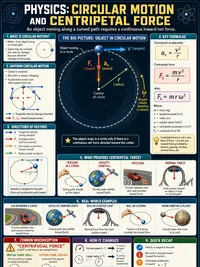
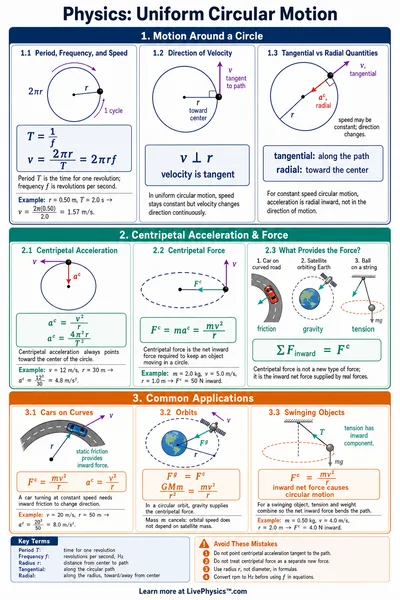
The velocity v stays tangent to the path; the centripetal force F_c always points toward the center.
Inputs
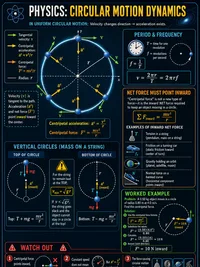
Speed, period, and frequency are linked by T = 2 π r / v and f = 1 / T.
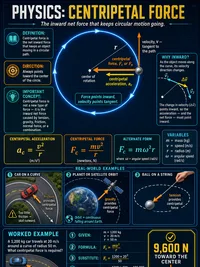
A 1000 kg car taking a 50 m radius bend at 20 m/s (about 72 km/h).
Results
The Physics of Circular Motion
What centripetal force is
An object moving in a circle at constant speed is still accelerating, because the direction of its velocity changes all the time. The acceleration, and the net force that causes it, always point toward the center of the circle. This inward force is called the centripetal force. It is not a new kind of force on its own. It is supplied by whatever physically pulls the object inward, such as tension in a string, friction between tires and road, or gravity.
Acceleration and force
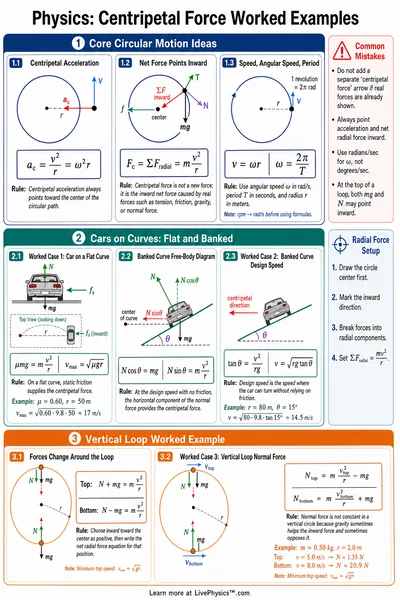
The centripetal acceleration is a = v² / r, where v is the speed and r is the radius of the circle. By Newton's second law, the centripetal force is F = m a = m v² / r. Doubling the speed quadruples both the acceleration and the force, while a larger radius reduces them. The velocity vector stays tangent to the path while the force vector stays perpendicular to it, pointing inward.
Period, frequency, and angular velocity
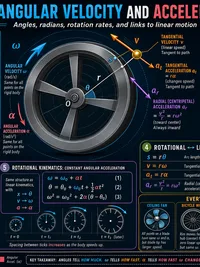
The period T is the time for one full revolution, T = 2 π r / v. The frequency f is the number of revolutions per second, f = 1 / T, measured in hertz. The angular velocity ω describes how fast the angle sweeps around, ω = v / r, measured in radians per second. These three quantities are all linked, so setting any one of them fixes the others for a given radius.
Banked curves and vertical loops
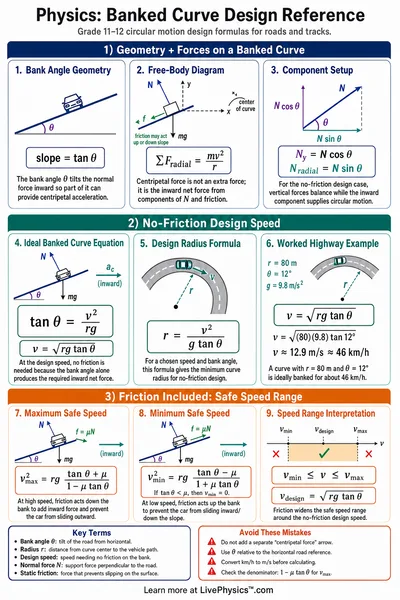
On a frictionless banked curve, the horizontal component of the normal force provides the centripetal force, giving the ideal banking angle tan θ = v² / (r g). At that angle a car needs no friction to round the curve at speed v. At the top of a vertical circle, gravity alone can supply the centripetal force, so the minimum speed to maintain contact is v_min = √(g r). Below that speed the object would fall away from the track.