Aircraft Lift Explorer
Vary angle of attack, airspeed, wing area, air density, camber, and thickness on a NACA 4-digit airfoil. Watch lift and drag forces shift in real time, trace the lift coefficient curve, and find the stall point.
Flight Conditions
Airfoil Shape
Forces and Coefficients
Reference Guide
The lift equation
- L. Lift force in newtons.
- ρ. Air density in kg/m³. Drops with altitude.
- v. True airspeed in m/s.
- S. Wing planform area in m².
- C_L. Lift coefficient. Captures the airfoil shape and angle of attack.
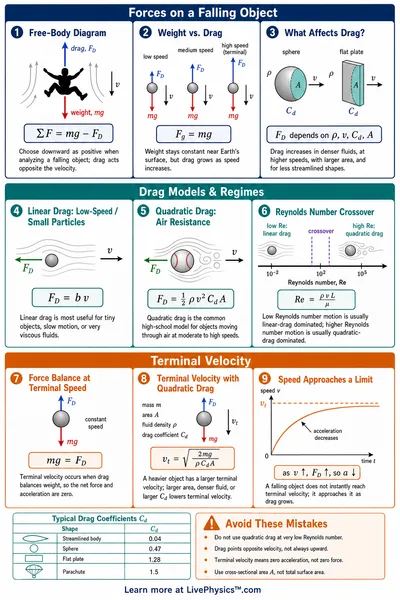
Drag follows the same form with C_D in place of C_L. Doubling airspeed quadruples both forces because lift and drag scale with v squared.
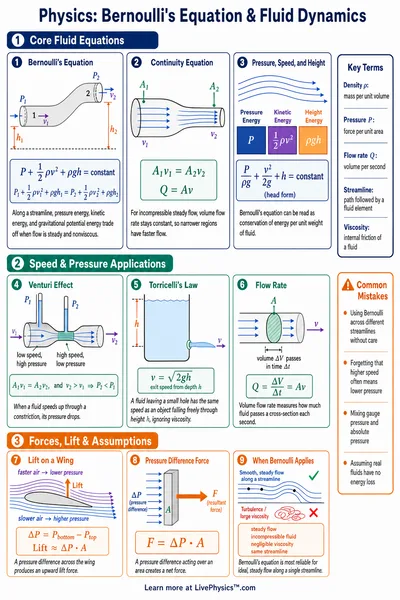
Bernoulli and pressure difference
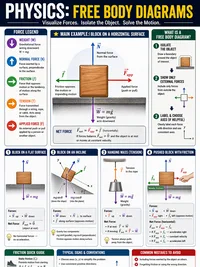
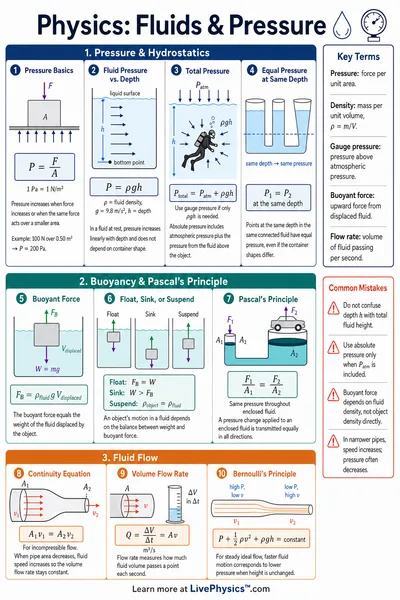
A cambered or tilted airfoil accelerates air over the top surface, lowering pressure there. Higher pressure on the lower surface pushes the wing up. Most teaching uses Bernoulli for intuition. The full picture also requires Newton's third law, because the wing turns the airflow downward.
Try this. Set α to 0° on a symmetric airfoil (camber 0). Lift drops to roughly zero. Add a few percent camber and lift returns even at zero angle of attack.
Angle of attack and the linear region
In the linear region thin-airfoil theory predicts a slope of 2π per radian, or about 0.11 per degree. α is the geometric angle between the chord line and the free-stream flow. α₀ is the zero-lift angle, which shifts negative for cambered airfoils.
The simulator plots C_L over a useful range of α. The marker tracks your current setting so you can see how each slider moves the operating point along the curve.
Stall
Beyond about 14° to 16° of angle of attack the boundary layer separates from the upper surface. Lift drops sharply and drag shoots up. This is the stall.
Cambered airfoils generally reach a slightly higher peak C_L and stall at a slightly larger geometric angle. Real wings also use slats, slots, and flaps to delay stall and increase C_L_max for takeoff and landing.
Try this. Push α past 15°. The streamlines above the airfoil break up, the lift arrow shrinks, and the drag arrow grows.
The drag polar
- C_D0. Parasite drag at zero lift. About 0.02 for a clean airfoil.
- k. Induced drag factor. Smaller is better. Long thin wings have low k.
- C_L². Why induced drag rises fast as you pull more lift. Slow flight is expensive.
The drag polar plots C_L on the vertical axis against C_D on the horizontal axis. The tangent from the origin to the curve touches at the maximum L/D point. That is the most efficient cruise condition.
Best L/D and how aircraft use it
| Aircraft | Typical max L/D | Note |
|---|---|---|
| High-performance glider | 50 to 70 | Long thin wing, low k |
| Airliner cruise | 17 to 22 | Boeing 747, A320 class |
| General aviation | 10 to 14 | Cessna 172 family |
| Fighter (subsonic) | 8 to 12 | Lower wingspan, more parasite drag |
Best L/D angle of attack is the most fuel-efficient cruise point and the best glide angle when the engine quits. Pilots memorize the airspeed that corresponds to it on their aircraft.
Try these experiments
1. Find best L/D
Sweep α from 0° to 12° and watch the L/D plot. Note the angle that maximizes L/D for your camber and thickness.
2. Effect of altitude
Click each altitude preset. Lift drops as density falls. Pilots fly faster at altitude to maintain the same lift.
3. Cambered vs symmetric
Compare camber 0 against camber 4 at α = 0. Cambered airfoils generate lift even with no angle of attack.