Understanding Pressure in Fluids Lab
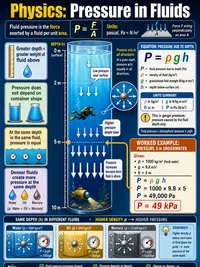
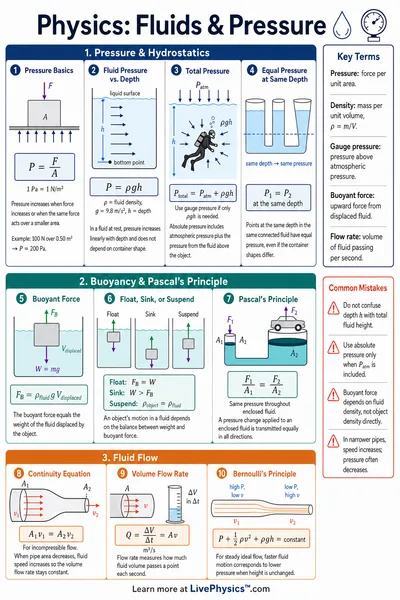
Pressure in a resting fluid comes from the weight of all the fluid above a point. Each thin layer pulls downward because gravity acts on its mass. The layers below support that weight, so pressure rises steadily as depth increases.
This is why a swimmer feels stronger pressure on their ears near the bottom of a pool than near the surface. It is not caused by the shape of the container. A narrow pipe and a wide tank give the same pressure at equal depth when they contain the same fluid.
Density controls how much pressure each metre of depth adds. Mercury has far more mass in the same volume than water, so its pressure rises much faster with depth. Oil is less dense than water, so an equal column of oil produces less pressure.
The calculation uses pressure equals density times gravitational field strength times depth. This relationship is useful when checking whether a result makes sense.
Doubling the depth doubles the gauge pressure, while using a fluid with twice the density doubles it too. Gravitational field strength changes slightly from place to place, but school calculations usually use a value close to ten newtons per kilogram.
A U tube manometer turns a pressure difference into a height difference. If one side experiences greater pressure, it pushes the manometer liquid down on that side and up on the other. The difference between the liquid levels shows the pressure difference, not necessarily the pressure at one point by itself.
A dense manometer liquid needs only a small height difference to measure a large pressure difference. This is one reason mercury was widely used in older instruments. Modern equipment often uses safer liquids or electronic sensors because mercury is toxic.
Gauge pressure is measured relative to the surrounding air pressure. At the free surface of an open container, gauge pressure is zero even though air is still pressing on the liquid. Absolute pressure includes the atmospheric pressure above the liquid, so it is larger by that amount.
This distinction matters in weather reports, tyre gauges, diving, sealed containers, and vacuum systems. When reading values in different units, focus first on whether the value is gauge or absolute.
Unit conversion changes the number and its label, but it does not change the physical pressure. In lab work, record the fluid, depth, reference pressure, and unit before comparing measurements.