Understanding Hydraulics & Pascal's Law Lab
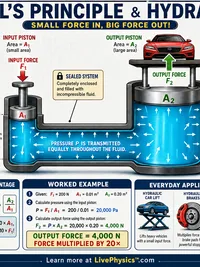
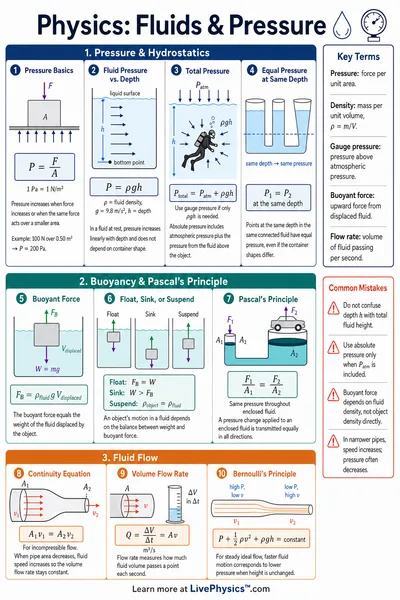
A hydraulic device works best when its fluid is nearly incompressible. When one piston pushes on oil or water, the particles have very little room to move closer together.
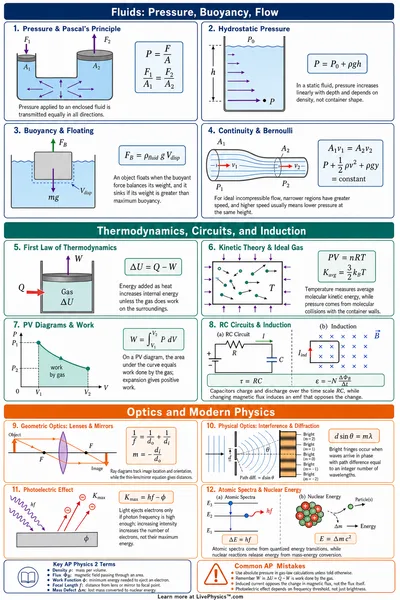
That push creates pressure throughout the connected fluid. Pressure is force spread over an area, so a small input force can create high pressure when it acts on a small piston.
The receiving piston can produce a larger force if it has a larger area. For example, if the output piston has ten times the area of the input piston, it can exert ten times the force.
This does not create free energy. The small piston must move ten times farther than the large piston moves, so the work put in is close to the work delivered out.
Real machines lose some energy through friction, fluid resistance, and tiny leaks. Seals around pistons are important because escaping fluid lowers pressure and can make a lift drift downward.
Air bubbles cause another problem because air compresses much more than liquid. A spongy brake pedal can be a sign that air has entered a brake line, reducing the direct transfer of force.
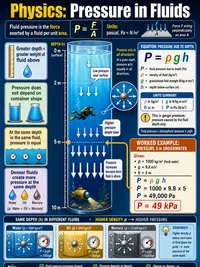
Pressure in a still liquid increases with depth because deeper layers support the weight of liquid above them. The pressure change depends on the liquid density, gravitational field strength, and vertical depth.
Water produces a noticeable increase in pressure even over a few metres. Divers feel this in their ears, while engineers account for it when designing dams, aquariums, and underwater pipes.
A dam is thicker near its base because the water pushes harder there than near the surface. This is why a container of water can push strongly sideways on a wall even when the water is not moving.
The shape of a container does not determine pressure at a given depth. A wide tank and a narrow tank give the same pressure at the same depth if they hold the same liquid.
Hydraulic brakes show why pressure transmission matters for safety. A driver presses a pedal connected to a small master cylinder, which raises fluid pressure in sealed lines.
That pressure reaches larger pistons at the wheels, where brake pads clamp the rotating discs. The system gives the driver enough braking force without requiring an impossibly hard push on the pedal.
Hydraulic excavators use the same idea in cylinders that move arms, buckets, and booms. A pump supplies pressurised oil, while control valves send it to selected cylinders.
The oil can push a piston in one direction or the other depending on which side receives the higher pressure. This allows heavy loads to be moved smoothly with precise control.
When solving problems, keep force, pressure, and area clearly separate. Force is measured in newtons, while pressure is measured in pascals, meaning newtons per square metre.
A common error is to compare piston diameters when the calculation needs areas. Since circular area depends on diameter squared, doubling a diameter makes the area four times larger.
Drawings can help reveal what a calculation means physically. Mark the input piston, output piston, fluid, and directions of motion before choosing numbers.
Then check whether the answer makes sense. A larger output force should come with a smaller output distance, and greater depth should give greater liquid pressure.
Hydraulic equipment can be dangerous because high pressure can lift vehicles or rupture damaged hoses. Never rely only on a hydraulic jack when working beneath a car, since a leak or valve failure can lower it.
Solid support stands carry the load safely. Understanding the physics helps students see that pressure is not just a number, but a force effect that must be controlled.