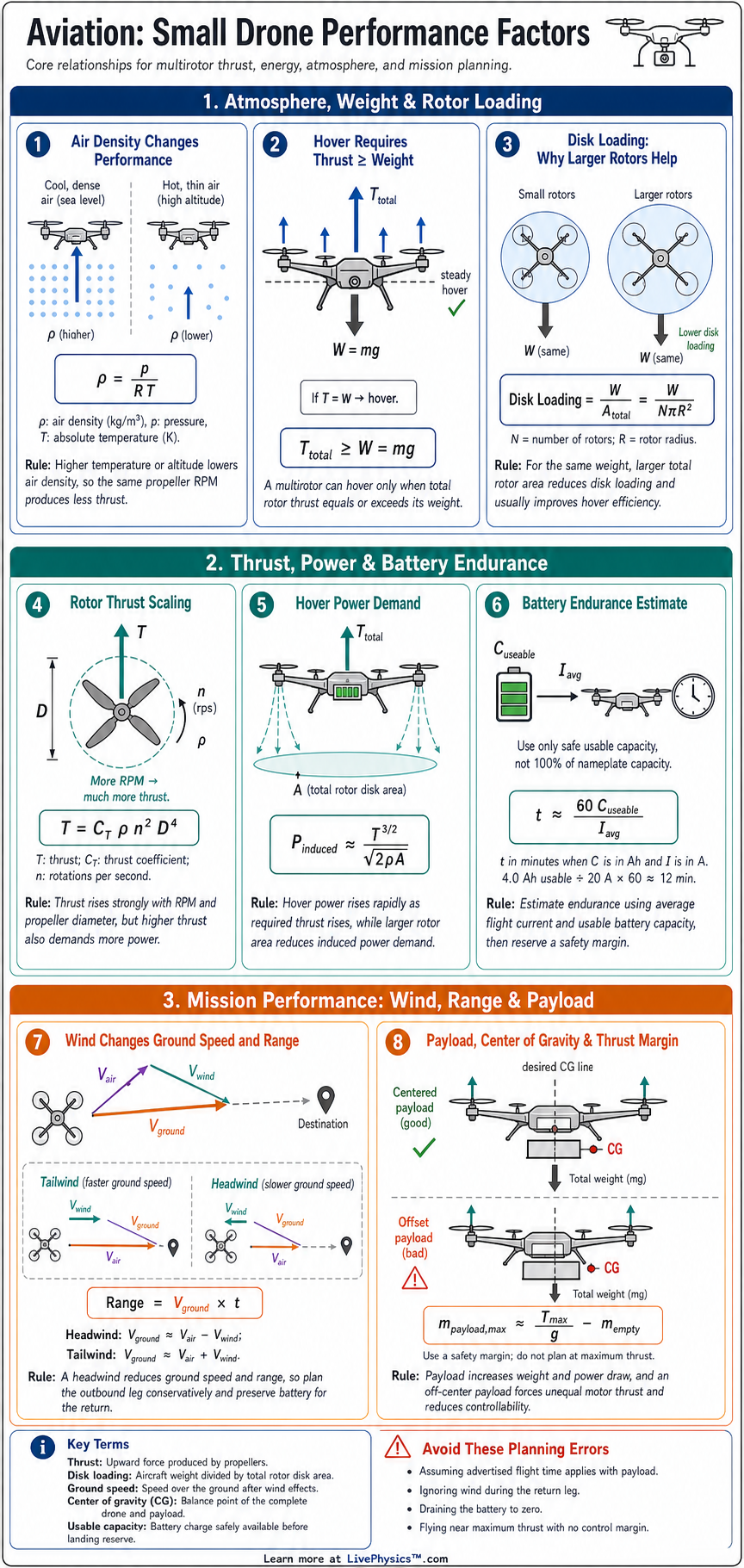
Small drone performance depends on how effectively its motors, propellers, battery, and airframe produce and use force. Pilots and technicians use performance factors to predict climb, hover time, range, speed, and safe payload limits. This cheat sheet organizes the main relationships into a quick reference for planning and operating small unmanned aircraft.
It is useful for flight training, maintenance checks, and mission planning.
The central idea is that a drone must produce enough thrust to balance or exceed its weight. Air density, temperature, altitude, wind, battery condition, and payload all change the available performance. Power determines how quickly the aircraft can do work, while battery energy limits how long that power can be supplied.
Understanding these links helps operators make safer decisions before and during flight.
Key Facts
- In a steady hover, total thrust equals weight.
- Weight equals mass times gravitational acceleration, where gravitational acceleration is about 9.81 meters per second squared.
- Net upward force equals total thrust minus weight.
- Thrust to weight ratio equals total available thrust divided by aircraft weight.
- Electrical power equals voltage times current.
- Battery energy in watt hours equals battery voltage times battery capacity in ampere hours.
- Approximate flight time in hours equals usable battery capacity in ampere hours divided by average current in amperes.
- Ground speed equals airspeed plus or minus the wind component along the flight path.
Vocabulary
- Thrust
- Thrust is the upward or forward force produced by propellers that moves or supports a drone.
- Payload
- Payload is equipment or cargo carried by the drone in addition to the aircraft itself.
- Density altitude
- Density altitude is a value that shows how air density affects aircraft performance under current pressure and temperature conditions.
- Current
- Current is the rate at which electric charge flows from a battery and is measured in amperes.
- C-rate
- C-rate describes how quickly a battery can safely deliver or receive current compared with its stated capacity.
- Ground speed
- Ground speed is the speed of a drone relative to the ground after wind effects are included.
Common Mistakes to Avoid
- Treating maximum advertised flight time as a normal mission time is wrong because the value is usually measured in calm conditions with a light aircraft and a new battery. Plan with a reserve and account for payload, wind, and temperature.
- Adding a payload without checking thrust margin is unsafe because the extra weight increases hover power and reduces climb capability. Confirm that available thrust remains well above total weight.
- Ignoring a headwind on the return leg is a planning error because it can greatly increase current draw and travel time. Plan the route so enough battery remains for the worst wind direction.
- Assuming battery percentage always shows available power is incorrect because voltage can sag during high current demand. Monitor voltage, temperature, and warnings, especially with cold or aging batteries.
- Using damaged or unbalanced propellers reduces performance because vibration wastes energy and may overload motors or flight sensors. Inspect and replace propellers before flight.
Practice Questions
- 1 A drone has a mass of 2.4 kilograms. Calculate its weight using gravitational acceleration of 9.81 meters per second squared.
- 2 A battery operates at 14.8 volts and supplies 12 amperes. Calculate the electrical power in watts.
- 3 A drone battery has a usable capacity of 4.0 ampere hours, and the average current during a mission is 16 amperes. Estimate the flight time in minutes.
- 4 Explain why a drone may have poorer climb performance on a hot day at a high-elevation launch site, even when the battery is fully charged.
Understanding Small Drone Performance Factors
A multirotor stays in a hover when total upward thrust equals its weight. Weight is the force caused by gravity acting on the aircraft mass. To climb, total thrust must become greater than weight.
To descend under control, thrust is reduced below weight. A drone with a high thrust to weight ratio can climb faster, carry more payload, and better resist wind, but it normally uses more energy at high power settings.
Propellers create thrust by accelerating air downward. Their performance depends on diameter, pitch, shape, rotational speed, and the density of the surrounding air. Larger propellers can move more air at lower rotational speeds and are often efficient for stable flight.
Small fast propellers may give quick response but can draw more current. Propeller damage, poor balance, or an incorrect installation reduces thrust and can cause vibration, unstable control, and extra battery use.
Air density has a major effect on performance. Warm air, high altitude, and humid air are less dense than cool, dry air near sea level. In thin air, propellers push less mass of air during each rotation.
Motors must work harder to create the same thrust, and the drone may have less climb ability and less payload margin. Density altitude combines pressure altitude and temperature effects into one practical measure of how the aircraft will perform.
Battery performance sets the practical flight limit. Battery capacity is measured in ampere hours, while energy is commonly expressed in watt hours. Current draw rises sharply during takeoff, fast climbing, heavy payload flight, and strong wind conditions.
A battery also has internal resistance, which causes voltage to drop under heavy load. Cold temperatures and aged cells increase this effect. Pilots should keep a reserve because the voltage near the end of a flight can fall quickly when power demand increases.
Wind changes both ground performance and energy use. A headwind slows ground speed and extends the time required to reach a destination, while a tailwind can make the outbound leg seem easy. The return flight may require much more power if it becomes a headwind leg.
Gusts also require rapid motor changes to hold position. Before launch, operators should compare wind speed with the drone capability, plan a conservative battery reserve, and avoid operating near the published limits.