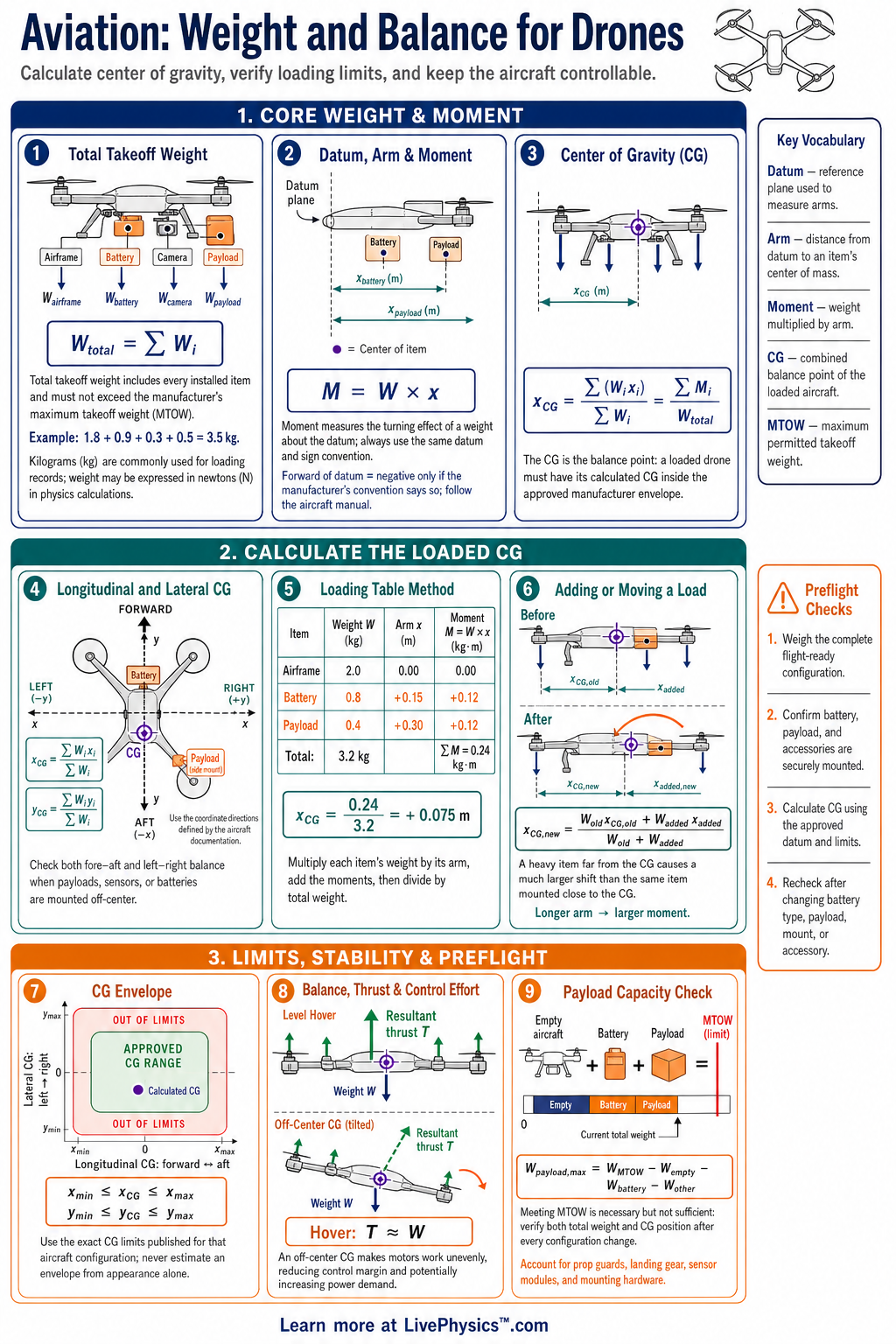
Weight and balance determines whether a drone can take off, fly, and land safely. Every battery, camera, payload, and accessory changes the aircraft's total weight and center of gravity. Drone pilots need a quick method for checking that a planned configuration stays within the manufacturer limits.
This cheat sheet summarizes the calculations and checks used before flight.
The main ideas are weight, arm, moment, total moment, and center of gravity. Weight is the mass force of each item, while the arm is its distance from a chosen reference point called the datum. Moment equals weight times arm, and the center of gravity equals total moment divided by total weight.
A safe drone has an approved total weight and a center of gravity inside its stated balance range.
Key Facts
- Moment equals weight times arm.
- Center of gravity equals total moment divided by total weight.
- The total loaded weight equals the sum of the drone, battery, payload, and all installed accessories.
- Every arm must be measured from the same datum reference point.
- A forward arm may be negative when the approved balance system defines positions ahead of the datum as negative.
- A loaded drone is acceptable only when total weight is at or below the maximum takeoff weight and center of gravity is within the approved range.
- Moving a payload farther from the datum changes its moment even when its weight stays the same.
- A center of gravity outside the approved range can reduce stability, control response, and available motor performance.
Vocabulary
- Datum
- A datum is the fixed reference point or plane from which all balance distances are measured.
- Arm
- An arm is the horizontal distance from the datum to the center of gravity of an item.
- Moment
- A moment is the turning effect of an item, calculated by multiplying its weight by its arm.
- Center of gravity
- The center of gravity is the point where the total weight of the drone and its equipment is considered to act.
- Maximum takeoff weight
- Maximum takeoff weight is the highest approved total weight of the drone at the start of flight.
- Payload
- Payload is equipment or cargo carried by the drone that is not part of its basic empty configuration.
Common Mistakes to Avoid
- Adding payload weight without its mounting hardware is wrong because brackets, cables, and guards also count toward total weight and moment.
- Using distances measured from different reference points is wrong because all arms must use the same datum for moments to combine correctly.
- Checking only the maximum takeoff weight is wrong because an aircraft can be underweight but have an unsafe center of gravity.
- Ignoring negative arms is wrong when the approved system uses positions ahead of the datum as negative, since the moment sign changes the final result.
- Reusing a calculation after moving a battery or camera is wrong because changing location changes arm, moment, and center of gravity.
Practice Questions
- 1 A camera payload weighs 0.8 kilograms and is installed 0.25 meters aft of the datum. Calculate its moment in kilogram meters.
- 2 A drone configuration has a total weight of 4.0 kilograms and a total moment of 0.36 kilogram meters. Calculate the center of gravity arm from the datum.
- 3 An empty drone weighs 2.6 kilograms, a battery weighs 0.7 kilograms, and a sensor package weighs 0.5 kilograms. Calculate the total loaded weight and state whether it meets a maximum takeoff weight of 4.0 kilograms.
- 4 A pilot moves the same battery farther forward while leaving all other equipment unchanged. Explain how this move changes the center of gravity and why the pilot must compare the new result with the approved range.
Understanding Weight and Balance for Drones
A drone is balanced when its center of gravity is in the correct location for its design. The center of gravity is the single point where the aircraft would balance if supported. It affects how hard the motors must work to hold level flight.
A center of gravity that is too far forward can make the drone pitch down and reduce control authority. A center of gravity that is too far aft can make the drone unstable and difficult to recover.
Weight alone is not enough for a safe loading decision. Two payloads can have the same weight but create different balance results when installed in different places. A battery placed near the nose has a longer forward arm than the same battery placed near the middle.
Its longer distance produces a larger moment. Pilots therefore calculate both the total loaded weight and the final center of gravity before operating a modified drone.
Start with the empty aircraft weight and its known moment or center of gravity. List every item added for the flight, including batteries, camera equipment, propeller guards, landing gear, sensors, cargo, and mounting hardware. Record each item weight and its arm from the same datum.
Multiply each weight by its arm to find its moment. Add all weights and all moments separately, then divide total moment by total weight to find the loaded center of gravity.
The datum is a fixed reference plane selected by the manufacturer or operator. It may be at the nose, a frame bulkhead, or another marked location. Arms forward of the datum may be written as negative values, depending on the approved system.
This sign convention matters because a negative arm creates a negative moment. Mixing positive and negative signs incorrectly can move the calculated center of gravity far from its true location.
Manufacturers publish a maximum takeoff weight and, for some drones, a permitted center of gravity range. The calculated result must meet both limits. A configuration can be under the weight limit but still unsafe because its center of gravity is outside the approved range.
Environmental conditions also matter. High temperature, altitude, wind, and low battery charge reduce available performance, so operating close to the maximum weight can leave little safety margin.
Weight and balance appears in aerial photography, surveying, delivery operations, agriculture, emergency response, and research flights. A new camera or a larger battery can change flight behavior even when it fits physically. Study the manufacturer flight manual and use its stated datum, limits, and approved equipment.
Recheck calculations whenever payload location, battery type, or mounting equipment changes. A documented loading check helps pilots make repeatable decisions and supports safe, predictable flight.