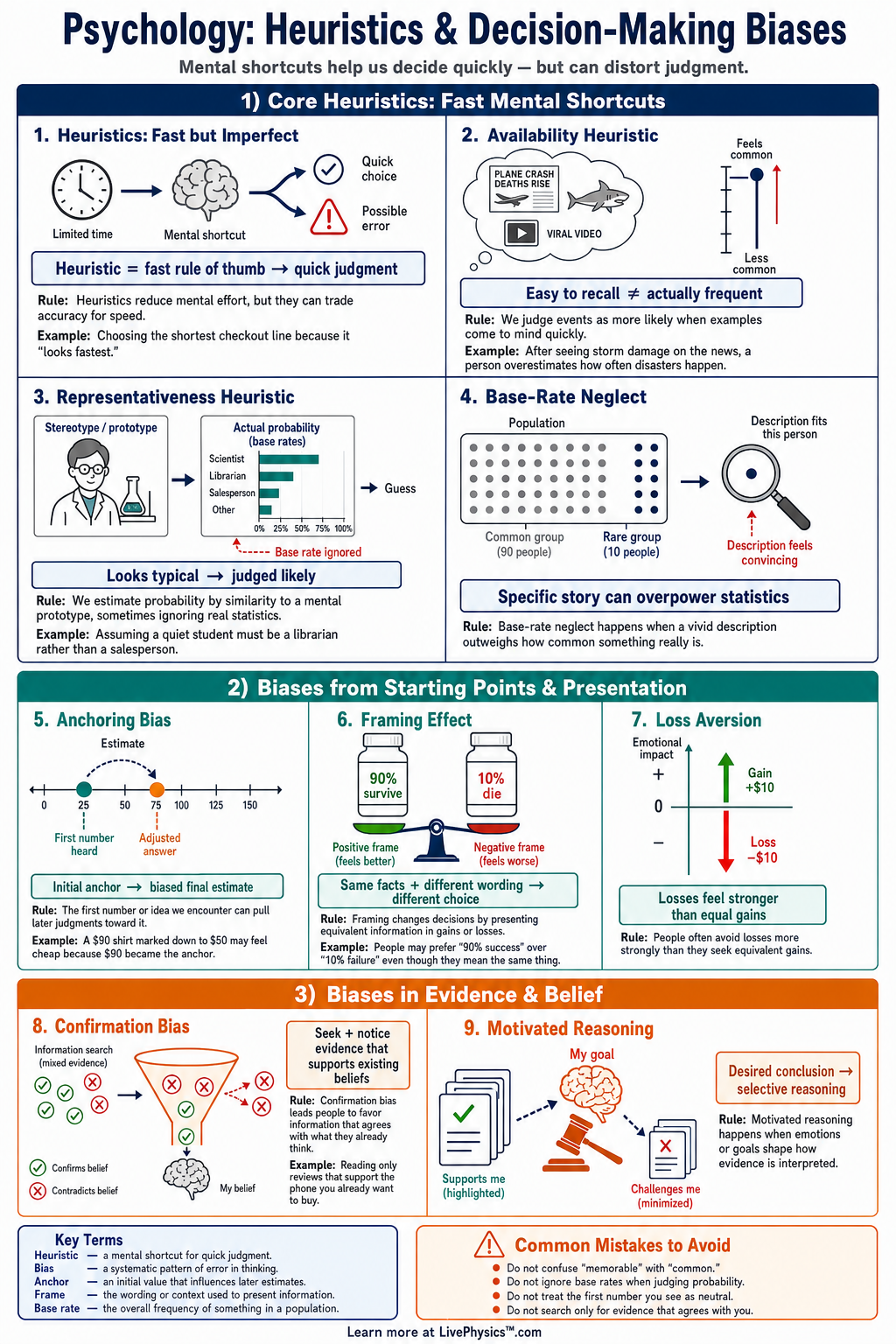
Heuristics are mental shortcuts that help people make decisions quickly when time, information, or attention is limited. They are useful because daily life requires many fast judgments, from estimating risk to choosing between options. This cheat sheet helps students recognize common shortcuts and the biases that can come from them.
Understanding these patterns supports stronger critical thinking in psychology, school, media, and everyday choices.
The core idea is that quick thinking can be efficient but not always accurate. Availability, representativeness, and anchoring are common heuristics that shape how people judge probability, categories, and numbers. Biases such as confirmation bias, framing effects, and loss aversion can influence what evidence people notice and how they value outcomes.
Better decisions often come from slowing down, checking evidence, comparing alternatives, and looking for missing information.
Key Facts
- A heuristic is a mental shortcut that reduces effort by using a simple rule instead of a full analysis.
- Availability heuristic rule, if examples come to mind easily, people often judge the event as more common or more likely.
- Representativeness heuristic rule, if something seems similar to a category prototype, people may judge it as belonging to that category while ignoring base rates.
- Anchoring effect rule, an initial number or idea can pull later estimates toward it, even when the anchor is irrelevant.
- Confirmation bias rule, people tend to seek, notice, and remember evidence that supports what they already believe.
- Framing effect rule, the same information can lead to different choices depending on whether it is presented as a gain, loss, risk, or benefit.
- Loss aversion rule, losses usually feel stronger than equal-sized gains, so losing 20 dollars may affect a person more than gaining 20 dollars.
- A stronger decision process is define the goal, list options, check evidence, compare costs and benefits, and look for bias before choosing.
Vocabulary
- Heuristic
- A quick mental rule or shortcut used to make judgments with less time and effort.
- Bias
- A systematic error in thinking that can push judgment away from accuracy or fairness.
- Availability Heuristic
- A shortcut in which people judge how likely something is based on how easily examples come to mind.
- Representativeness Heuristic
- A shortcut in which people judge something by how closely it matches a typical example or stereotype.
- Anchoring
- The tendency to rely too heavily on the first piece of information when making later judgments.
- Confirmation Bias
- The tendency to favor information that supports an existing belief while discounting information that challenges it.
Common Mistakes to Avoid
- Assuming a vivid example proves something is common. This is wrong because memorable events, such as dramatic news stories, may be rare even if they are easy to recall.
- Ignoring base rates when using representativeness. This is wrong because a description that sounds like a category does not outweigh actual frequency information.
- Treating the first number you hear as neutral. This is wrong because anchors can influence estimates even when the starting number is random or unrelated.
- Looking only for evidence that supports your opinion. This is wrong because confirmation bias can make weak beliefs feel stronger by hiding conflicting evidence.
- Thinking a different frame changes the facts. This is wrong because 90% survival and 10% mortality describe the same outcome but may feel different emotionally.
Practice Questions
- 1 A student hears about 3 shark attacks on the news and concludes that swimming in the ocean is extremely dangerous. Which heuristic is most likely influencing the student?
- 2 A phone is listed at 800 dollars, then discounted to 600 dollars. A buyer feels 600 dollars is cheap because of the first price. Which bias or heuristic is shown?
- 3 In a school of 1,000 students, 700 take art and 50 take robotics. Maya is described as creative, detail oriented, and interested in design, so a classmate assumes she is in robotics. What important probability information is being ignored?
- 4 Explain why slowing down and looking for disconfirming evidence can improve a decision influenced by confirmation bias.
Understanding Heuristics & Decision-Making Biases
Many biases begin because the brain must work with incomplete information. Attention is limited, memory is selective, and people often need to act before every fact is known. A shortcut may use a vivid memory, a first impression, or a familiar story as a stand in for careful evidence.
This can save effort, yet it can produce a confident answer from weak evidence. Confidence is not a reliable sign of accuracy.
A student may feel certain that a news event is common because it appears repeatedly online, even if the event is rare in the wider population. Repetition can make an idea feel true or important without making it well supported.
Probability judgments are especially vulnerable to error. When using representativeness, people may focus on how closely a person fits a stereotype and forget how common the category is overall. Base rates matter because they provide the starting frequency.
For example, a school has far more students than professional athletes. A student who is tall and plays basketball may resemble an athlete, but that resemblance does not make a professional career likely. Good reasoning combines the individual details with the base rate.
It also separates a description from a prediction. Descriptions can be interesting, while predictions need data about how often outcomes actually occur.
Numbers affect judgment even when people believe they are thinking independently. A price shown before a discount can make the sale price seem attractive. An early estimate during a group project can pull later estimates closer to it.
This happens partly because people adjust away from the first number too little. To reduce this effect, make an estimate before seeing other estimates when possible.
When comparing prices, use the final price, quality, and need rather than the size of the claimed discount. In experiments, researchers test anchoring by giving different groups different starting numbers, then checking whether their later judgments move in the direction of those numbers.
Biases can shape social decisions, schoolwork, and public debate. Confirmation bias can lead someone to search for posts that support a favorite claim while dismissing reliable sources that disagree. Framing can change choices about medical treatment, saving money, or environmental action because people react differently to possible gains and possible losses.
Loss aversion can explain why someone keeps an unused item, refuses to sell a declining investment, or avoids trying a new activity after one setback. A useful habit is to write down what evidence could prove a belief wrong. Compare at least two credible sources, ask what information is missing, and state the decision rule before choosing.
When studying these ideas, pay attention to the difference between a bias in one situation and a permanent flaw in a person. Everyone uses shortcuts, including trained researchers.
The goal is not perfect neutrality. The goal is noticing when a quick judgment needs a slower check.