Practice identifying problem-solving strategies, cognitive biases, and decision-making principles in realistic situations.
Read each problem carefully. Use psychology vocabulary when explaining your answers. Write complete sentences and support your reasoning with evidence from the scenario.
How people use strategies, shortcuts, and evidence to choose and solve
Psychology - Grade 9-12
- 1
A student needs to find the combination to a 3-digit lock. The student tries every possible combination from 000 to 999 in order until the lock opens. Identify the problem-solving strategy being used and explain one strength and one weakness of this strategy.
- 2
A doctor hears that a patient has a cough and immediately assumes it is a common cold because colds are very frequent in the community. The doctor does not first test for less common illnesses. Identify the mental shortcut being used and explain how it can help or hurt decision making.
- 3
Maya believes that students who listen to music while studying always do worse on tests. She searches online for articles that support her belief and ignores studies showing mixed results. Name the bias shown in this example and explain how Maya could reduce it.
- 4
A group is asked to solve a puzzle that requires using a paper clip as a tool. They only think of the paper clip as something that holds papers together, so they fail to solve the puzzle. Identify the obstacle to problem solving and explain it.
- 5
A basketball player always practices free throws the same way. During a game, the player keeps using that routine even though the gym is louder and the timing is different. The routine no longer helps, but the player keeps relying on it. Identify the problem-solving obstacle and explain why it occurs.
- 6
A news report says, "This medication has a 90% survival rate." Another report says, "This medication has a 10% death rate." Both statements describe the same data, but people react more positively to the first report. Identify the decision-making effect shown and explain why it matters.
- 7
After seeing several videos about airplane crashes, Jordan becomes afraid to fly even though car travel is statistically more dangerous per mile. Identify the bias or heuristic affecting Jordan's judgment and explain it.
- 8
A person meets one very friendly dog and concludes that all dogs are friendly. Identify the reasoning error and explain why the conclusion is weak.
- 9
A store first shows a jacket priced at $300, then marks it down to $180. Many customers see $180 as a good deal because they compare it to the first price. Identify the bias involved and explain how it affects decisions.
- 10
A family has already spent $60 on movie tickets, but everyone feels sick and tired before the movie starts. They go anyway because they do not want the money to be wasted. Identify the decision-making error and explain what a more rational decision would consider.
- 11
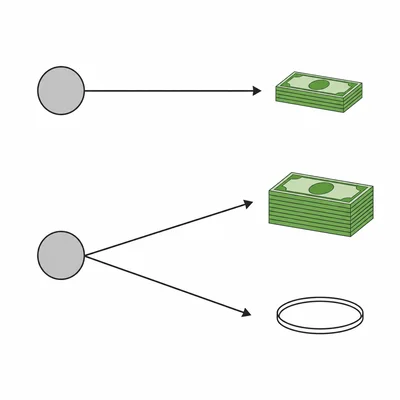
Use expected value to compare these two choices. Choice A gives a 100% chance of winning $20. Choice B gives a 50% chance of winning $50 and a 50% chance of winning $0. Which choice has the higher expected value, and what is it?
- 12
A team brainstorming ways to reduce cafeteria waste lists every idea without judging them at first. Later, they choose the most practical ideas. Identify the two types of thinking used in this process and explain each one.
- 13
A student says, "I knew I would get that question wrong," after seeing the correct answer on a test. Before the test, the student had not predicted that question would be difficult. Identify the bias and explain why it can distort learning.
- 14
A class is choosing a fundraiser. The first student suggests selling 5,000 raffle tickets. Later suggestions are much lower, but the class still chooses a number much higher than usual because the first suggestion influenced them. Identify the bias and explain one way the class could reduce it.
- 15
A jury hears a dramatic eyewitness story and gives it more weight than DNA evidence that is more reliable but less emotional. Identify the decision-making problem and explain how critical thinking could improve the decision.