Hypothesis Testing Lab
Investigate when sample data is strong enough to reject a claim about a population. Adjust the population mean, sample mean, standard deviation, and sample size to see how each affects the z-statistic and p-value.
Guided ExperimentHypothesis Testing Lab
State H₀ and H₁ for your scenario. Do you expect to reject H₀? Why?
Write your hypothesis in the Lab Report panel, then click Next.
Hypotheses
Null hypothesis
H₀: μ = 100
Alternative hypothesis
H₁: μ ≠ 100
Parameters
Significance level α
Results
z-statistic
+1.826
z = (x̄ - μ₀) / (σ / sqrt(n))
p-value (two-tailed)
0.0679
Probability of result this extreme if H₀ is true
Decision
Fail to reject
p = 0.0679 > α = 0.05
Controls
Data Table
(0 rows)| # | μ₀ | x̄ | σ | n | α | z-stat | p-value | Decision |
|---|
Reference Guide
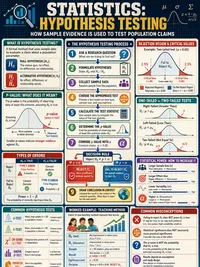
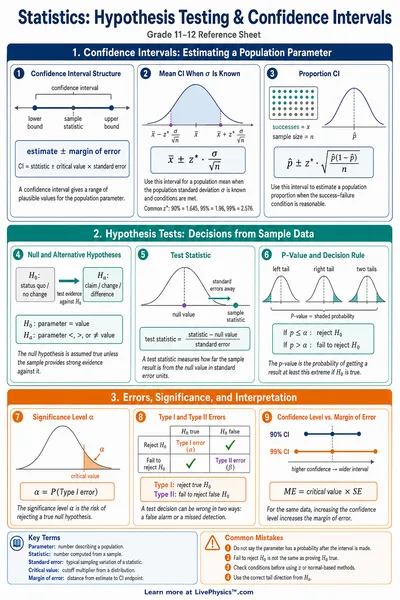
The Null Hypothesis
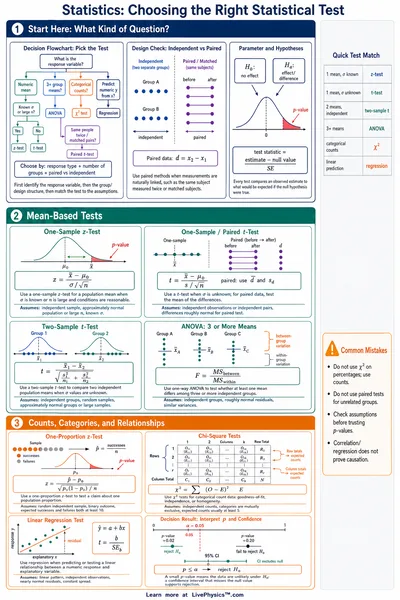
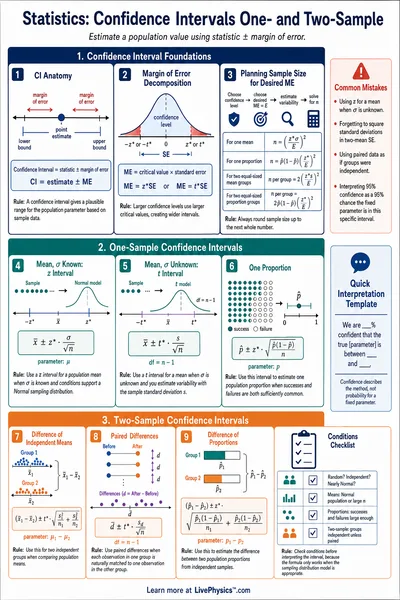
H₀ claims the population mean equals μ₀. We test whether data contradicts it.
H₀ μ = μ₀ (no effect, no difference from the claimed value)
H₁ μ ≠ μ₀ (two-tailed alternative; the mean differs in either direction)
The test does not prove H₀ is true. It either provides evidence against it (reject) or fails to find such evidence (fail to reject).
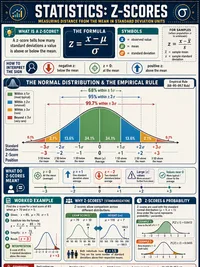
The Z-Statistic
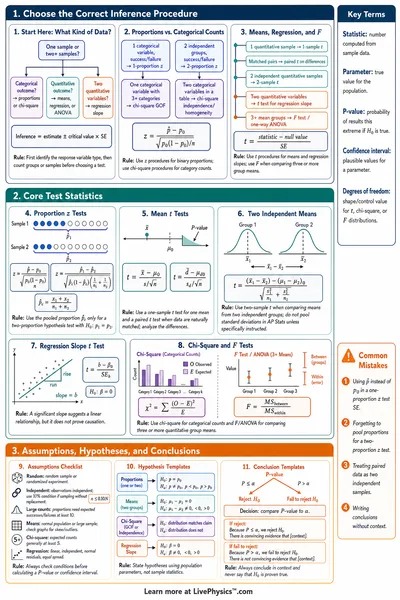
The z-statistic measures how many standard errors x̄ is from μ₀.
Formula z = (x̄ - μ₀) / (σ / sqrt(n))
A larger absolute value of z means the sample mean is further from μ₀, making it harder to explain by random chance alone.
Increasing n shrinks the standard error σ/sqrt(n), which amplifies z even when x̄ and μ₀ stay the same.
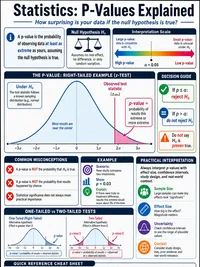
The P-Value
The p-value is the probability of seeing a sample at least this extreme if H₀ were true. A small p-value means the result is rare under H₀.
Two-tailed p = 2 × P(Z > |z|), capturing extremes in both directions.
A p-value of 0.03 means there is a 3% chance of observing a difference this large (or larger) by random sampling variation alone, assuming H₀ is correct.
The Decision Rule
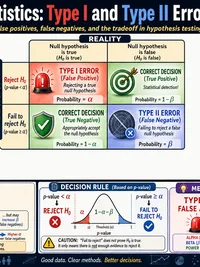
If p ≤ α, reject H₀. If p > α, fail to reject.
Common α values 0.01 (strict), 0.05 (standard), 0.10 (lenient).
A smaller α reduces the chance of a false rejection (Type I error) but requires stronger evidence to reject H₀.
The choice of α should be made before collecting data, not after seeing the p-value.