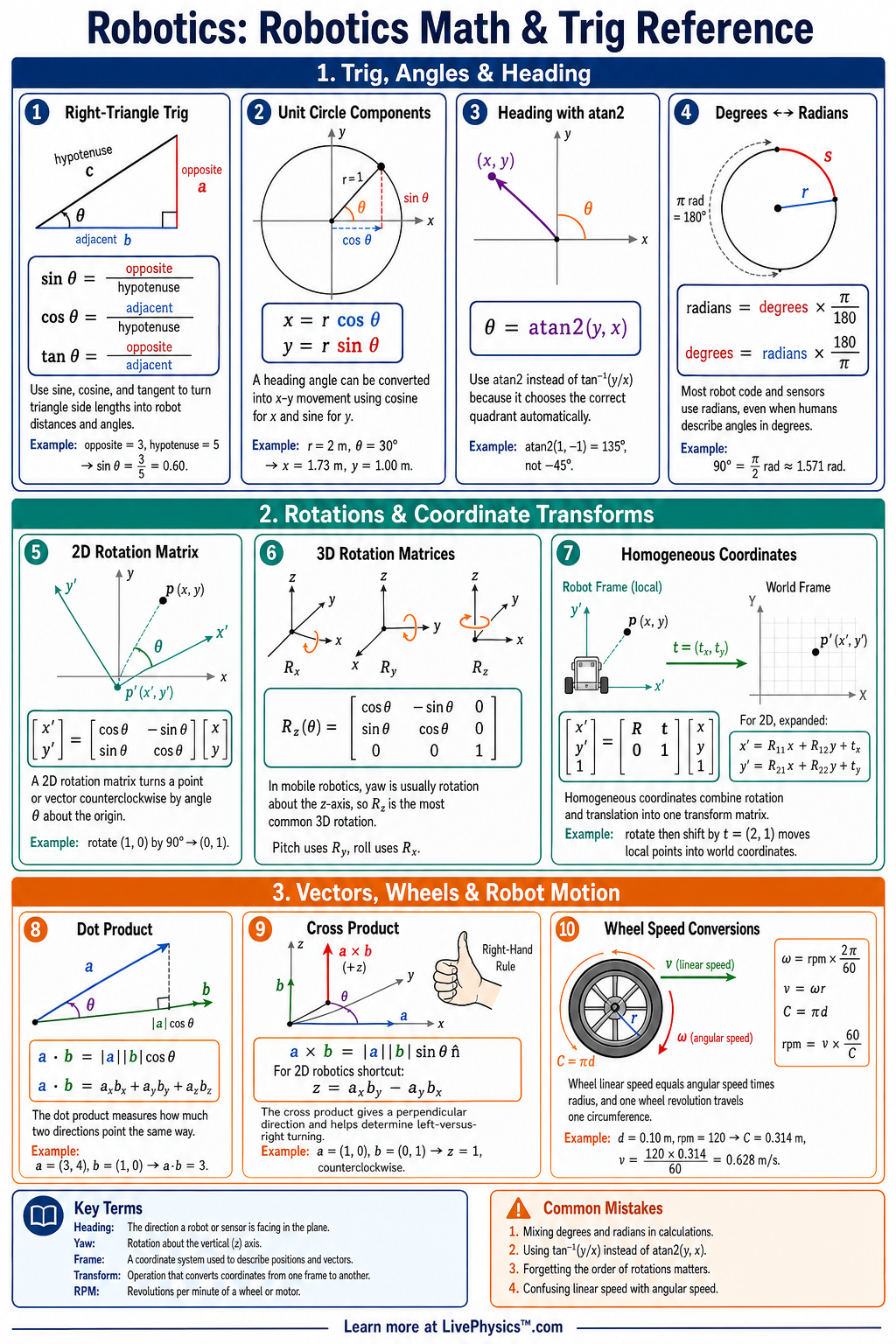
Robotics uses math to turn sensor readings, motor commands, and physical measurements into controlled motion. This cheat sheet covers the math and trigonometry students need when building, programming, and testing robots. It is useful for drive trains, arms, odometry, navigation, and basic mechanism design.
The goal is to give quick access to formulas that connect code to real robot behavior.
The most important ideas are angle measurement, right-triangle trigonometry, vectors, coordinate systems, and motion relationships. Students should know how to switch between degrees and radians, use sin, cos, and tan, and break motion into x and y components. Robotics also depends on wheel circumference, gear ratios, speed, torque, and rotation formulas.
These tools help predict how far a robot moves, how fast it turns, and where it is on the field.
Key Facts
- Convert degrees to radians with radians = degrees x pi / 180.
- Convert radians to degrees with degrees = radians x 180 / pi.
- For a right triangle, sin(theta) = opposite / hypotenuse, cos(theta) = adjacent / hypotenuse, and tan(theta) = opposite / adjacent.
- The distance between two points is d = sqrt((x2 - x1)^2 + (y2 - y1)^2).
- Vector components from a magnitude and direction are x = r cos(theta) and y = r sin(theta).
- Wheel circumference is C = pi d, and travel distance = wheel rotations x pi x wheel diameter.
- For gears or pulleys, output speed = input speed x input teeth / output teeth, while output torque = input torque x output teeth / input teeth.
- Average speed is v = distance / time, and angular speed is omega = angle / time when angle is measured in radians.
Vocabulary
- Radian
- A unit of angle measure based on arc length, where one full circle equals 2 pi radians.
- Vector
- A quantity with both magnitude and direction, such as robot velocity or displacement.
- Coordinate Plane
- A grid that uses x and y values to describe position on a flat surface.
- Odometry
- A method of estimating robot position by tracking wheel movement and rotation over time.
- Gear Ratio
- A comparison of gear sizes or tooth counts that changes speed and torque between input and output.
- Angular Velocity
- The rate at which an object rotates, usually measured in radians per second or degrees per second.
Common Mistakes to Avoid
- Using degrees when a formula or programming function expects radians is wrong because trig functions in many languages use radians by default.
- Forgetting to use wheel diameter in the circumference formula is wrong because C = pi d, not pi r, unless you first convert radius to diameter.
- Mixing units such as inches, centimeters, seconds, and minutes in one calculation is wrong because formulas only work when units are consistent.
- Swapping sine and cosine for vector components is wrong because x = r cos(theta) and y = r sin(theta) when theta is measured from the positive x-axis.
- Assuming a larger gear always makes a robot faster is wrong because a larger output gear usually increases torque while reducing output speed.
Practice Questions
- 1 Convert 135 degrees to radians.
- 2 A robot wheel has a diameter of 10 cm and turns 8 rotations. How far does the robot travel, ignoring wheel slip?
- 3 A robot moves 5 m at an angle of 30 degrees above the positive x-axis. Find the x and y components of its displacement.
- 4 A robot's calculated odometry position does not match its real position after driving across the field. Explain two physical reasons this could happen.
Understanding Robotics Math & Trig Reference
A robot needs a clear reference frame before any position calculation can mean anything. On a competition field or classroom floor, teams usually choose one fixed corner as the origin. They define one direction as positive x and the perpendicular direction as positive y.
A heading must be defined too. Some programs call straight ahead zero degrees, while others use the positive x direction.
Both choices work, but every sensor, drawing, and line of code must follow the same choice. A reversed axis or a heading measured clockwise in one part of a program can make a robot drive in a believable but wrong direction.
Trigonometry connects a robot's heading to its movement across the floor. A forward command has a size and a direction. The size is the distance traveled, while the direction comes from the heading.
Sine and cosine split that one movement into horizontal and vertical parts. This matters when the robot drives diagonally, follows a path made of short segments, or uses field centric controls. Calculator settings matter greatly here.
A calculator in degree mode gives different results from one in radian mode. Programming libraries commonly expect radians, especially when working with angular speed, turning, or circular motion. Students should label angle units in notes and variables instead of assuming them.
Real robots rarely move exactly as ideal calculations predict. Wheel diameter may differ slightly from its listed value. Foam wheels compress under the robot's weight.
A wheel can slip during a fast stop or a sharp turn. Gearboxes have friction, and batteries lose voltage during a match. Encoder counts measure motor or wheel rotation, not guaranteed travel across the floor.
This is why teams calibrate. They command the robot to travel a known measured distance, compare the predicted result with the real result, then adjust the wheel diameter value or conversion factor in code. Repeating this test at slow and fast speeds reveals whether slipping is causing an error.
Gear ratios show an important tradeoff. A reduction gearbox makes the output turn more slowly, but it increases the turning force available at the output. That helps an arm lift a load or helps a drivetrain push without stalling.
A faster ratio can improve top speed, yet the motor may struggle to accelerate the robot or climb over obstacles. Students should track which gear is the input and which gear is the output before using a ratio. Swapping them produces a result that is backward.
It is useful to estimate the result first. A larger driven gear should turn slower than the smaller driving gear.
Position tracking, often called odometry, builds up many small motion estimates over time. After each short movement, the program updates the estimated x position, y position, and heading. Small errors accumulate, so a robot that starts accurately can drift far from its expected location.
Gyroscopes help correct heading, while distance sensors, cameras, or field markers can provide occasional position checks. When debugging, test one idea at a time. First verify wheel distance.
Then verify turn angle. Then test a simple square path. A robot that fails to return near its starting point gives useful evidence about whether the main problem is scale, heading, wheel slip, or coordinate signs.