Understanding Simple Machines & Mechanical Advantage Lab
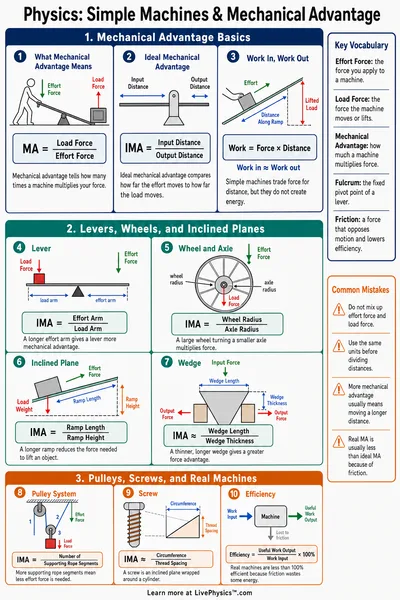
Mechanical advantage compares the input force with the force delivered to the load. A machine gives a force advantage when a smaller effort force moves a larger resistance force. The tradeoff is distance, because the effort usually travels farther than the load.
This is why a machine cannot create free work. In an ideal system, work put in equals work delivered out, so force times distance stays balanced.
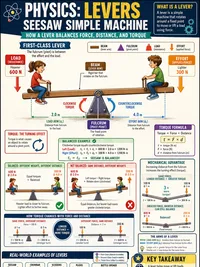
A lever works because turning effects depend on both force and distance from the pivot. Pushing far from the pivot gives the same turning effect as a much larger push close to it.
Students can see this on a playground seesaw, a crowbar, scissors, and a bottle opener. The pivot position matters greatly, since moving it changes how much effort is needed and how far the handle must move.
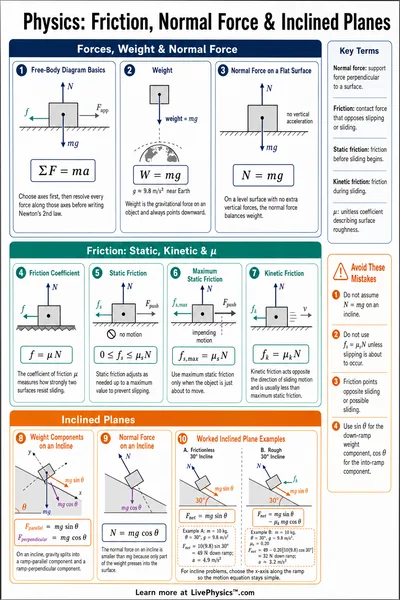
An inclined plane reduces the force needed to raise an object by spreading the height gain over a longer path. A long ramp is easier to push a box up than a short steep ramp, but the box travels farther across its surface.
Loading ramps, wheelchair ramps, mountain roads, and staircases all show this tradeoff. The angle matters because steeper slopes require more force, while gentler slopes require more travel space.
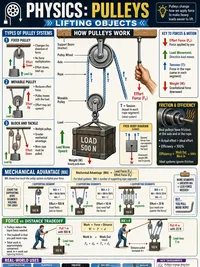
Pulley systems change the direction of a pull and can share a load among several supporting rope sections. A fixed pulley mainly helps a person pull downward, while movable pulleys can reduce the effort force.
In real lifts, window blinds, flagpoles, and cranes, the rope arrangement determines the force benefit. Students should count the rope sections supporting the moving load, but should remember that this count describes an ideal case before friction is included.
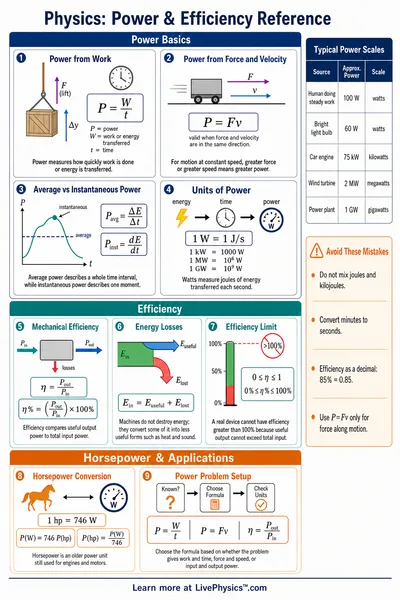
Friction turns some input work into thermal energy, so actual machines need more effort than ideal calculations predict. Rough surfaces, bending ropes, axle resistance, and parts rubbing together all lower efficiency.
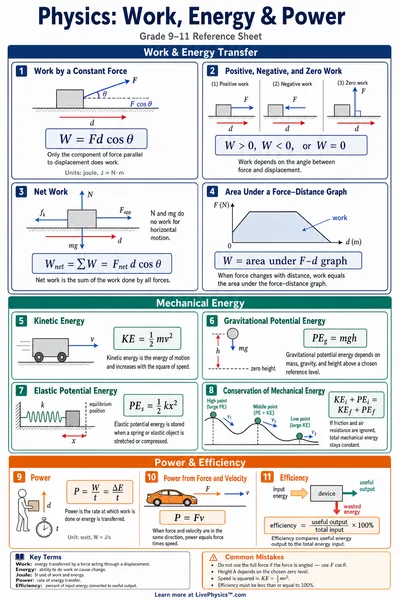
Efficiency describes the useful output work compared with the total input work, often expressed as a percentage. When carrying out a lab, measure distances carefully, keep the pulling direction steady, and repeat trials because small errors in force readings can strongly affect calculated mechanical advantage.